Annotated Catalog of the Collection
Abbreviations and Terminology
When I began this cataloging project in 1972, I was fortunate to
encounter the American Imprints
Inventory, a Works Progress Administration project carried out from
1937 to 1942. It was the brainchild of Douglas McMurtrie, a trained
engineer who became one of the foremost authorities on book production.
McMurtrie wrote the two manuals that I read with great interest. From
them I first learned the distinction between
broadside and
broadsheet—a
distinction I still find myself explaining to rare book dealers who see
no difference between a sheet printed on one side and one printed on
both. Over the years I have developed my own system of notation, but to
Douglas McMurtrie and the American
Imprints Inventory I remain deeply indebted.
Here are explanations of the abbreviations and terminology I use:
The CATALOG field identifies the group that produced the item:
CC = Communication Company
DP = Diggers*
DR = Digger Related*
FC = Free City Collective
FPS = Free Print Shop
KF = Kaliflower
PD = Planet Drum [Foundation]
PE = Planetedge
HA = Misc Haight-Ashbury
MI = Misc Countercultural
*DP and DR are closely related. DP are all writings by the original
Diggers, starting with the 1966 series of street sheets signed "THE D I
G G E R S" and including articles written subsequently by any of the
original Diggers (including the two founders and everyone who actively
participated from 1966-68). DR are "Digger related" items that are not
identifiable as produced by the original Diggers. Both DP and DR do not
include anything published by Communication Company (CC) or Free City
Collective (FC) or KF (Kaliflower).
The GROUP field identifies curated sets of material that cut
across the catalog categories. At present there is one curated group:
“DIGGER MOVEMENT (Core
Collection),” which includes significant materials written by
or about the Digger movement, broadly understood to include the groups
and individuals who joined, extended, or emerged from the original San
Francisco Diggers. For example, many of the articles in
Kaliflower reflect what might
be called the
“passing of the dharma” from the original Diggers to the Sutter
Street Commune.
The MEDIUM field identifies the type of material:
Broadside = one
sheet printed on one side
Broadsheet = one
sheet printed on both sides
Newspaper = either
issue, a clipping, or partial issue
Folder = one sheet
folded, thus two leaves [four pages] of printed material
Leaflet = two or more
sheets stapled (or affixed) at one corner
Pamphlet = two or
more sheets gathered into a single section, bound or unbound. The term
also includes a one-sheet pamphlet: a single sheet cut and folded
to produce a multi-page publication.
Booklet = two or more
sheets, not in a section, bound on one edge
Book = two or more
sections bound
Collection =
identifiable set of materials held intact
Audio tape = oral
history or other audio recording of an event
Video tape = video
recording of an event
Digital = item
existing in born-digital or digitized format
Manuscript =
handwritten or typewritten document
The COLLECTION field identifies copies of each item in the
form:
[Abbreviation of library etc]-[original or xerox etc](source).
Libraries: SOLA (Summer of Love Archives); SS (Shotwell Street); CSL
(California State Library); BL (Bancroft Library).
Abbreviations
illus =illustrated
... = edited in transcription
[...] = ellipsis in the original text
r.s = reverse side
x = xerox (photocopy)
xx = photocopy of a photocopy
o = original
ComCo = item has the Communication Company imprint
SOLA = the collection which encompasses the Digger Archives
n.d. = no date
n.p. = no publishing imprint
r. = recto
v. = verso
Lt. = Letter size (8-1/2" x 11")
Lg. = Legal size (8-1/2" x 14")
Note: all dimensions given in inches (rule of origination) BibCit
= bibliographic citation. The construction order is: Author. Date.
Publication / periodical information (with volume, issue, page). Medium.
Dimension. Extent. Place + Publisher. Imprint. Collation.
So the general sequence of BibCit is:
By Author. Date. Publication, vol. Volume, no. Issue, p. Page. Medium.
Dimension. Extent. Place: Publisher. Imprint: Imprint. Collation:
Collation. Collection: Collection.
TITLE and TRANS_TITLE
TITLE is the catalog’s normalized identifying title. For
broadsides, flyers, handbills, and other items without formal title
pages, the title is usually taken from the printed heading, opening
line, or most distinctive identifying phrase. The
TITLE field regularizes
obvious display typography, such as all-capital lettering, erratic
spacing, or purely decorative line breaks, but does not attempt to
reproduce the item line for line. Capitalization generally follows the
grammar of the phrase or sentence: sentence-style capitalization for
opening sentences or prose statements, and title-style capitalization
only when the source clearly presents a formal title or headline.
TRANS_TITLE is the
transcribed title or heading as it appears on the item. It preserves
original capitalization, punctuation, spelling, line breaks, and notable
typographic features as far as practical. Line breaks are indicated with
a vertical bar: |.
Ellipses or bracketed notes may be used where the heading is too long,
illegible, interrupted by images, or otherwise requires editorial
clarification.
|
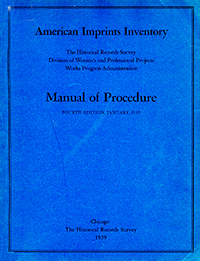
The American Imprints Inventory Manual of Procedure, 1939
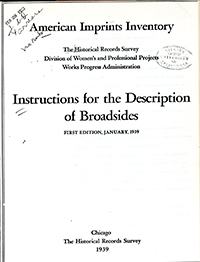
The AII manual I located in 1976 and studied as I began the Digger catalog
project.
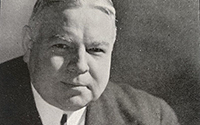
Douglas McMurtrie, the mastermind of the American Imprints Inventory project
1937-1942.
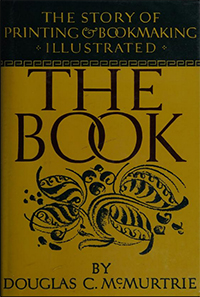
One of McMurtrie's dozens of books and articles.
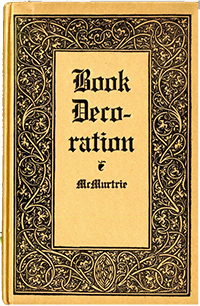
McMurtrie, trained as an engineer, became a first rank bibliophile.
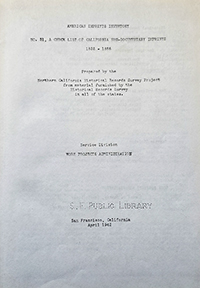
The AII publication of California imprints, 1833-1855.
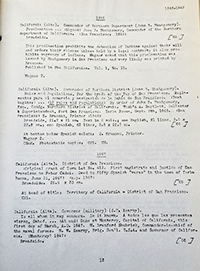
Note the rendering of broadsides in the California imprints checklist. |