Rolling Stone
625 Third Street San Francisco California 94107 (415) 362-4730

July 29, 1976

Dear Peter,

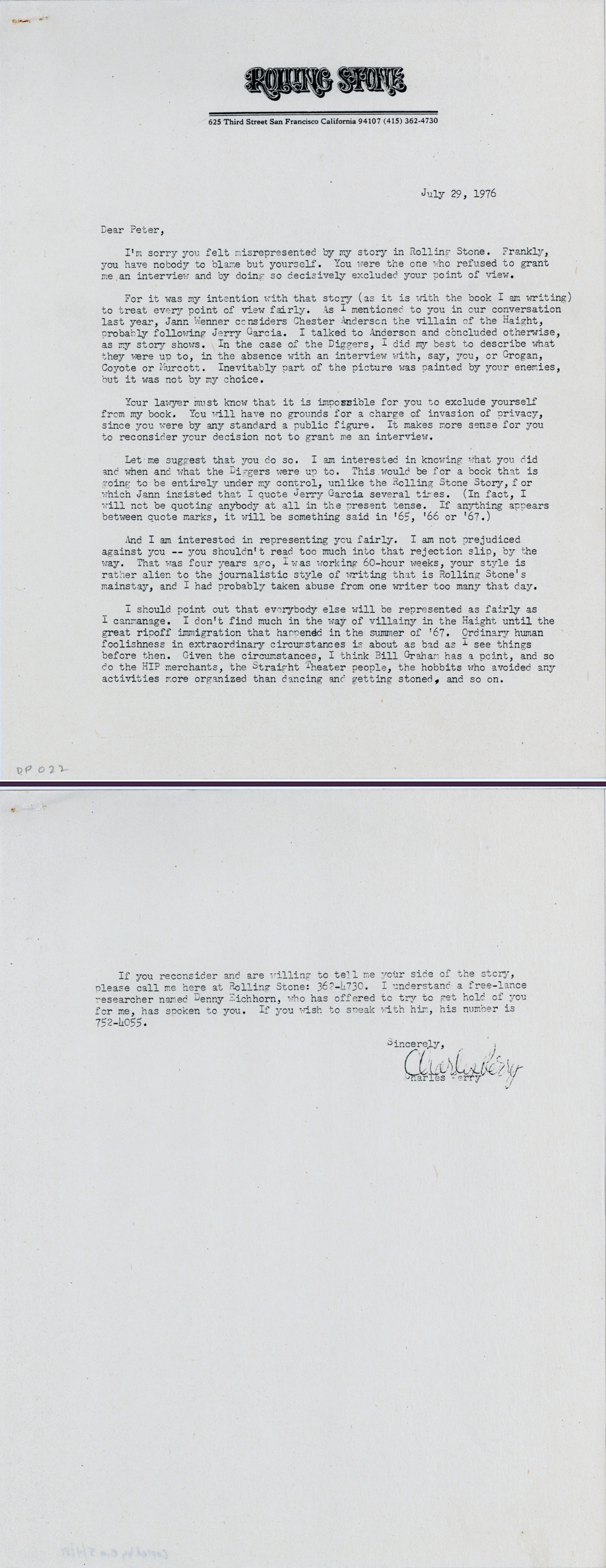
I’m sorry you felt misrepresented by my story in Rolling Stone. Frankly, you have nobody to blame but yourself. You were the one who refused to grant me an interview and by doing so decisively excluded your point of view.

For it was my intention with that story (as it is with the book I am writing) to treat every point of view fairly. As I mentioned to you in our conversation last year, Jann Wenner considers Chester Anderson the villain of the Haight, probably following Jerry Garcia. I talked to Anderson and concluded otherwise, as my story shows. In the case of the Diggers, I did my best to describe what they were up to, in the absence with an interview with, say, you, or Grogan, Coyote or Murcott. Inevitably part of the picture was painted by your enemies, but it was not by my choice.

Your lawyer must know that it is impossible for you to exclude yourself from my book. You will have no grounds for a charge of invasion of privacy, since you were by any standard a public figure. It makes more sense for you to reconsider your decision not to grant me an interview.

Let me suggest that you do so. I am interested in knowing what you did and when and what the Diggers were up to. This would be for a book that is going to be entirely under my control, unlike the Rolling Stone story, for which Jann insisted that I quote Jerry Garcia several times. (In fact, I will not be quoting anybody at all in the present sense. If anything appears between quote marks, it will be something said in ’65, ’66 or ’67.)

And I am interested in representing you fairly. I am not prejudiced against you — you shouldn’t read too much into that rejection slip, by the way. That was four years ago, I was working 60-hour weeks, your style is rather alien to the journalistic style of writing that is Rolling Stone’s mainstay, and I had probably taken abuse from one writer too many that day.

I should point out that everybody else will be represented as fairly as I can manage. I don’t find much in the way of villainy in the Haight until the great ripoff immigration that happened in the summer of ’67. Ordinary human foolishness in extraordinary circumstances is about as bad as I see things before then. Given the circumstances, I think Bill Graham has a point, and so do the HIP merchants, the Straight Theater people, the hobbits who avoided any activities more organized than dancing and getting stoned, and so on.

If you reconsider and are willing to tell me your side of the story, please call me here at Rolling Stone: 362-4730. I understand a free-lance researcher named Denny Eichhorn, who has offered to try to get hold of you for me, has spoken to you. If you wish to speak with him, his number is 752-4055.

Sincerely,

Charles Perry
|