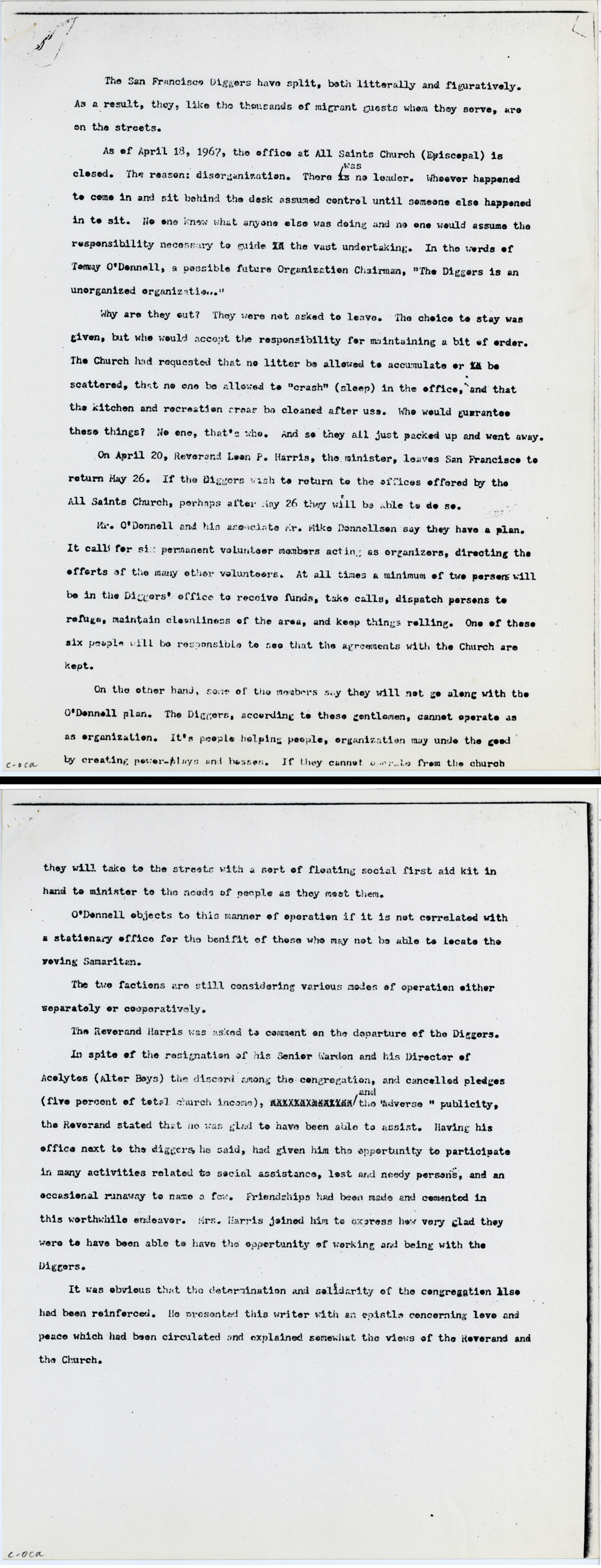
Even though this report indicates that Digger activity at All Saints Church had ended in April 1967, the separation was temporary and partial. Within two months, the Digger Free Bakery operation began at the church and would continue there for at least two years. The report therefore documents a moment of rupture and reorganization, not a final break between the Diggers and All Saints Church. (See Berkeley Barb, Sept. 19, 1969, p. 14, about the Free Bakery's continuing operation at All Saints Church.)
Abstract
Father Leon Harris sent this to me in 1974, a two-page typed report on the Diggers’ break with All Saints Church, dated internally to April 1967. Its opening line is striking: “The San Francisco Diggers have split, both literally and figuratively.” The immediate issue was the closing of the Diggers’ office at All Saints Church on April 13, 1967, but the deeper subject was organization versus anti-organization.
The report should be read with some caution, since “the Diggers” were never a single, centrally organized body. The group using the All Saints Church office for referral, refuge, and social-service work was not the same group operating the Trip Without A Ticket Free Store, which had opened a few months earlier. What the report documents is therefore not the collapse of Digger activity as a whole, but a crisis within one Digger-associated operation.
The text says the office was closed because of “disorganization,” and then explains what that meant in practical terms: no one had assumed responsibility for the desk, the flow of people, litter, sleeping in the office, or cleaning the kitchen and recreation areas. The church had not simply thrown them out; rather, it required some minimum guarantees of order, and no one would take responsibility for making those guarantees.
The article names Tommy O’Donnell as a possible future “Organization Chairman” and quotes him saying, “The Diggers is an unorganized organization.” O’Donnell and Mike Donnellson are described as having a plan for six permanent volunteer organizers who would keep the office staffed, receive funds, take calls, dispatch people to refuge, maintain cleanliness, and keep the church agreements. Against this, another faction argues that the Diggers could not operate as an organization: they were “people helping people,” and organization might undo the good by creating “personality and bosses.” If they could not work from the church, they proposed taking to the streets with “a sort of floating social first aid kit.”
The piece is valuable because it catches one early Digger formation at a moment when practical free services were colliding with anti-bureaucratic principle. It documents a conflict that would recur throughout the Digger movement: how to keep free food, refuge, communication, and street-level aid functioning without creating leaders, offices, permissions, and administrative hierarchy.
It also gives a sympathetic view of Reverend Leon P. Harris and All Saints Church. The article notes that Harris had been “glad to have been able to assist,” and that having the Diggers’ office next to the church had given him contact with “radical assistance, lost and needy persons, and an occasional runaway.” The closing was therefore not portrayed as simple rejection by the church, but as a strained negotiation between religious institutional hospitality and Digger anarchic practice.
Full Text
The San Francisco Diggers have split, both litterally and figuratively.

As a result, they, like the thousands of migrant guests whom they serve, are
on the streets.

As of April 13, 1967, the office at All Saints Church (Episcopal) is
closed. The reason: disorganization. There is no leader. Whoever happened
to come in and sit behind the desk assumed control until someone else happened
in to sit. No one knew what anyone else was doing, and no one would assume the
responsibility necessary to guide in the vast undertaking. In the words of
Tommy O’Donnell, a possible future Organization Chairman, “The Diggers is an
unorganized organization…”

Why are they out? They were not asked to leave. The choice to stay was
given, but who would accept the responsibility for maintaining a bit of order.
The Church had requested that no litter be allowed to accumulate or be
scattered, that no one be allowed to “crash” (sleep) in the office, and that
the kitchen and recreation areas be cleaned after use. Who would guarantee
these things? No one, that’s who. And so they all just packed up and went away.

On April 20, Reverend Leon P. Harris, the minister, leaves San Francisco to
return May 26. If the Diggers wish to return to the offices offered by the
All Saints Church, perhaps after May 26 they will be able to do so.

Mr. O’Donnell and his associate Mr. Mike Donnellson say they have a plan.
It calls for six permanent volunteer members acting as organizers, directing the
efforts of the many other volunteers. At all times a minimum of two persons will
be in the Diggers’ office to receive funds, take calls, dispatch persons to
refuge, maintain cleanliness of the area, and keep things rolling. One of these
six people will be responsible to see that the agreements with the Church are
kept.

On the other hand, some of the members say they will not go along with the
O’Donnell plan. The Diggers, according to these gentlemen, cannot operate as
an organization. It’s people helping people, organization may undo the good
by creating personality and bosses. If they cannot operate from the church
they will take to the streets with a sort of floating social first aid kit in
hand to minister to the needs of people as they meet them.

O’Donnell objects to this manner of operation if it is not correlated with
a stationary office for the benefit of those who may not be able to locate the
roving Samaritan.

The two factions are still considering various modes of operation either
separately or cooperatively.

The Reverend Harris was asked to comment on the departure of the Diggers.

In spite of the resignation of his Senior Warden and his Director of
Acolytes (Alter Boys) the discord among the congregation, and cancelled pledges
(five percent of total church income), and the adverse “publicity,
the Reverend stated that he was glad to have been able to assist. Having his
office next to the diggers, he said, had given him the opportunity to participate
in many activities related to social assistance, lost and needy persons, and an
occasional runaway to name a few. Friendships had been made and cemented in
this worthwhile endeavor. Mrs. Harris joined him to express how very glad they
were to have been able to have the opportunity of working and being with the
Diggers.

It was obvious that the determination and solidarity of the congregation also
had been reinforced. He presented this writer with an epistle concerning love and
peace which had been circulated and explained somewhat the views of the Reverend and
the Church.