TitleThe current status of the Haight-Ashbury hippie community
AuthorStephen M. Pittell
Publisher
Place
Year
Date 19/1/1968
Date 2n.d., ca.
Publication
Volume
Issue
Page(s)
MediumLeaflet
Dimension
Extent
Imprint
Collation3 sht; stapled; additional typed note
CatalogDR-010b
CollectionSOLA-o(LH)
Cit. No.
Keywords
Trans. Title
Section
Group
Sub-Group
Series
Folder
click image to enlarge
Notes
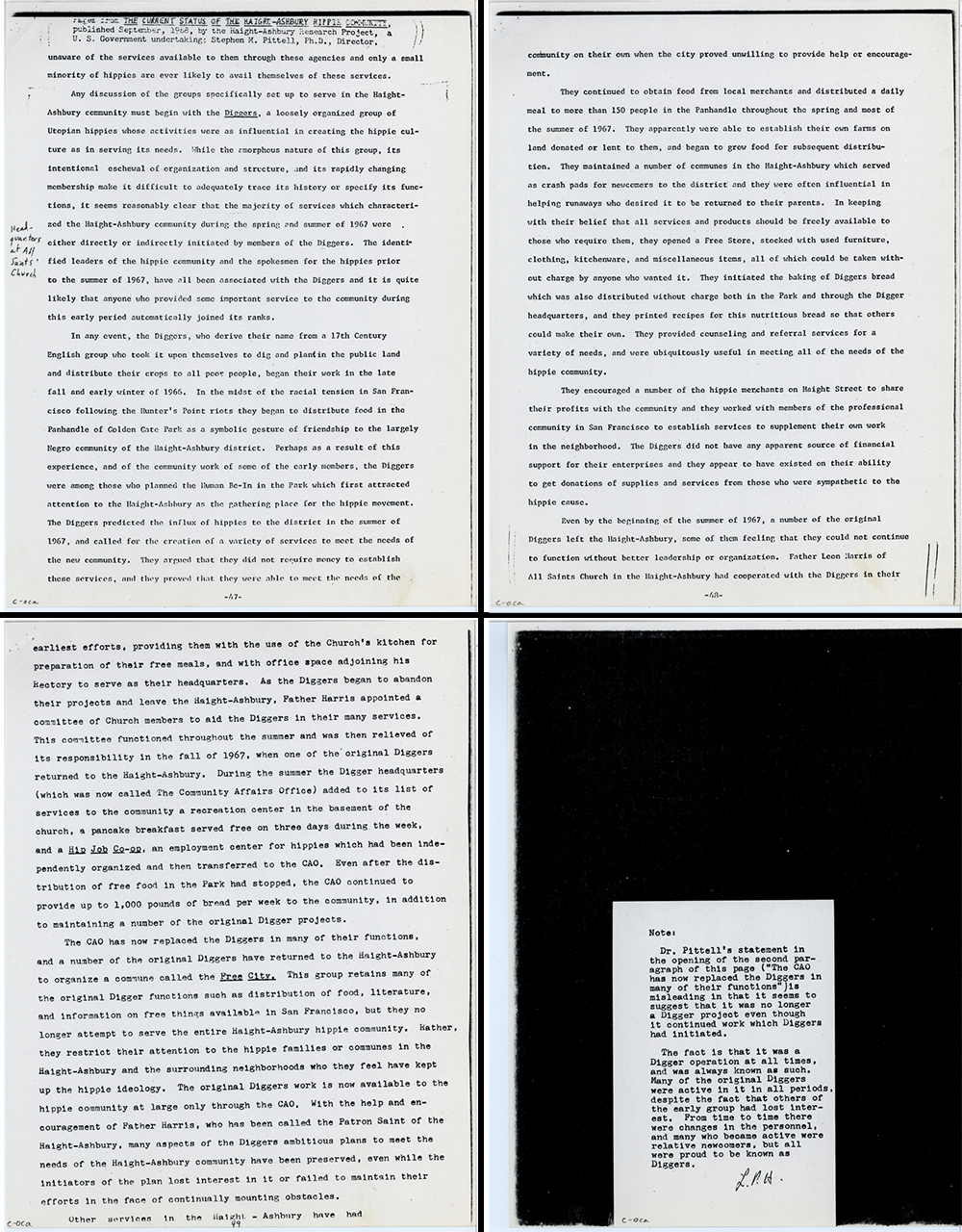
The report’s interpretation, however, seems to have troubled Leon Harris. In his attached note, Harris objects to Pittell’s statement that “the CAO has now replaced the Diggers in many of their functions.” Harris calls that wording misleading because it suggests that the Diggers were no longer a Digger project, even though many of the activities being described were continuations of work that Diggers had initiated. He clarifies that this was “a Digger operation at all times,” though many of the original Diggers were not active in all periods, and some later activists were not necessarily known as Diggers.
The document helps untangle the continuity between the All Saints Church office, the Digger Free Bakery, and the Community Affairs Office. It shows that the April 1967 “split” or departure from All Saints was not the end of Digger activity there. Instead, the relationship continued and changed form, with Harris and the church becoming important institutional supports for free food, referral, recreation, and other neighborhood services rooted in the original Digger impulse.
Abstract
Father Leon Harris of All Saints Church sent me this excerpt in 1974. It comes from "The Current Status of the Haight-Ashbury Hippie Community," published in September 1968 by the Haight-Ashbury Research Project, a U.S. Government undertaking directed by Stephen M. Pittell, Ph.D.
The report treats the Diggers as the central source of organized service activity in the Haight-Ashbury during the crucial period from late 1966 through the spring and summer of 1967. It describes them as a loosely organized group of “Utopian hippies” whose work was not merely expressive or theatrical, but practical: free food distribution, crash pads, a Free Store, baked bread, recipes for making bread, referrals, and informal aid for newcomers and runaways. The report emphasizes that many of the services associated with the Haight-Ashbury scene either began with the Diggers or were strongly influenced by them.
The report also traces the Diggers’ relationship with All Saints Church. It states that Father Leon Harris cooperated with the Diggers in their earliest efforts, providing use of the church kitchen for free meals and office space adjoining the rectory for their headquarters. After the original Diggers began to leave the Haight, Harris appointed a committee of church members to continue assisting Digger-related services. This committee eventually became known as the Community Affairs Office, or CAO.
The excerpt then describes a transition from the original Digger operations to the CAO. During the summer of 1967, the Digger headquarters—now called the Community Affairs Office—expanded its work to include a recreation center in the church basement, a free pancake breakfast three days a week, and a Hip Job Co-op. Even after free food distribution in the Panhandle stopped, the CAO reportedly continued to distribute up to 1,000 pounds of bread per week and maintained several of the original Digger projects.
Full Text
from THE CURRENT STATUS OF THE HAIGHT-ASHBURY HIPPIE COMMUNITY, published September, 1968, by the Haight-Ashbury Research Project, a U. S. Government undertaking; Stephen M. Pittell, Ph.D., Director.

unaware of the services available to them through these agencies and only a small minority of hippies are ever likely to avail themselves of these services.

Any discussion of the groups specifically set up to serve in the Haight-Ashbury community must begin with the Diggers, a loosely organized group of Utopian hippies whose activities were as influential in creating the hippie culture as in serving its needs. While the amorphous nature of this group, its intentional eschewal of organization and structure, and its rapidly changing membership make it difficult to adequately trace its history or specify its functions, it seems reasonably clear that the majority of services which characterized the Haight-Ashbury community during the spring and summer of 1967 were either directly or indirectly initiated by members of the Diggers. The identified leaders of the hippie community and the spokesmen for the hippies prior to the summer of 1967, have all been associated with the Diggers and it is quite likely that anyone who provided some important service to the community during this early period automatically joined its ranks.

In any event, the Diggers, who derive their name from a 17th Century English group who took it upon themselves to dig and plant in the public land and distribute their crops to all poor people, began their work in the late fall and early winter of 1966. In the midst of the racial tension in San Francisco following the Hunter’s Point riots they began to distribute food in the Panhandle of Golden Gate Park as a symbolic gesture of friendship to the largely Negro community of the Haight-Ashbury district. Perhaps as a result of this experience, and of the community work of some of the early members, the Diggers were among those who planned the Human Be-In in the Park which first attracted attention to the Haight-Ashbury as the gathering place for the hippie movement. The Diggers predicted the influx of hippies to the district in the summer of 1967, and called for the creation of a variety of services to meet the needs of the new community. They argued that they did not require money to establish these services, and they proved that they were able to meet the needs of the community on their own when the city proved unwilling to provide help or encouragement.

They continued to obtain food from local merchants and distributed a daily meal to more than 150 people in the Panhandle throughout the spring and most of the summer of 1967. They apparently were able to establish their own farms on land donated or lent to them, and began to grow food for subsequent distribution. They maintained a number of communes in the Haight-Ashbury which served as crash pads for newcomers to the district and they were often influential in helping runaways who desired it to be returned to their parents. In keeping with their belief that all services and products should be freely available to those who require them, they opened a Free Store, stocked with used furniture, clothing, kitchenware, and miscellaneous items, all of which could be taken without charge by anyone who wanted it. They initiated the baking of Diggers bread which was also distributed without charge both in the Park and through the Digger headquarters, and they printed recipes for this nutritious bread so that others could make their own. They provided counseling and referral services for a variety of needs, and were ubiquitously useful in meeting all of the needs of the hippie community.

They encouraged a number of the hippie merchants on Haight Street to share their profits with the community and they worked with members of the professional community in San Francisco to establish services to supplement their own work in the neighborhood. The Diggers did not have any apparent source of financial support for their enterprises and they appear to have existed on their ability to get donations of supplies and services from those who were sympathetic to the hippie cause.

Even by the beginning of the summer of 1967, a number of the original Diggers left the Haight-Ashbury, some of them feeling that they could not continue to function without better leadership or organization. Father Leon Harris of All Saints Church in the Haight-Ashbury had cooperated with the Diggers in their earliest efforts, providing them with the use of the Church’s kitchen for preparation of their free meals, and with office space adjoining his Rectory to serve as their headquarters. As the Diggers began to abandon their projects and leave the Haight-Ashbury, Father Harris appointed a committee of Church members to aid the Diggers in their many services. This committee functioned throughout the summer and was then relieved of its responsibility in the fall of 1967, when one of the original Diggers returned to the Haight-Ashbury. During the summer the Digger headquarters (which was now called The Community Affairs Office) added to its list of services to the community a recreation center in the basement of the church, a pancake breakfast served free on three days during the week, and a Hip Job Co-op, an employment center for hippies which had been independently organized and then transferred to the CAO. Even after the distribution of free food in the Park had stopped, the CAO continued to provide up to 1,000 pounds of bread per week to the community, in addition to maintaining a number of the original Digger projects.

The CAO has now replaced the Diggers in many of their functions, and a number of the original Diggers have returned to the Haight-Ashbury to organize a commune called the Free City. This group retains many of the original Digger functions such as distribution of food, literature, and information on free things available in San Francisco, but they no longer attempt to serve the entire Haight-Ashbury hippie community. Rather, they restrict their attention to the hippie families or communes in the Haight-Ashbury and the surrounding neighborhoods who they feel have kept up the hippie ideology. The original Diggers work is now available to the hippie community at large only through the CAO. With the help and encouragement of Father Harris, who has been called the Patron Saint of the Haight-Ashbury, many aspects of the Diggers ambitious plans to meet the needs of the Haight-Ashbury community have been preserved, even while the initiators of the plan lost interest in it or failed to maintain their efforts in the face of continually mounting obstacles.

Other services in the Haight-Ashbury have had

Note:

Dr. Pittell’s statement in the opening of the second paragraph of this page “The CAO has now replaced the Diggers in many of their functions” is misleading in that it seems to suggest that it was no longer a Digger project even though it continued work which Diggers had initiated.

The fact is that it was a Digger operation at all times, and was always known as such. Many of the original Diggers were active in it in all periods, despite the fact that others of the early group had lost interest. From time to time there were changes in the personnel, and many who became active were relative newcomers, but all were proud to be known as Diggers.

L.P.H.