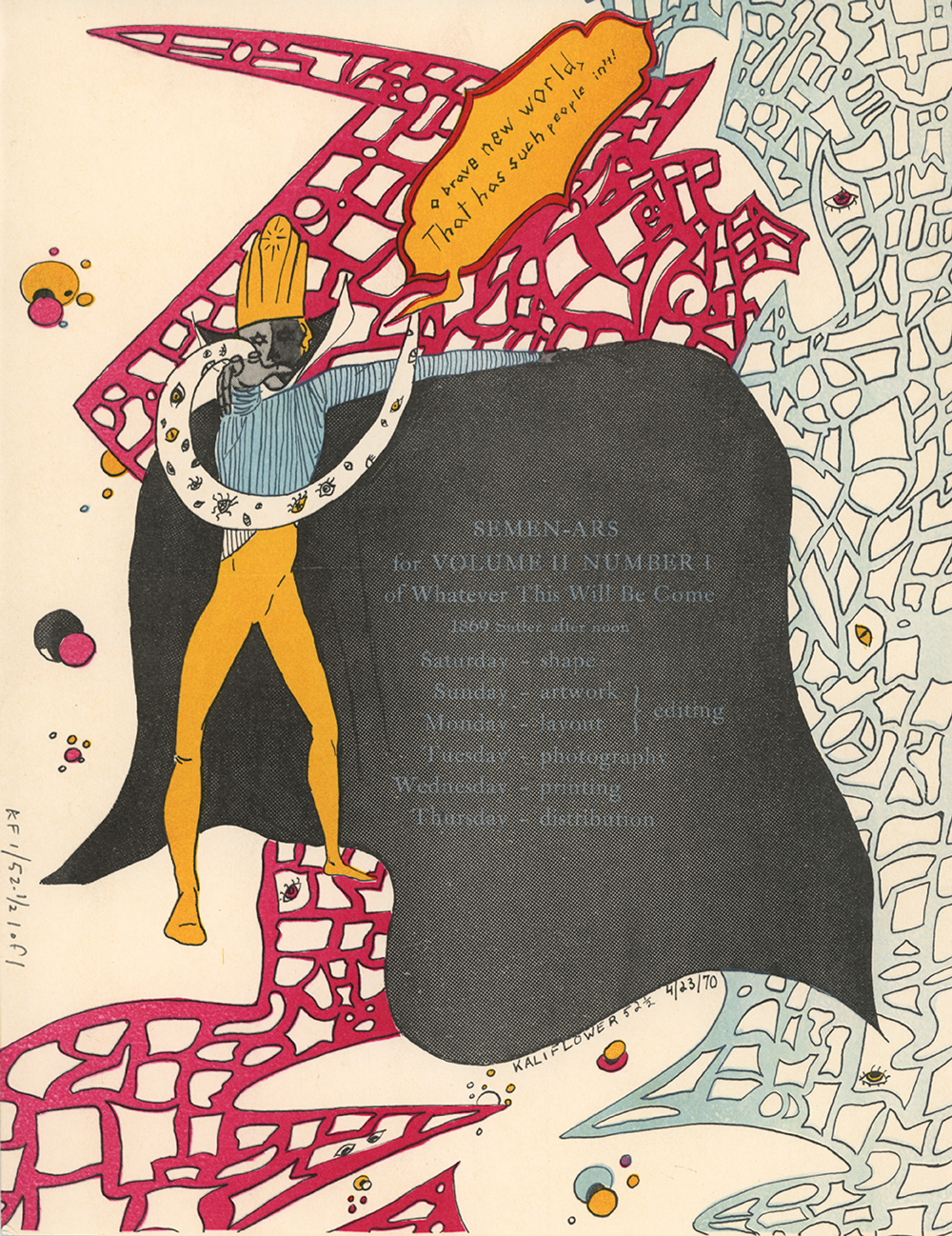
The schedule is useful because it shows *Kaliflower* as a weekly production cycle, not just as a finished object.
It appears to lay out the work this way:
**Saturday — shape**
This sounds like the first gathering: deciding the form, theme, contents, direction, and perhaps who will do what. “Shape” is a very Kaliflower word — less bureaucratic than “planning meeting,” but still clearly organizational.
**Sunday — artwork**
The visual work comes early, before layout. That suggests the art was not decoration added at the end, but part of the issue’s structure and identity.
**Monday — layout / editing**
This is where the issue begins to become a printable object. Text, images, order, page design, and editorial decisions would have to come together.
**Tuesday — photography / editing**
The word “editing” seems bracketed across Monday and Tuesday, which makes sense: editing was not a single step but continued through layout, paste-up, and preparation of camera-ready pages. “Photography” probably refers to photographic reproduction work needed for printing — shooting the pages or artwork, making negatives/stencils/plates, depending on the exact production method being used.
**Wednesday — printing**
By midweek the issue had to be technically ready. This gives one full day to produce the physical copies.
**Thursday — distribution**
The week culminates in circulation. For *Kaliflower*, distribution was not an afterthought; it was the point at which the paper entered the intercommunal network and became part of the weekly social exchange.
What is striking is that the schedule converts what might look from the outside like a spontaneous underground paper into a disciplined weekly practice. Each issue required a sequence: conception, art, editing, technical preparation, printing, and delivery. The sheet is almost a miniature production manual. It was teaching a new crew not only how to make *Kaliflower*, but how to inhabit the rhythm of making it.
Note: The quotation is from Miranda’s line in *The Tempest*: “O brave new world, / That has such people in’t.” |