Up
Introduction
Instructions
Abbreviations
Favorites

Full Catalog Record

« Return to Catalog

TitleIf You Look at the Style of Life and the Orientation of the Pacific Basin People ... [Planetedge 1 (verso)]
Author
Publisher
Place
Year1969
Date 112/1/1969
Date 2n.d., ca.
Publication
Volume
Issue
Page(s)
MediumBroadside
Dimension17" x 22"
Extent
Imprint
Collation
CatalogPE-01-v
CollectionSOLA-o(PB)
Cit. No.
Keywords
Filename
Trans. Titleif you look at the style of life and the orientation of the Pacific Basin people ...
Section
Group
Sub-Group
Series
Folder
PE-01-v
click image to enlarge
Notes
Abstract
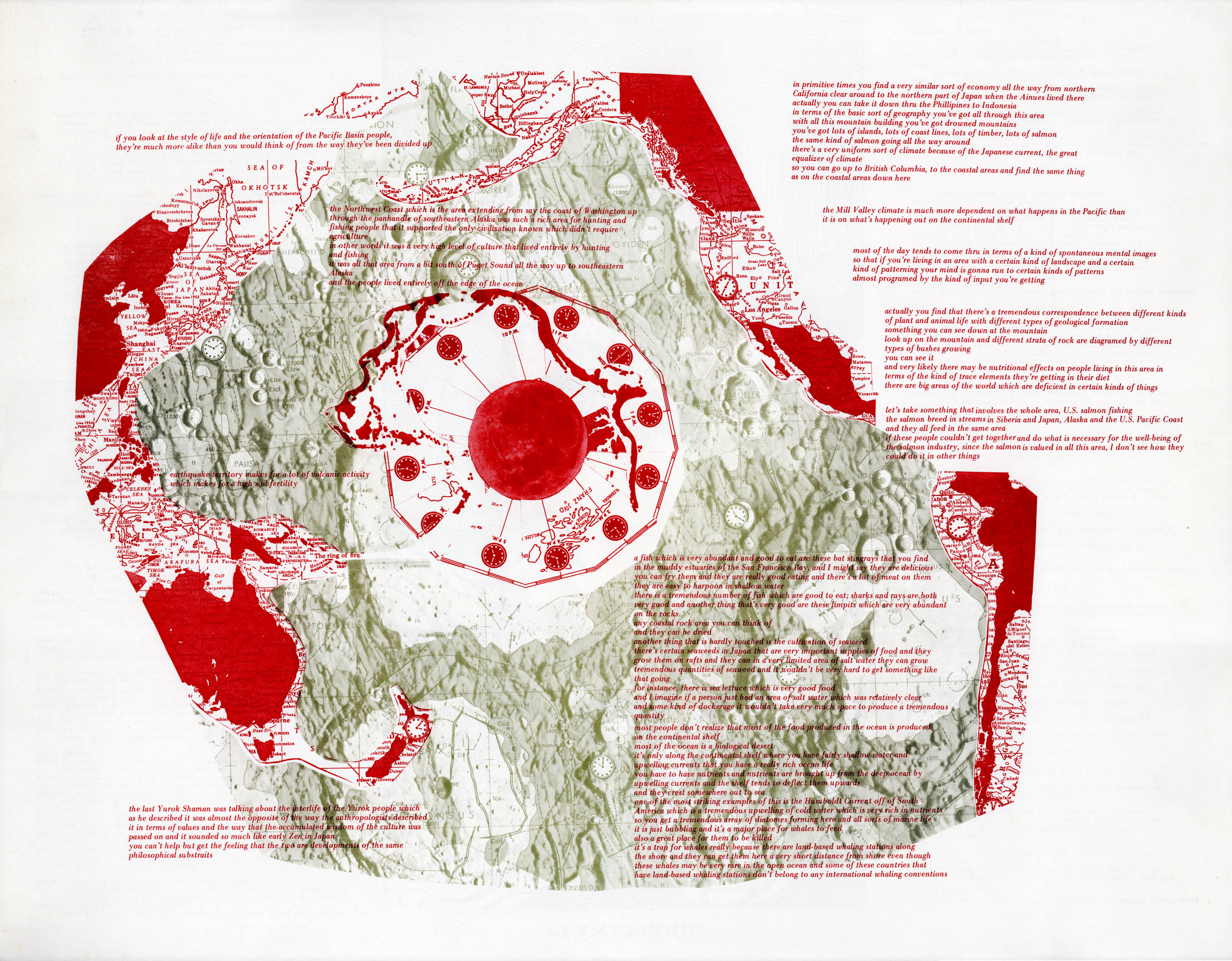
A visual manifesto centered on a map of the Pacific Rim, extending from East Asia and the western Pacific across Alaska and the Pacific Northwest to California and the Americas. Dense red cartographic detail, place names, coastal outlines, route lines, and diagrams surround a mottled green landmass and a prominent circular, eye-like or cellular image at the center. Typewritten passages distributed around the map consider Pacific geography, climate, fishing, land use, regional interdependence, and the relation between human settlement and ecological systems. The poster treats the Pacific Rim not simply as a geographic region but as a shared planetary environment shaped by currents, migration, resource use, and collective responsibility.
Full Text
if you look at the style of life and the orientation of the Pacific Basin people, they’re much more alike than you would think of from the way they’ve been divided up

the Northwest Coast which is the area extending from say the coast of Washington up through the panhandle of southeastern Alaska was such a rich area for hunting and fishing people that it supported the only civilization known which didn’t require agriculture

in other words it was a very high level of culture that lived entirely by hunting and fishing

it was all that area from a bit south of Puget Sound all the way up to southeastern Alaska

and the people lived entirely off the edge of the ocean

earthquake territory makes for a lot of volcanic activity which makes for a high soil fertility

in primitive times you find a very similar sort of economy all the way from northern California clear around to the northern part of Japan when the Ainus lived there

actually you can take it down thru the Philippines to Indonesia

in terms of the basic sort of geography you’ve got all through this area with all this mountain building you’ve got drowned mountains

you’ve got lots of islands, lots of coast lines, lots of timber, lots of salmon

the same kind of salmon going all the way around

there’s a very uniform sort of climate because of the Japanese current, the great equalizer of climate

so you can go up to British Columbia, to the coastal areas and find the same thing as on the coastal areas down here

the Mill Valley climate is much more dependent on what happens in the Pacific than it is on what’s happening out on the continental shelf

most of the day tends to come thru in terms of a kind of spontaneous mental images so that if you’re living in an area with a certain kind of landscape and a certain kind of patterning your mind is gonna run to certain kinds of patterns almost programmed by the kind of input you’re getting

actually you find that there’s a tremendous correspondence between different kinds of plant and animal life with different types of geological formation

something you can see down at the mountain

look up on the mountain and different strata of rock are diagramed by different types of bushes growing

you can see it

and very likely there may be nutritional effects on people living in this area in terms of the kind of trace elements they’re getting in their diet

there are big areas of the world which are deficient in certain kinds of things

let’s take something that involves the whole area, U.S. salmon fishing

the salmon breed in streams in Siberia and Japan, Alaska and the U.S. Pacific Coast

and they all feed in the same area

if these people couldn’t get together and do what is necessary for the well-being of the salmon industry, since the salmon is valued in all this area, I don’t see how they could do it in other things

a fish which is very abundant and good to eat are these bat stingrays that you find in the muddy estuaries of the San Francisco Bay, and I might say they are delicious

you can fry them and they are really good eating and there’s a lot of meat on them

they’re easy to harpoon in shallow water

there is a tremendous number of fish which are good to eat; sharks and rays are both very good and another thing that’s very good are these limpets which are very abundant on the rocks

any coastal rock area you can think of

and they can be dried

another thing that is hardly touched is the cultivation of seaweed

there’s certain seaweeds in Japan that are very important supplies of food and they grow them on rafts and they can in a very limited area of salt water they can grow tremendous quantities of seaweed and it wouldn’t be very hard to get something like that going

for instance there is sea lettuce which is very good food

and I imagine if a person just had an area of salt water which was relatively clear and some kind of dock arrangement it wouldn’t take very much space to produce a tremendous quantity

most people don’t realize that most of the food produced in the ocean is produced on the continental shelf

most of the ocean is a biological desert

it’s only along the continental shelf where you have fairly shallow water and upwelling currents that you have a really rich ocean life

you have to have nutrients and nutrients are brought up from the deep ocean by upwelling currents and the shelf tends to deflect them upwards

and they crest somewhere out to sea

one of the most striking examples of this is the Humboldt Current off of South America which is a tremendous upwelling of cold water which is very rich in nutrients

so you get a tremendous array of diatoms forming here and all sorts of marine animals

it is just bubbling and it’s a major place for whales to feed

also a great place for them to be killed

it’s a trap for whales really because there are land-based whaling stations along the shore and they can get them here a very short distance from shore even though these whales may be very rare in the open ocean and some of these countries that have land-based whaling stations don’t belong to any international whaling conventions

the last Yurok Shaman was talking about the afterlife of the Yurok people which as he described it was almost the opposite of the way the anthropologists described it in terms of values and the way that the accumulated wisdom of the culture was passed on and it sounded so much like early Zen in Japan you can’t help but get the feeling that the two are developments of the same philosophical substrates

« Return to Catalog


Large view
Mouse wheel zooms. Use the rotate buttons or press R / Shift+R. Click again or press Esc to close.
Large image
Large view
The Digger Archives is published under a Creative Commons Attribution-Non-Commercial-ShareAlike 4.0 International License.
Cite As: (Courtesy of) The Digger Archives (www.diggers.org) / CC BY-NC-SA 4.0 / All other uses must receive permission.
Contact: curator at diggers dot org.