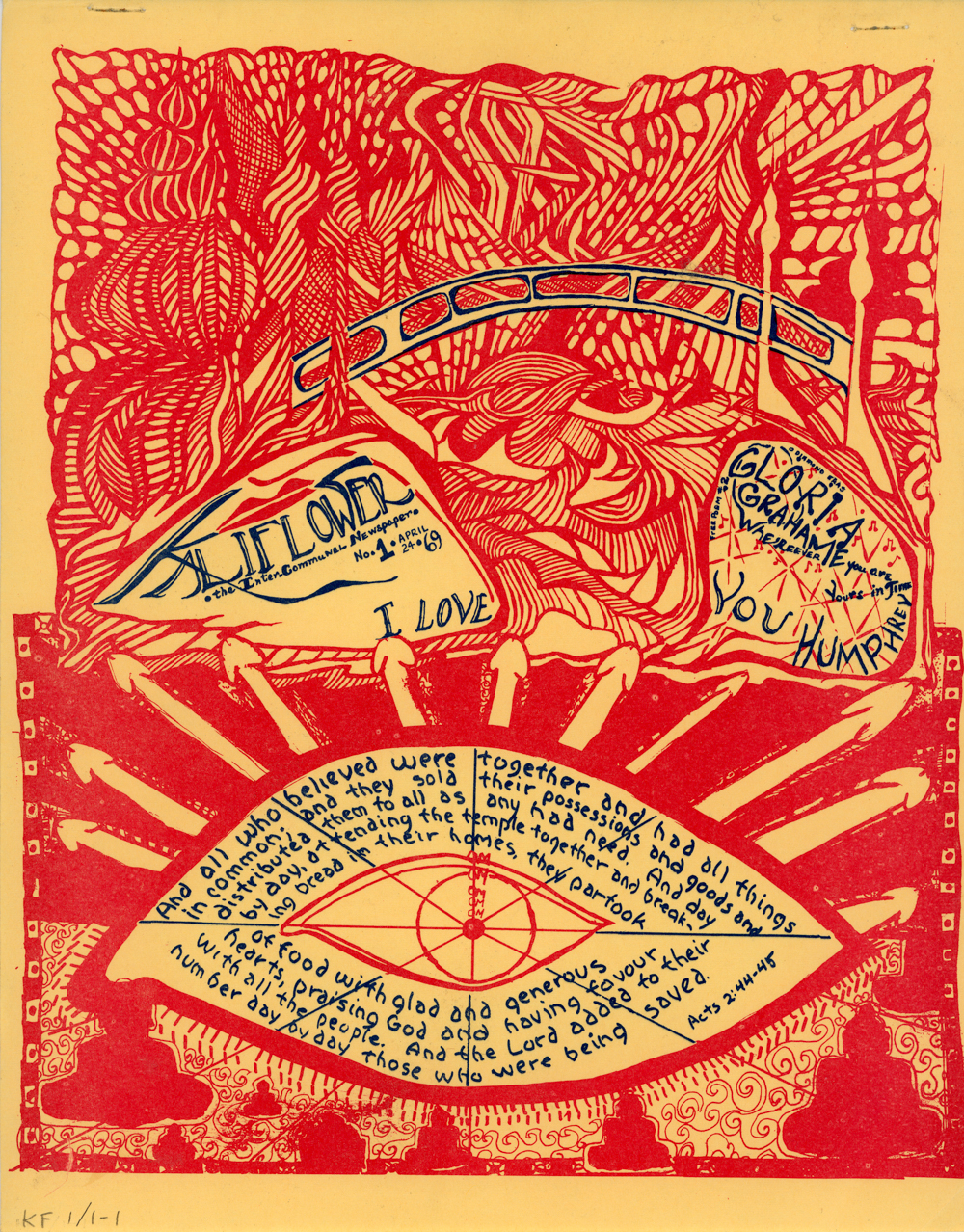
The cover page of the first issue of *Kaliflower* identified itself as “the Inter-Communal Newspaper.” The page announces the paper’s founding vision through the language of Acts: “all who believed were together and had all things in common,” and “they sold their possessions and distributed them to all, as any had need.” From the beginning, then, *Kaliflower* presents itself not simply as an underground newspaper, but as a vehicle for an apostolic form of communalism — daily bread, common property, mutual aid, and the creation of a network of households bound together by love and shared practice.
But the graphics complicate and deepen that scriptural frame. The bridge across the top suggests the paper’s intercommunal function, while the eye, hands, rays, seated Buddhas along the bottom edge, and dense psychedelic patterning give the page the quality of a visionary diagram or devotional panel. At the same time, the repeated erect phallic forms introduce an unabashedly queer erotic charge. This is not merely the generalized heterosexual eroticism common in San Francisco psychedelic posters of the period; it is the opening statement of a visual style that would carry forward through Kaliflower’s three-plus-year run and through numerous Free Print Shop images as well, where phallic imagery, orgasmic energy, and male-to-male sexual imagery became part of the paper’s recurring graphic vocabulary.
The result is a remarkable fusion: early Christian communism, San Francisco psychedelia, intercommunal organizing, and an unapologetically queer aesthetic all appear together on the first page of the first issue. *Kaliflower* begins by declaring that the new world it imagines will be spiritual, economic, erotic, and collective all at once. |