Including Ephemera, Broadsides, Posters, Street Sheets, Collections, etc. for the
San Francisco Diggers, Communication Company, Free City Collective,
Kaliflower Intercommunal Network, Free Print Shop, Planetedge Manifestation,
Earth/Life Defense Commune, &c.
Category = | Keyword = ALL | Group = ALL | Issue = ALL | New = ALL | Followup = ALL | Order = DATE | Search = EMPTY | Records = 1309 | Page = 1 of 53 [Browsing category-filtered records]
Click thumbnail for large size. Click again to return.
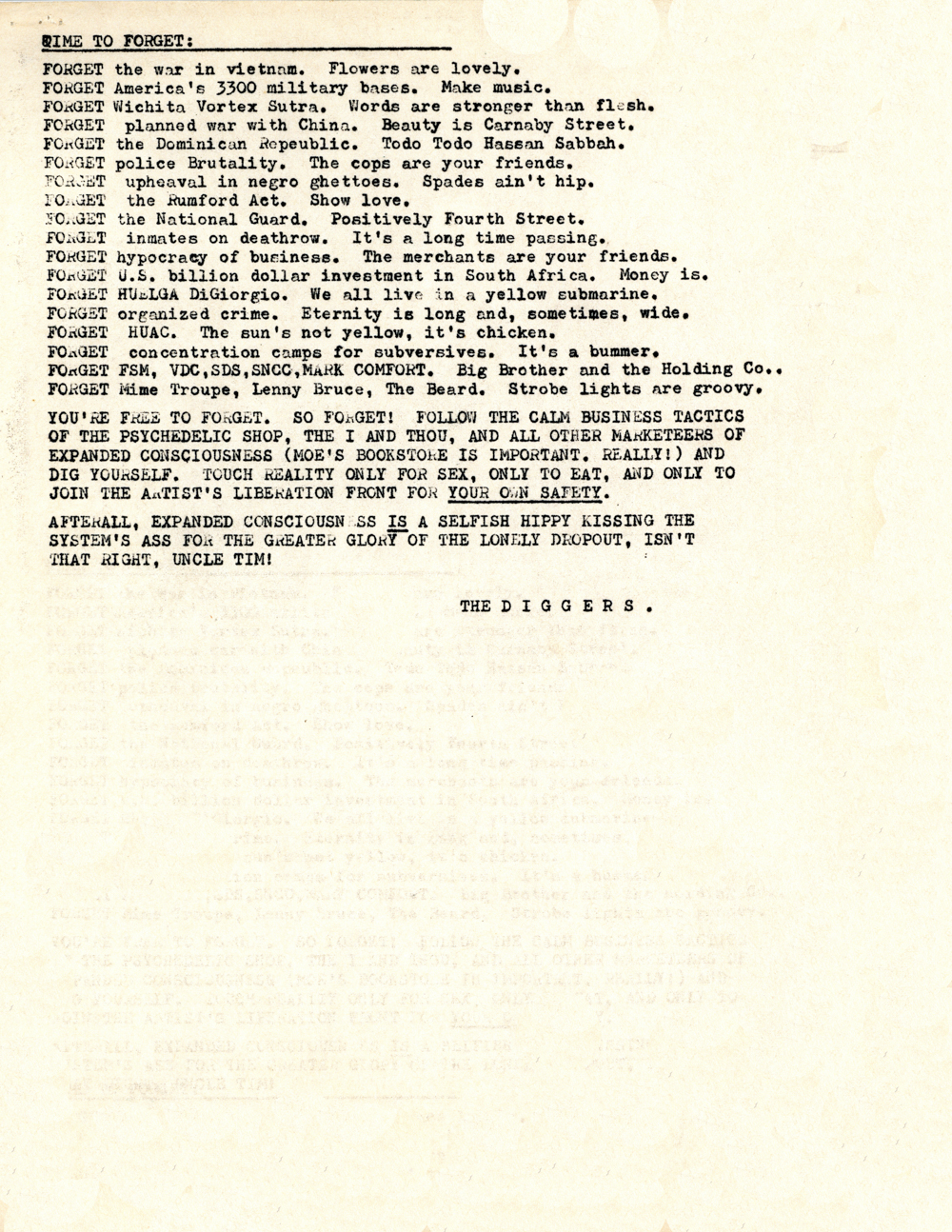
Cat. No.: DP-006 Full record BibCit: n.d., ca. 9/15/1966. Broadside. Letter size. Imprint: The D I G G E R S. Collection: SOLA-o. Abstract: Attacks the politics of withdrawal and fashionable “hip” disengagement. Repeating the command “FORGET,” it mocks the idea that beauty, music, style, and private consciousness can substitute for confronting war, racism, state repression, labor struggle, and corporate hypocrisy. Its target is the commercialization of counterculture and a dropout sensibility that turns inward while leaving the larger system intact.
Note: According to Ringolevio (page 238) this was the first Digger Paper.
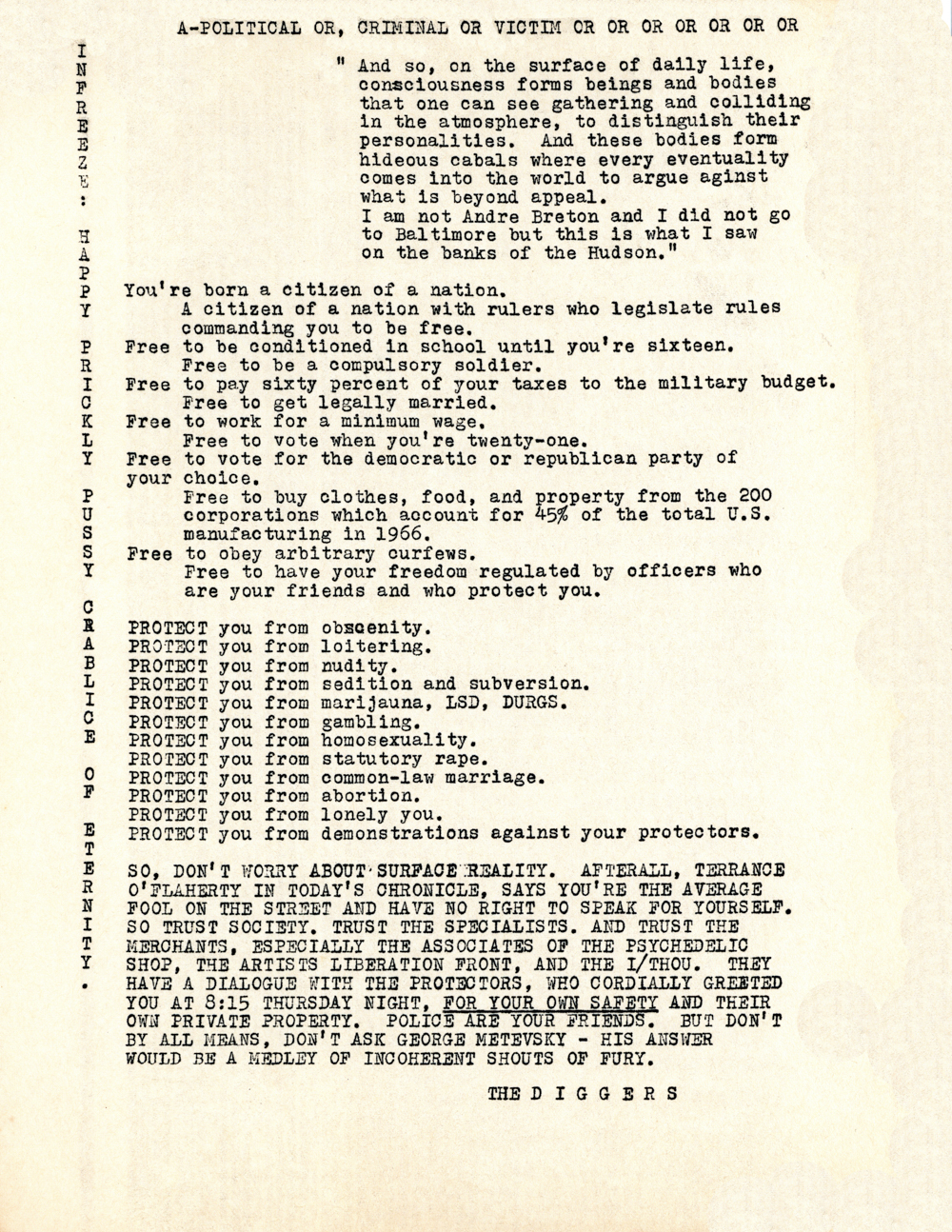
Cat. No.: DP-004 Full record BibCit: 9/30/1966. Broadside. Letter size. Imprint: THE D I G G E R S. Collection: SOLA-o;-xx(SS) | SS-x(T). Abstract: Uses irony to argue that American “freedom” is largely a system of control. It presents citizenship as a series of regulated choices—schooling, military service, wage labor, limited political options, and consumer dependence—enforced by police and law in the name of protection. The piece also attacks journalists, merchants, and other intermediaries for collaborating with authority while claiming to represent the public. Overall, it exposes the gap between official freedom and lived repression.
Note: The date of this Digger Paper is Friday, September 30, 1966 which is known from the reference to "Terence O'Flaherty in today's Chronicle."
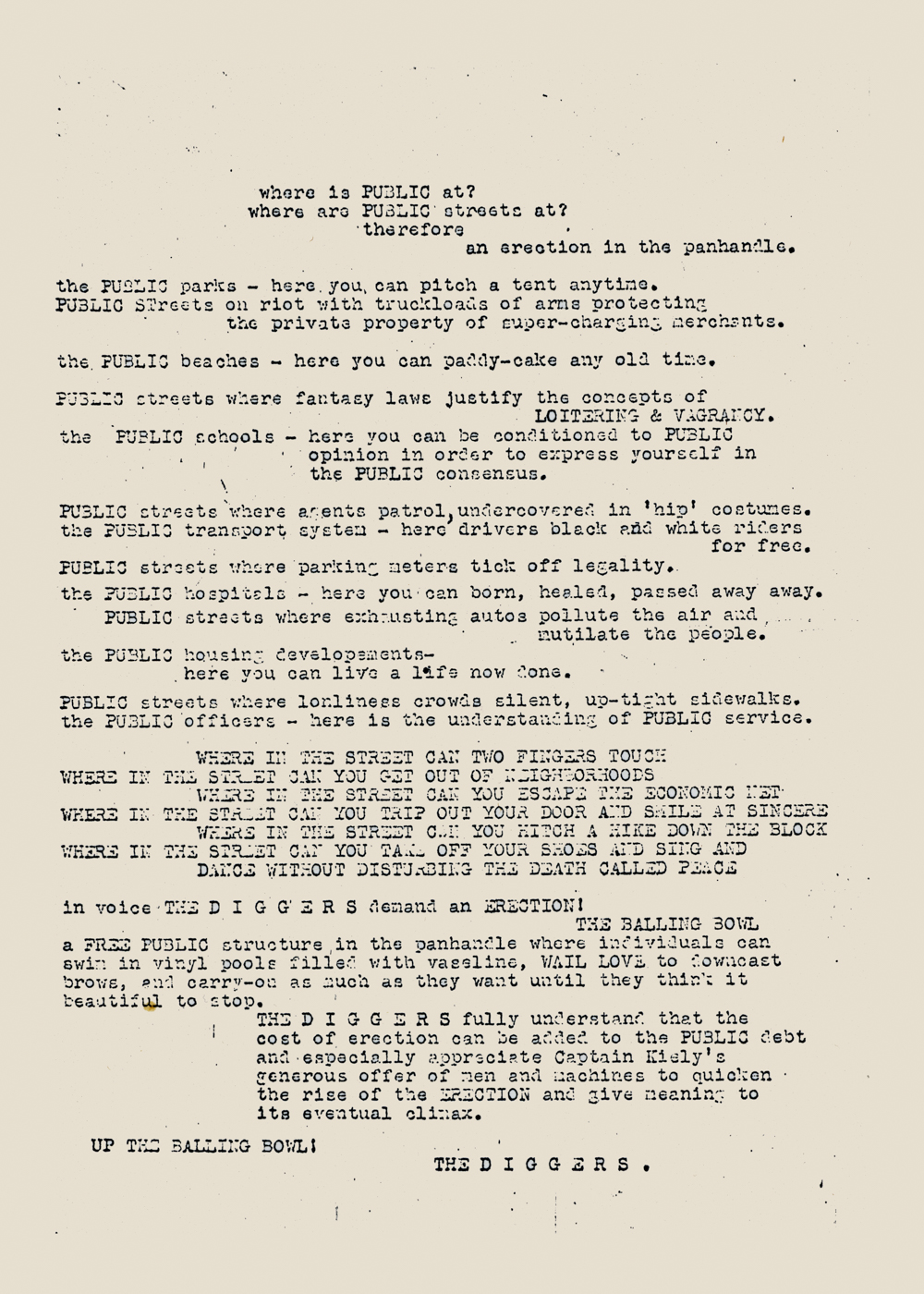
Cat. No.: DP-001 Full record BibCit: n.d., ca. 10/1/1966. Broadside. Letter size. San Francisco: The Diggers. Imprint: THE D I G G E R S. Collection: SOLA-x(SS) | SS-x(PB). Abstract: This text is a biting, surreal critique of the collapse of “public” life in a privatized society. Through ironic repetition, it exposes how spaces meant for communal use—streets, schools, parks—have become instruments of surveillance, conditioning, and control. The Diggers respond with parody and provocation, proposing a literal and symbolic “erection” of freedom: a public, ecstatic, collective space where love and liberation replace property and repression. It transforms civic frustration into theatrical revolt—an anarchic vision of reclaiming the commons.
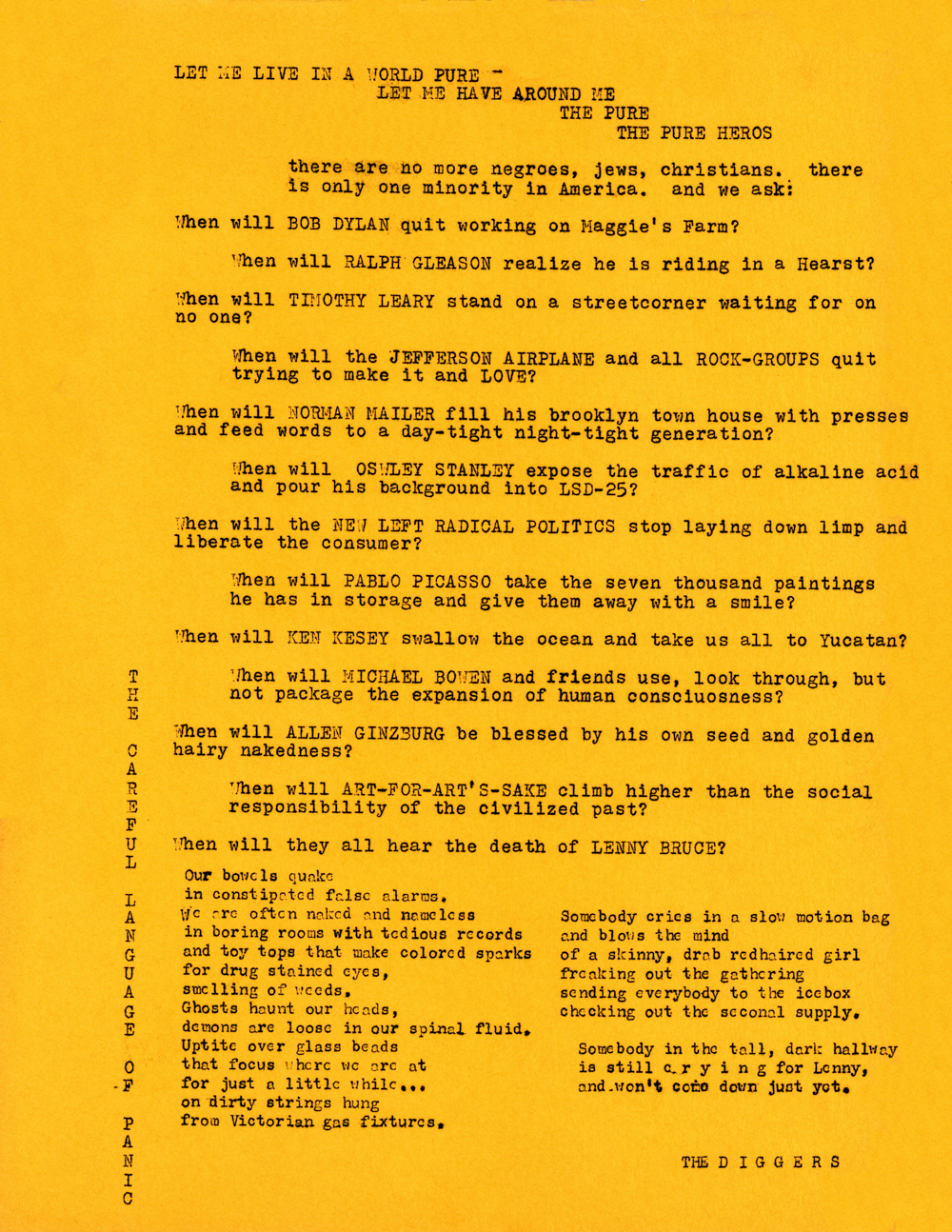
Cat. No.: DP-003 Full record BibCit: n.d., ca. 10/1/1966. Broadside. Letter size. The Diggers. Imprint: THE D I G G E R S. Collection: SOLA-o($). Abstract: This poetic manifesto mourns the spiritual decay of 1960s America while demanding renewal through authentic, liberated living. It calls out cultural figures—from Dylan to Ginsberg—for clinging to fame, ideology, or illusion rather than embracing communal purity and love. The piece condemns commercialism and false revolution, urging the destruction of social masks and the rebirth of genuine human connection. In its final invocation, the Diggers emerge as witnesses to a generation haunted by lost prophets and unfulfilled dreams.
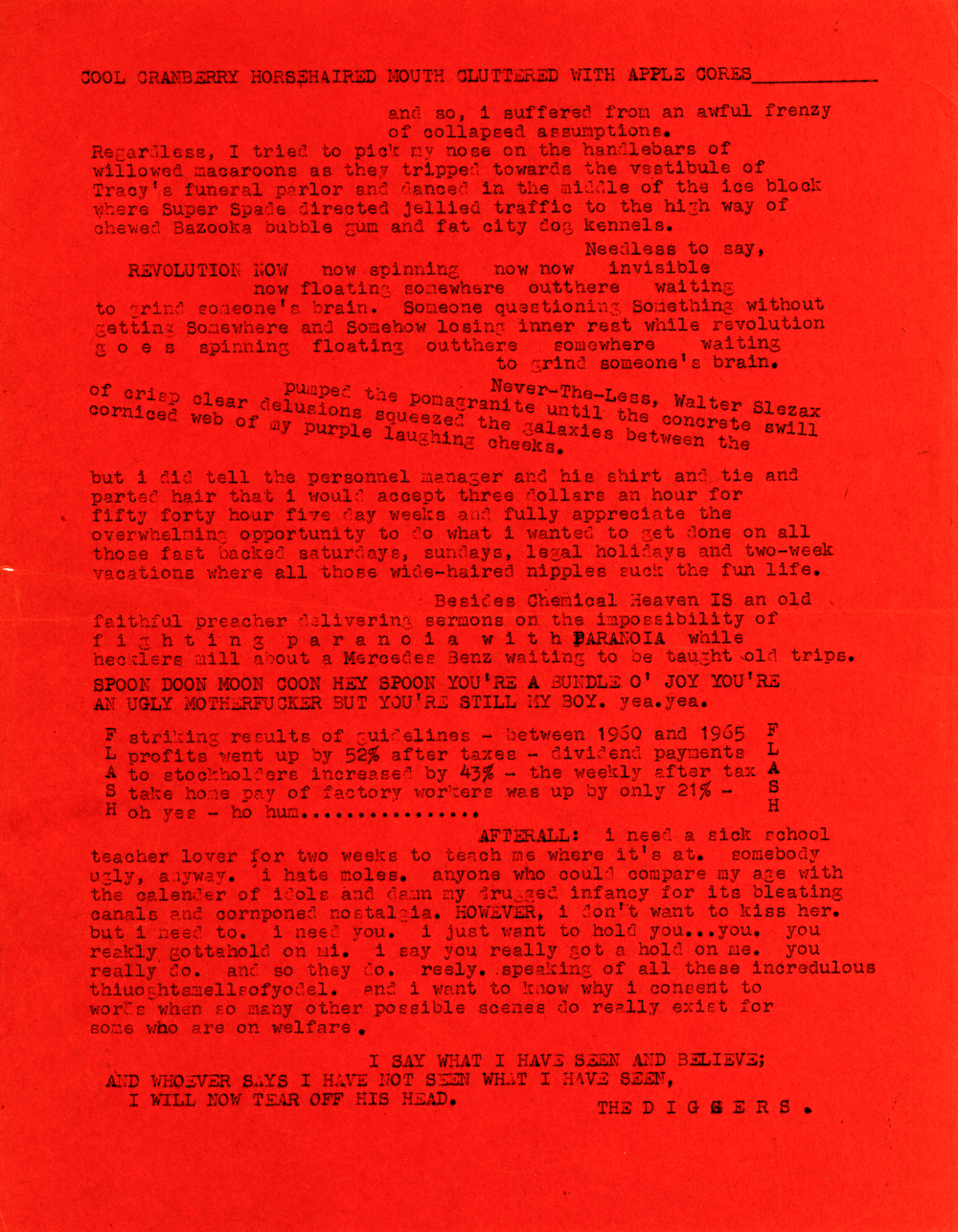
Cat. No.: DP-005 Full record BibCit: n.d., ca. 10/1/1966. Broadside. Letter size. Imprint: THE D I G G E R S. Collection: SOLA-o. Abstract: A deliberately chaotic collage of surreal images, countercultural slang, sexual anxiety, economic critique, and revolutionary longing. Beneath its stream-of-consciousness absurdity runs a serious tension: the speaker feels trapped between psychic dislocation, deadening work, consumer society, and the distant promise of “revolution.” Its fractured style is itself the point: it enacts the breakdown of stable meaning in a society experienced as both grotesque and coercive.
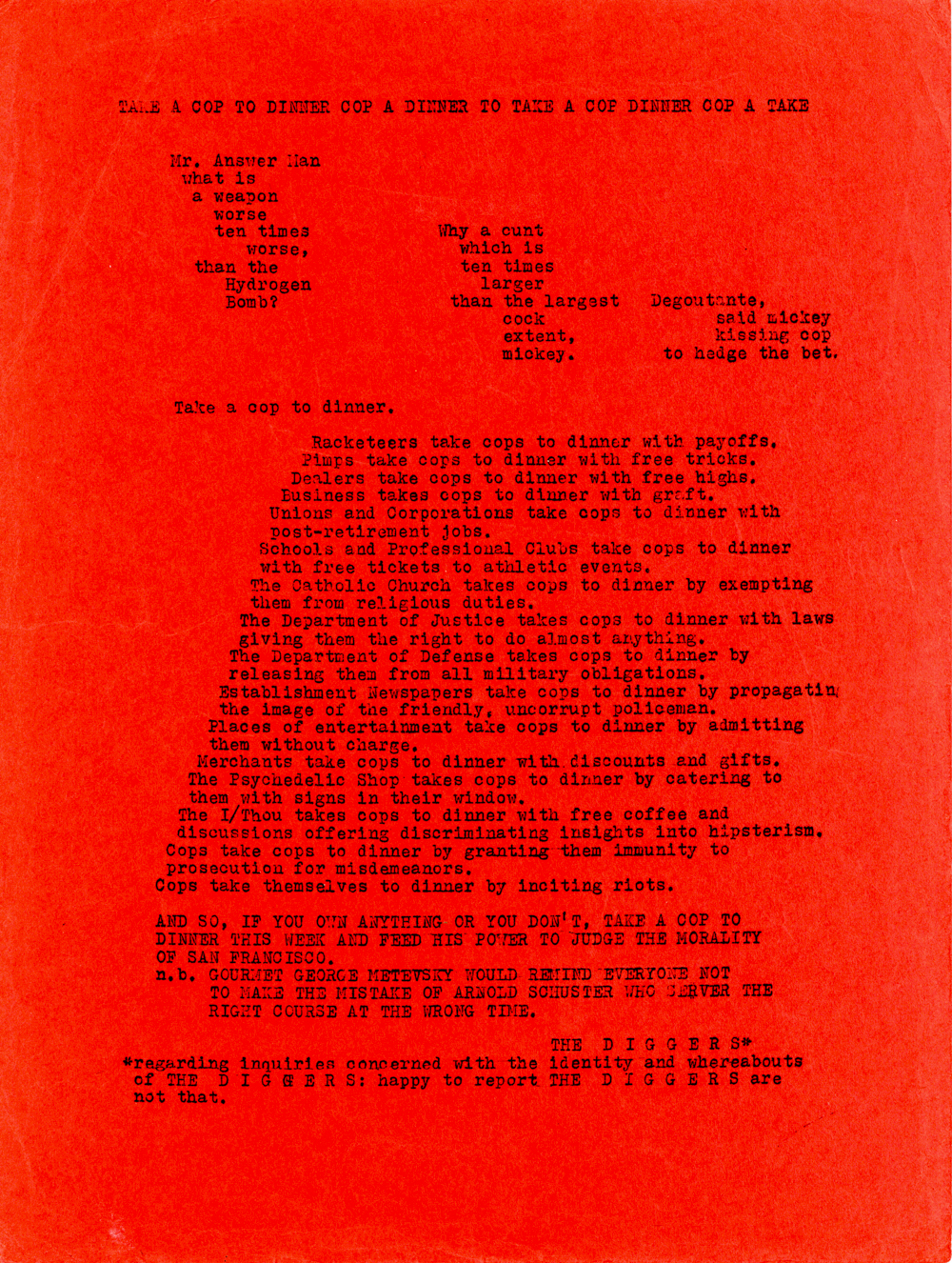
Cat. No.: DP-010 Full record BibCit: n.d. ca. 10/1/1966. Broadside. Letter size. The Diggers. Imprint: The D I G G E R S. Collection: SOLA-o. Abstract: Satirizes the many ways society sustains police power. Its refrain, “take a cop to dinner,” becomes a metaphor for the favors, privileges, exemptions, and public myths through which criminals, businesses, churches, government agencies, merchants, and even hip institutions all help legitimize and strengthen the police. Obscene and mocking in tone, the piece argues that police authority is socially fed, not merely legally granted.
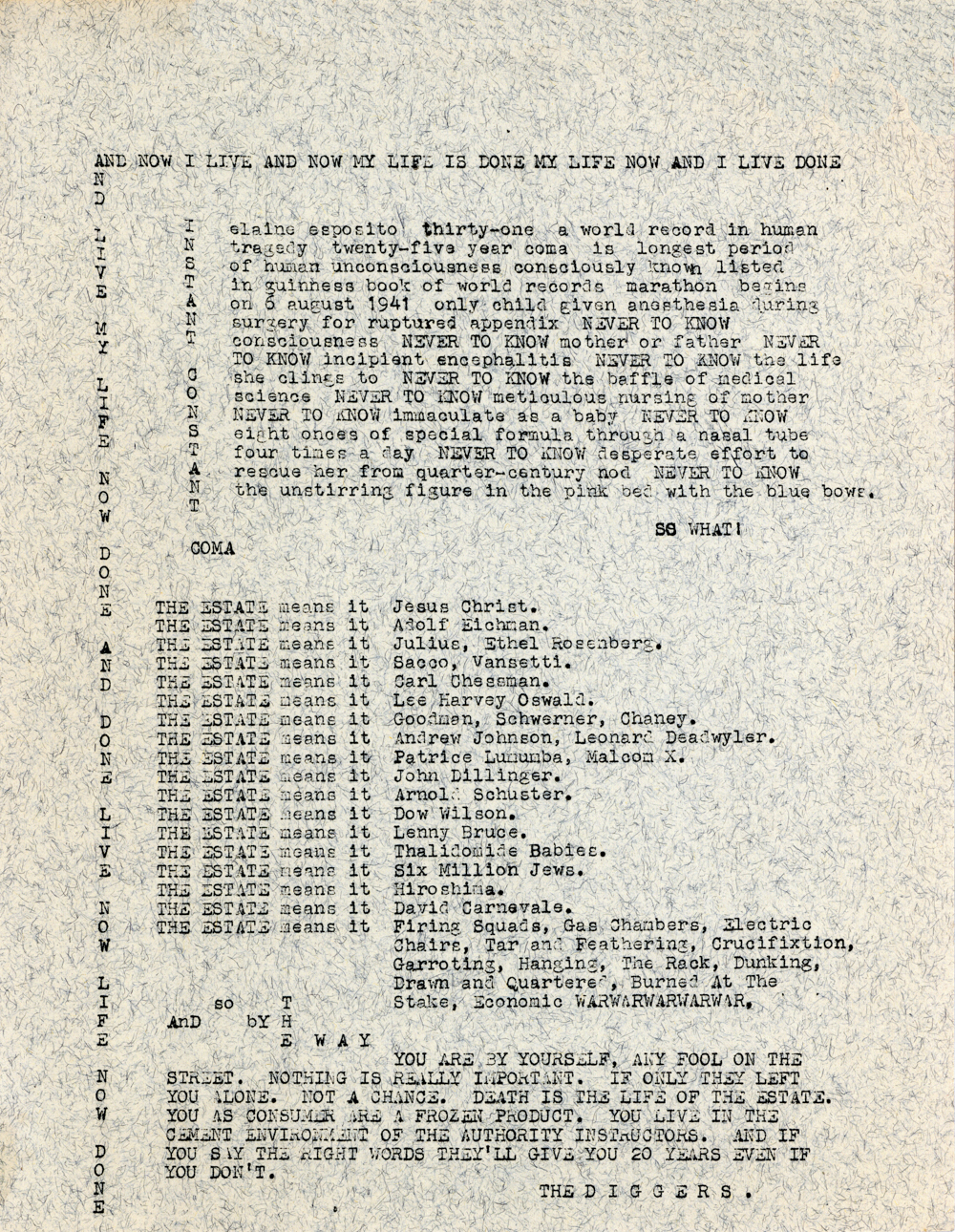
Cat. No.: DP-014 Full record BibCit: n.d., ca. 10/1/1966. Broadside. Letter size. The Diggers. Imprint: The D I G G E R S. Collection: SOLA-o. Abstract: This piece merges tragedy and existential despair to expose how institutional power—“The Estate”—defines life and death in modern civilization. Beginning with Elaine Esposito’s lifelong coma as metaphor, it portrays society itself as an unconscious body sustained by authoritarian systems and consumer conditioning. Through a litany of victims, the text equates political violence and everyday passivity as symptoms of systemic control. The Diggers’ closing declaration is both lament and warning: under “The Estate,” consciousness itself has become captivity.
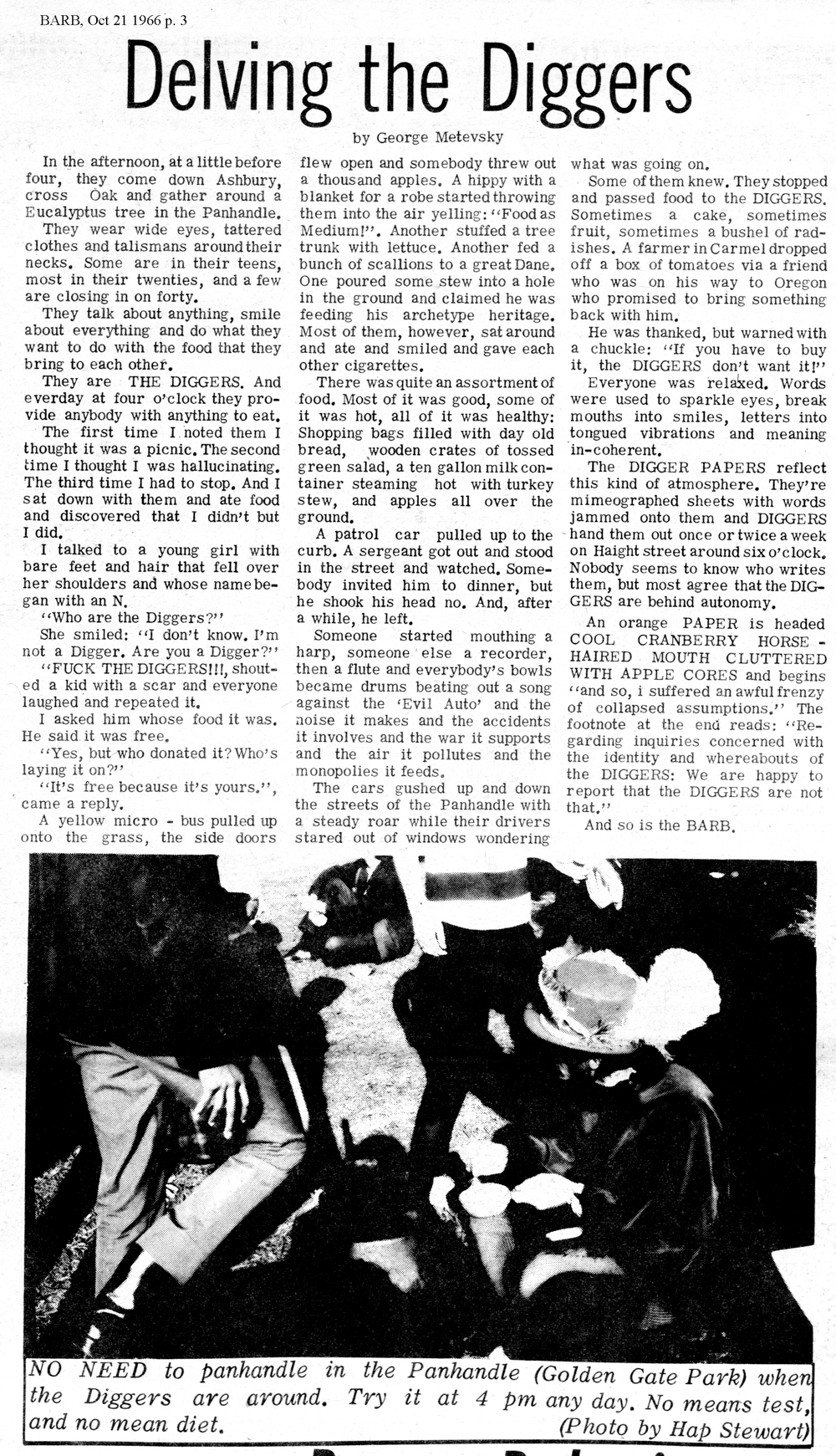
Cat. No.: DP-019 Full record BibCit: By George Metevsky [pseud.]. Berkeley Barb, 10/21/1966, p. 3. Collection: SOLA-x. Abstract: “Delving the Diggers,” published in The Berkeley Barb on October 21, 1966, appears under the byline “George Metevsky,” a pseudonym used by Diggers Emmett Grogan and Billy Murphy to channel insider reportage into the underground press while preserving the group’s anonymity and prankster mystique. The article offers a vivid, first-person account of the Diggers’ daily free food distribution in the Panhandle, presenting their communal meal as both radical generosity and street theater in which “food as medium” becomes a critique of property, scarcity, and commodification. Against a backdrop of music, playful absurdity, and casual exchanges with police and passersby, Metevsky describes an improvised chant and percussion piece directed at the “Evil Auto,” explicitly linking cars to noise, accidents, war, pollution, and monopoly power. This early, performative attack on the automobile foreshadows the Diggers’ emerging deep ecological sensibility, in which their refusal of consumer capitalism broadened into an incipient critique of industrial modernity and its environmental costs. Read in this light, the piece functions as both self-mythologizing manifesto and field report, documenting the Diggers’ fusion of art, activism, and ecological imagination in the early Haight-Ashbury counterculture.
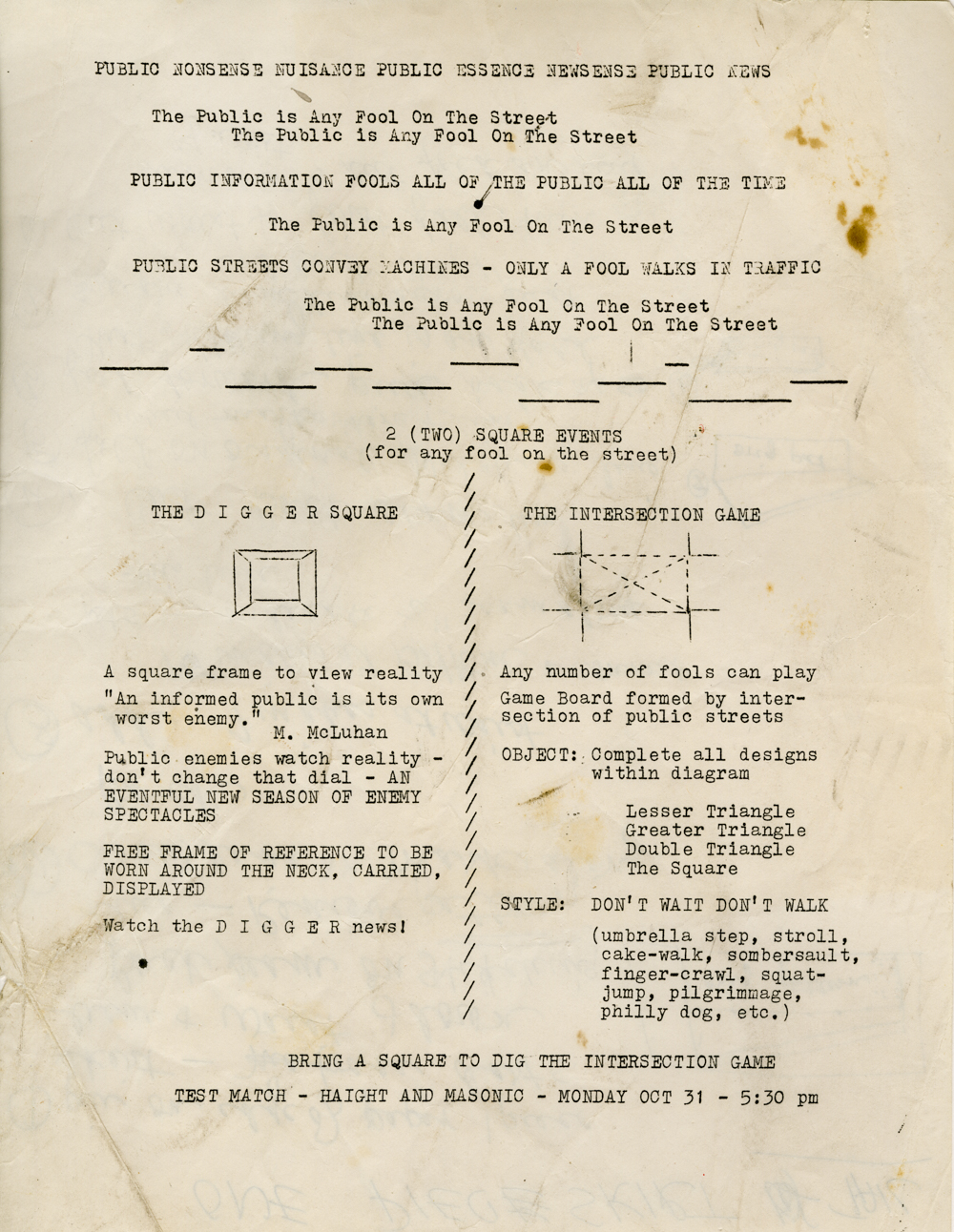
Cat. No.: DP-002 Full record BibCit: 10/31/1966. Broadside. Letter size. San Francisco: The Diggers. Collection: SOLA-x(SS) | SS-x(PB). Abstract: This sheet turns public space into a site of satire and performance, mocking the passive “public” created by media, traffic, and official information. By proposing the “Digger Square” and the “Intersection Game,” it invites people to stop being spectators and instead reframe the street through play, movement, and collective action. The piece treats the city not as a space to be managed and consumed, but as a stage where perception itself can be disrupted and remade. The first Digger street theater (Halloween, 1966).
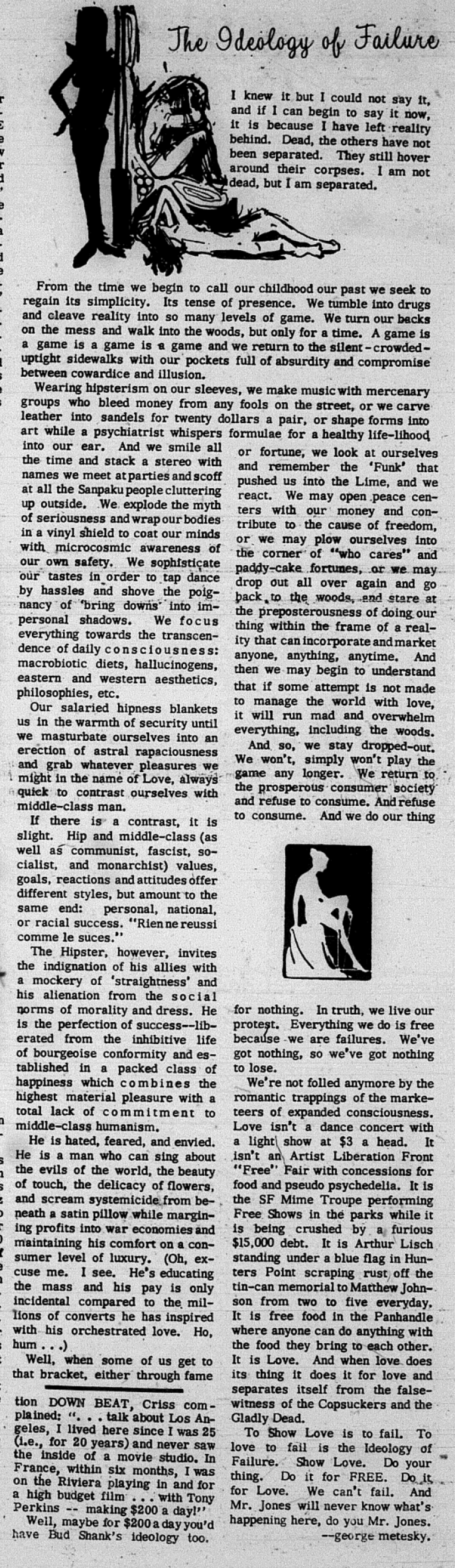
Cat. No.: DP-020 Full record BibCit: By George Metesky [pseud.]. Berkeley Barb, 11/18/1966, p. 6. Collection: SOLA-x. Abstract: This foundational Digger text is both a manifesto and a direct challenge to the “hip” merchants of the Haight-Ashbury, whom the Diggers saw as turning rebellion, consciousness, and even love itself into commodities for sale to the young bohemians fleeing middle-class conformity. Rejecting both straight society and its counterfeit hip counterpart, the piece argues that the culture of success corrupts every style it touches, unless one refuses the game altogether. Its answer is the “ideology of failure”: to do one’s thing for free, for love, and outside the marketplace. In that sense, the broadside throws down the gauntlet by defining authentic countercultural practice against the commercialized pseudo-radicalism that was already overtaking the Haight. That framing also helps show why the text was so foundational: it does not merely criticize hypocrisy in general, but identifies a concrete enemy within the emerging counterculture itself.
"And so, we stay dropped-out. We won't, simply won't play the game any longer. We return to the prosperous consumer society and refuse to consume. And refuse to consume. And we do our thing for nothing. In truth, we live our protest. Everything we do is free because we are failures. We've got nothing to lose, so we've got nothing to lose. We're not fooled anymore by the romantic trappings of the marketeers of expanded consciousness. Love isn't a dance concert with a light show at $3 a head. It isn't an Artist Liberation Front 'Free' Fair with concessions for food and pseudo psychedelia. It is the SF Mime Troupe performing Free Shows in the parks while it is being crushed by a furious $15,000 debt. It is Arthur Lisch standing under a blue flag in Hunters Point scraping rust off the tin-can memorial to Matthew Johnson from two to five everyday. It is free food in the Panhandle where anyone can do anything with the food they bring to each other. It is Love. And when love does its thing it does it for love and separates itself from the false-witness of the Copsuckers and the Gladly Dead. ... To Show Love is to fail. To love to fail is the Ideology of Failure. Show Love. Do your thing. Do it for FREE. Do it for Love. We can't fail."
Note: See the letter to Innerspace Magazine for an explanation of the Metesky pseudonym. This explains that all articles signed "George Metesky" or "Zapata" are to be considered Digger Papers.
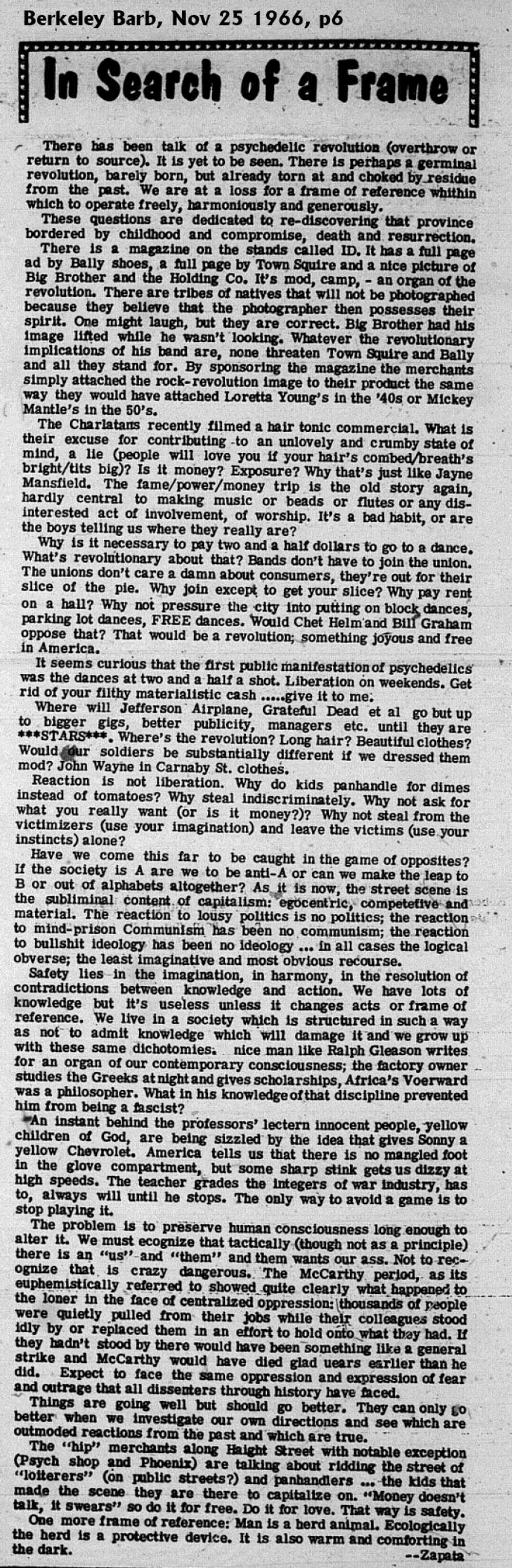
Cat. No.: DP-021 Full record BibCit: By Zapata [pseud.]. Berkeley Barb, 11/25/1966, p. 6. Collection: Bell & Howell. Abstract: This essay is a sharp Digger critique of the emerging psychedelic scene as it drifted toward commodification, celebrity, and empty reaction. Rejecting both the “hip” merchants of Haight Street and the pay-to-enter culture of psychedelic dances, it calls instead for a genuinely liberatory social frame grounded in free action, imagination, mutual aid, and collective resistance to capitalist and authoritarian structures. The piece argues that true revolution requires more than anti-establishment style or posture: it demands a transformed “frame of reference” that aligns knowledge with action and replaces competition, materialism, and passive complicity with love, courage, and communal solidarity.
Zapata frames the problem as a search for a new moral and social orientation, insisting that the existing counterculture is still trapped in “the game of opposites” and lacks “a frame of reference within which to operate freely, harmoniously and generously.” The essay contrasts false liberation—“Liberation on weekends”—with a deeper transformation rooted in imagination, free action, and solidarity. Its closing formulations are especially striking: “The only way to avoid a game is to stop playing it,” “Do it for free. Do it for love,” and “Man is a herd animal,” not as a call to conformity, but as an ecological and emotional argument for communal protection and warmth.
Note: See the letter to Innerspace Magazine for an explanation of the Zapata pseudonym. This explains that all articles signed "George Metesky" or "Zapata" are to be considered Digger Papers.
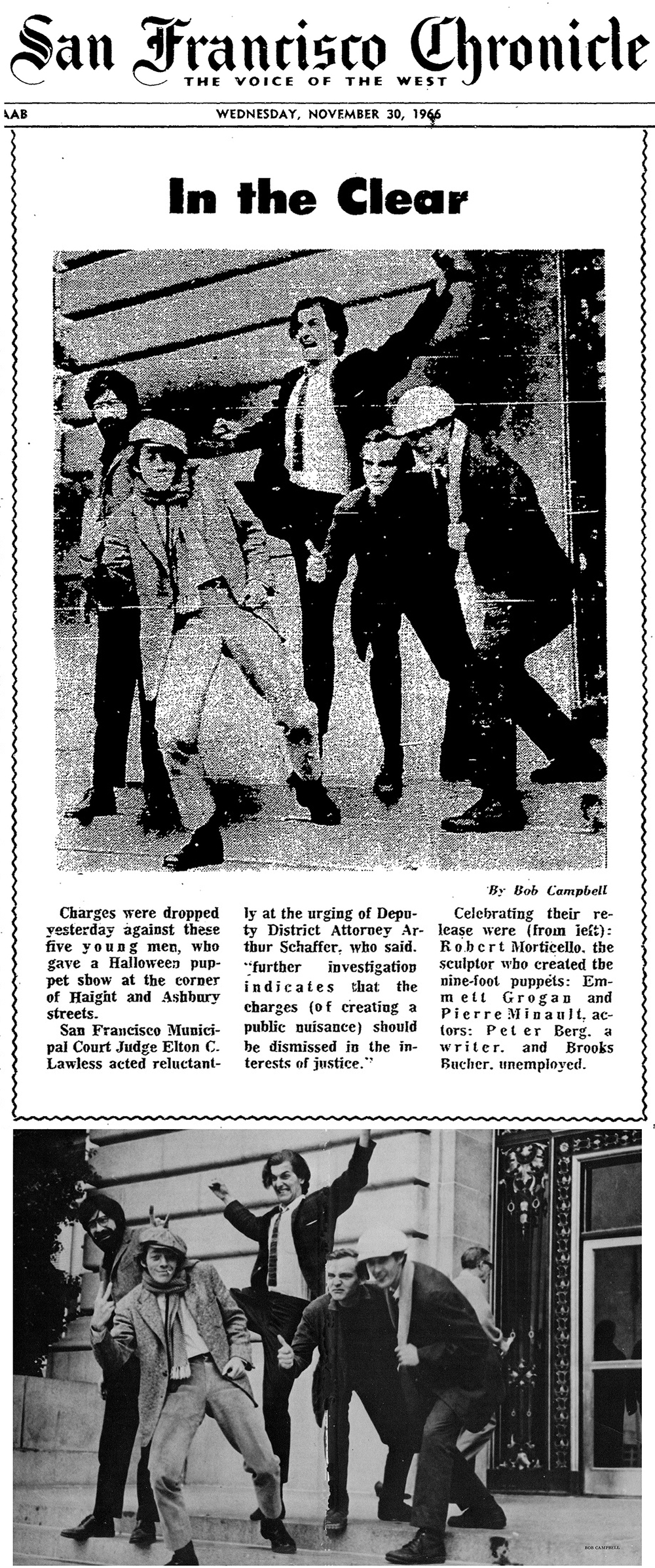
Cat. No.: DR-008 Full record BibCit: San Francisco Chronicle, 11/30/1966, p. 1. Abstract: This San Francisco Chronicle clipping, which appeared above the fold on the front page, records the dismissal of public nuisance charges against five Diggers arrested during the Intersection Game, staged at Haight and Ashbury on Halloween. The event has acquired a certain founding mystique as the first Digger street theater action, apart from the Panhandle free feeds that had begun a month earlier. The photograph names the released participants—Robert Morticello (the sculptor whose nine-foot tall puppets were part of the street theater), Emmett Grogan, Pierre Minault, Peter Berg, and Brooks Bucher—celebrating outside court. In one compact newspaper item, the clipping captures the early Digger fusion of theater, public space, police confrontation, and media visibility.
Emmett Grogan later gave this Chronicle photograph its own afterlife in Ringolevio. He wrote that the gesture he was making in the photograph was not the peace sign but a backwards V-sign, understood by the English and Irish as “Up Your Ass,” equivalent to the American raised middle finger. According to Grogan, after the photograph appeared on the front page, people in the Haight began greeting him with the forward-facing V-sign and saying “Peace, brother,” converting his intended obscene gesture into part of the local folklore surrounding the counterculture peace sign. (Ringolevio, p. 253)
Note: The presiding judge’s name, Elton C. Lawless, gives the clipping an unintended comic irony: the Diggers, arrested for disordering public space, were released under the authority of Judge Lawless.
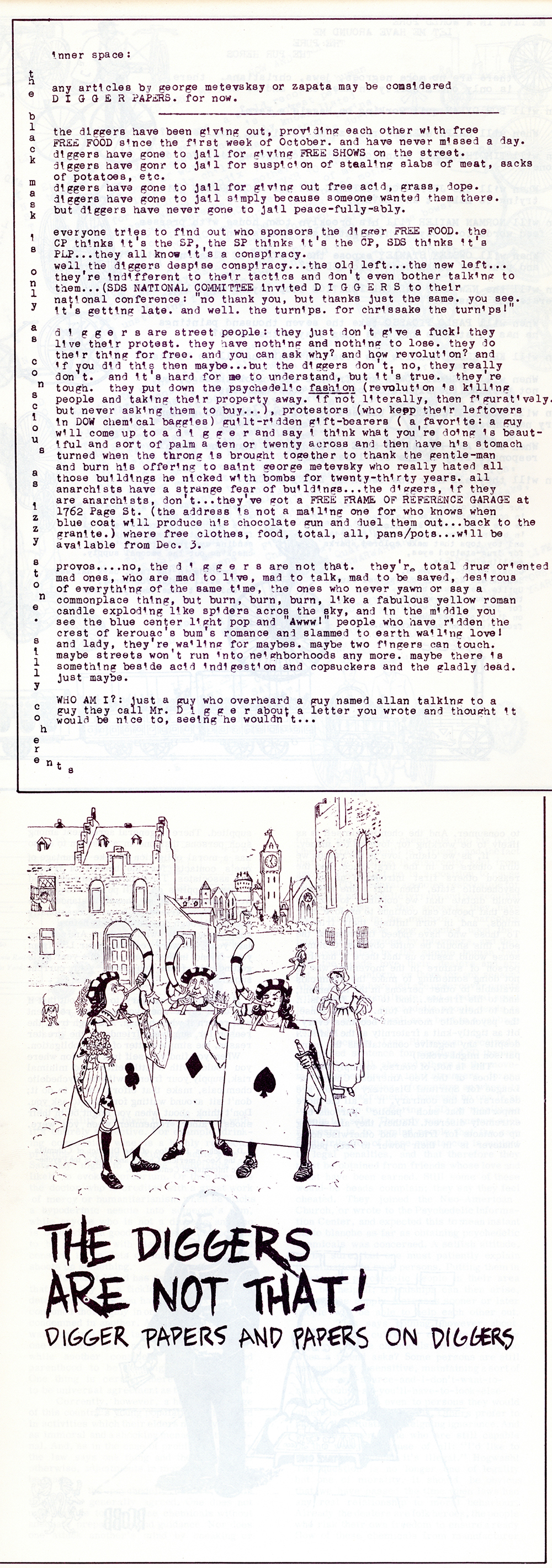
Cat. No.: DP-022 Full record BibCit: Innerspace Magazine, ca. 12/1/1966, vol. 1, no. 3 (December 1966). Collection: SOLA-o. Abstract: This letter is both a declaration and a performance: it identifies the writings of “Metevsky” and “Zapata” as Digger papers, then defines the Diggers not as a political sect or ideological faction but as people who “live their protest” through free action in the street. It catalogs their public practices—free food, free shows, free drugs, arrests, refusal of respectable behavior—and sharply rejects the frameworks through which others try to explain them, whether Old Left, New Left, SDS, or conspiracy politics. The Diggers are presented as indifferent to doctrine and organization, committed instead to immediacy, risk, and a lived revolution grounded in giving things away, refusing commodification, and collapsing the distance between idea and act.
At the same time, the piece is mythmaking in a distinctly Digger register: funny, confrontational, improvisational, and ecstatic. It mocks money, protest pieties, and conventional radicalism while celebrating a wild collective energy that is closer to beat prophecy than programmatic politics. The announcement of the “FREE FRAME OF REFERENCE GARAGE” gives this vision a concrete social form, a place where free goods and free relations might actually be practiced. In its closing passage, borrowing and transforming Kerouac’s language, the letter casts the Diggers as burning figures of desire and refusal, driven not by certainty but by possibility: that “maybe two fingers can touch,” “maybe streets won’t run into neighborhoods any more,” and “maybe there is something” beyond repression, deadness, and the false choices of the existing order.
Note: "any articles by metevsksy or zapata may be considered D I G G E R PAPERS. for now."
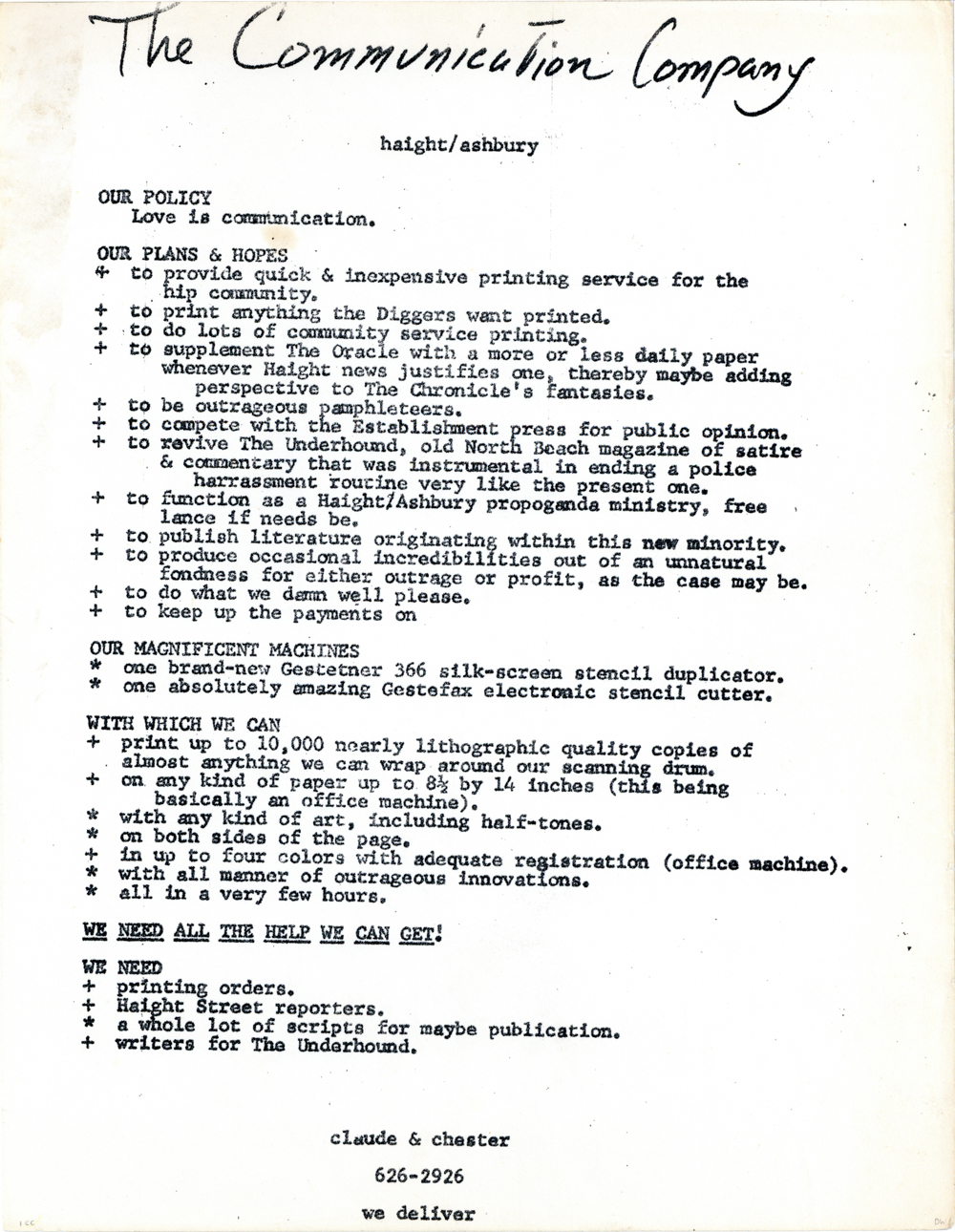
Cat. No.: CC-001 Full record BibCit: By Claude and Chester. n.d., ca. 1/1/1967. Broadside. Letter size. San Francisco: Communication Company. Imprint: CC h/a. Collation: 46LT\bl/wh. Collection: SOLA-o(DW)+2 | SS-o(L)|BL/CA-o. Abstract: Announces the aims of Communication Company. "OUR POLICY| Love is communication.| OUR PLANS & HOPES| to provide quick & inexpensive printing service for the| hip community.| to print anything the Diggers want printed.|.| to be outrageous pamphleteers.|.." "OUR MAGNIFICENT MACHINES .. WITH WHICH WE CAN .. WE NEED ALL THE HELP WE CAN GET! .. WE NEED .. " Signed "claude & chester | 626-2926 | we deliver".
Note: CC h/a = Communication Company | haight/ashbury Authors: Claude Hayward and Chester Anderson
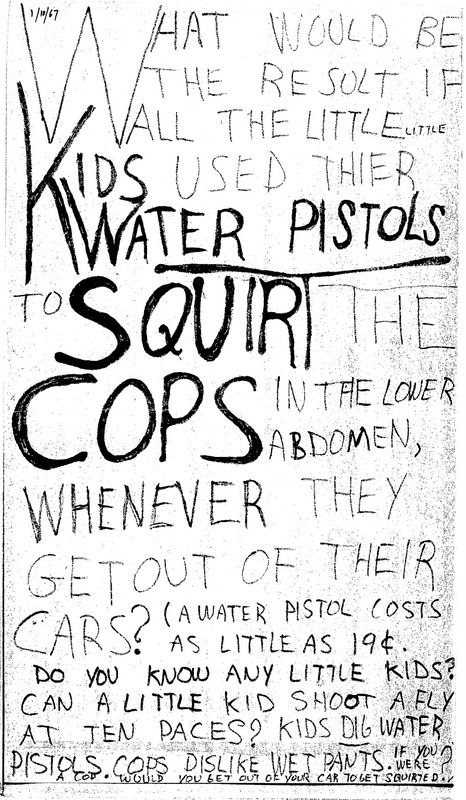
Cat. No.: CC-268 Full record BibCit: 1/10/1967. Broadside. Legal size. San Francisco: Communication Company. Imprint: n/a (presumably com/co). Collation: Hdw. lettering; B/W. Collection: o-BL/CA.
Note: The first [presumably] Communication Company sheet in the Anderson Papers. The date is handwritten, presumably by Chester. Note at BL: Folder 1:1/4. What would be the result if all the little kids used their water pistols (hand dated 1/10/67). (No ComCo imprint.) B.s. Lgl. BL-CAP-Bx-1-Fdr-01-Item-004. See also: DR-001 that explains the context (arrest of four Diggers on Jan. 8, 1967).
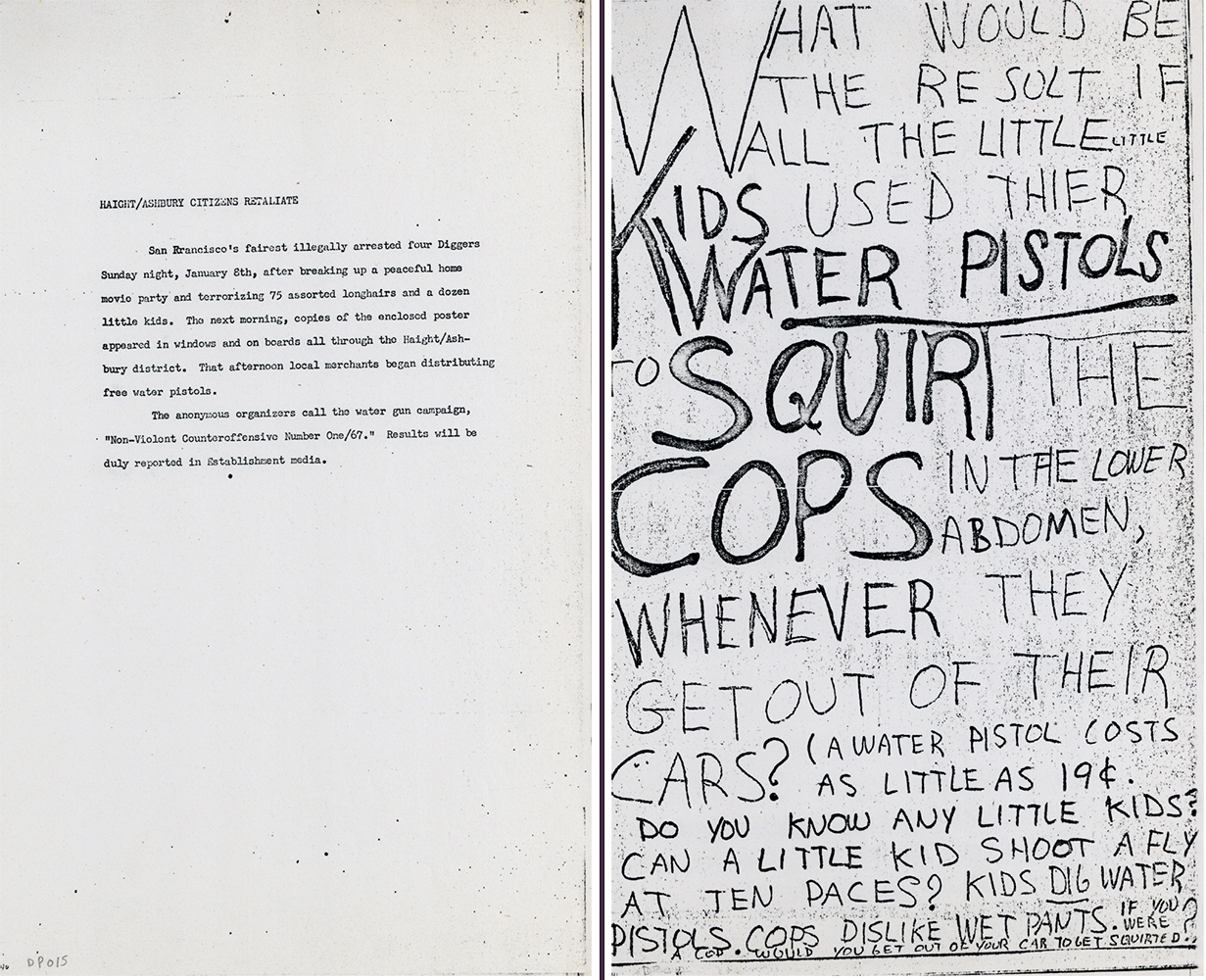
Cat. No.: DR-001a/b Full record BibCit: 1/10/1967. Broadside. Legal size. Collection: SOLA-x. Abstract: This two-part sheet reports on the police arrest of four Diggers after they broke up the W.C. Fields movie night at the Digger free store on Frederick Street, “terrorizing” a gathering of longhairs and children. The accompanying poster turns the incident into street theater, proposing a comic but pointed “Non-Violent Counteroffensive” in which children armed with water pistols would squirt police whenever they got out of their cars. The sheet captures the early Digger gift for converting repression into play, and play into public resistance: a child’s toy becomes a weapon of ridicule against armed authority. It is also a sharp example of how quickly the Haight could answer police intimidation with anonymous, collective, neighborhood-wide wit.
Note: This item is two legal-size sheets, each a broadside. Since Anderson included the second sheet with his archive (at Bancroft Library) it's likely both sheets are ComCo even though there is no ComCo imprint. See CC-268.
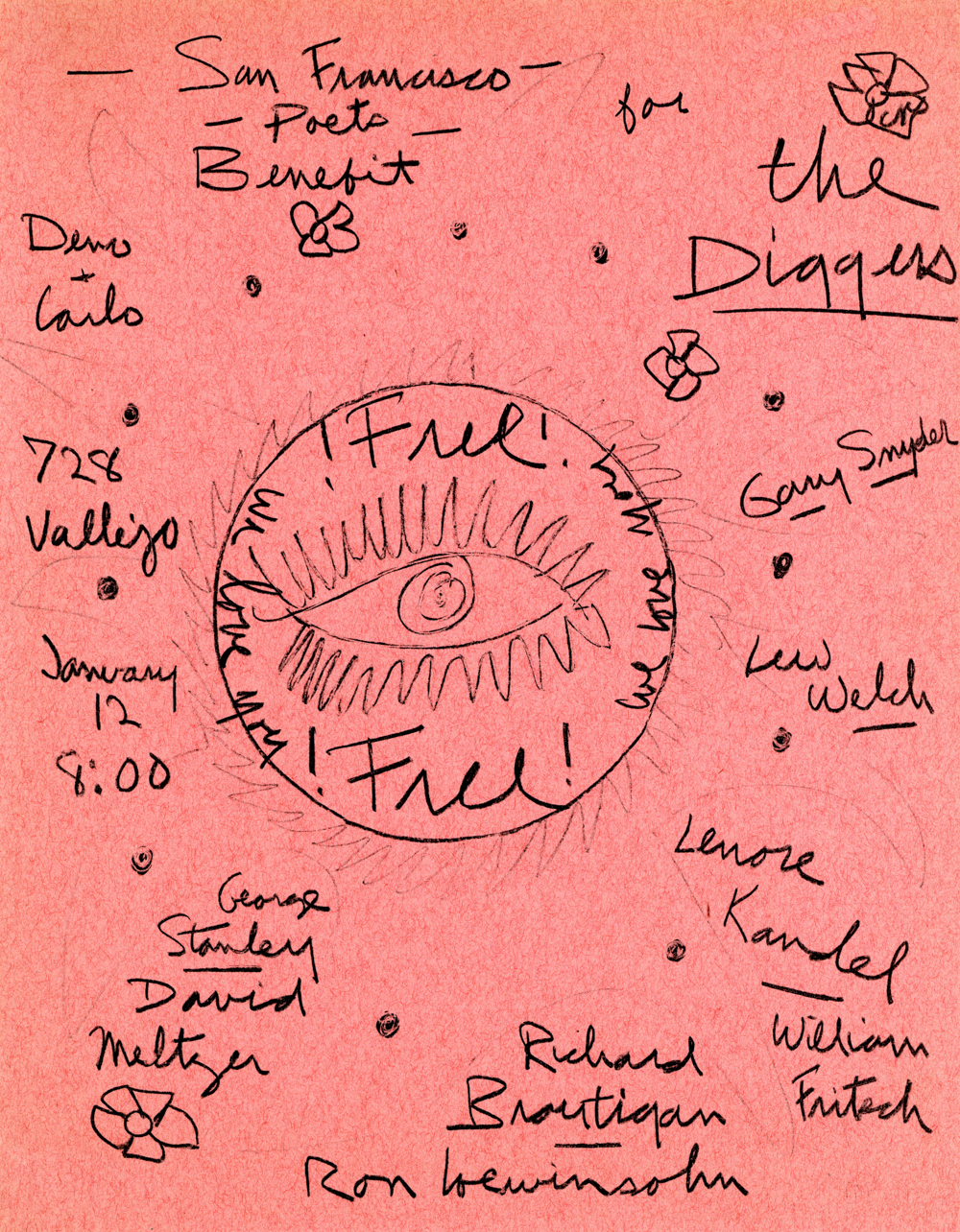
Cat. No.: DR-009 Full record BibCit: 1/12/1967. Broadside. Letter size. Collection: SOLA-o. Abstract: This flyer announces a San Francisco Poets Benefit for the Diggers, held in North Beach on January 12, 1967, in the charged days around the Human Be-In. Emmett Grogan later recalled that the reading began as a gesture of recognition from the poets—among them Richard Brautigan, Gary Snyder, Allen Ginsberg, and others—toward the Diggers’ free work in the Haight. Although the event was advertised as a “benefit,” the Diggers refused the usual logic of fundraising: when a hat was passed, Emmett and Peter Coyote turned the money back over to the bartender to buy drinks for everyone until it ran out. In Grogan’s telling, that was the point: “The only type of benefit that could be thrown for the Diggers is one where everything is free.” (See Ringolevio, p. 277)
Note: This event marked an important moment of mutual recognition between the Beat generation and the Diggers. The Digger street sheet “term paper” (DP-012) stated that “gregory corso’s poem POWER was the sole reason behind the concept of the Diggers: autonomy.” Here the Beats recognized the Diggers as carrying forward something they themselves had helped open up. In the period that followed, a number of Beat poets, writers, and artists became involved in Digger activities, including Gregory Corso, Lenore Kandel, Lew Welch, Kirby Doyle, Diane di Prima, and Richard Brautigan.
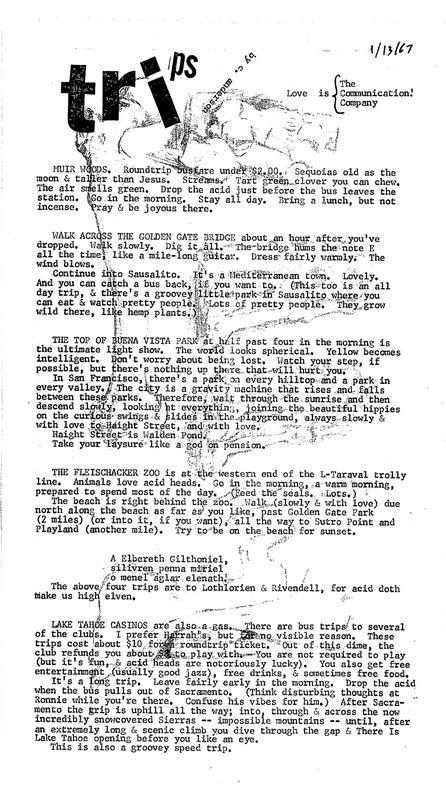
Cat. No.: CC-269 Full record BibCit: By Anderson, Chester. 1/13/1967. Broadside. Legal size. San Francisco: Communication Company. Imprint: The Communication! Company. Collation: Tpw text over watermark of drawing (?).. Collection: o-BL/CA. Abstract: This “trips” sheet is Chester Anderson offering practical suggestions for low-cost Bay Area excursions under the unmistakable influence of LSD-era Haight-Ashbury. The large heading, “trips,” works in both senses: literal day trips out of the neighborhood and psychedelic trips undertaken in motion, landscape, and shared public space. What is striking is how ordinary and visionary the sheet is at the same time. It gives concrete instructions—bus fares, routes, walking times, what to bring, when to go—while recasting the Bay Area as a field of available wonder: Muir Woods, the Golden Gate Bridge, Buena Vista Park, Fleishhacker Zoo, Playland, Lake Tahoe. The sheet is less a tourist guide than a map for altered perception, where fog, wind, bridges, animals, trolleys, cheap transit, and “groovy speed trips” become part of the countercultural commons.
Note: The phrase “The Love is Communication! Company” places it clearly in the early Com/Co style: playful, typographically loose, practical, and intimate. It also shows Chester Anderson’s genius for treating the city and its surrounding geography as an open text to be used, wandered through, and communally reimagined.
Note at BL: Folder 1:1/6. trips by c. anderson (hand dated 1/13/67). [never seen] [list of bay area trippy places.] ComCo. B.s. Lgl. BL-CAP-Bx-1-Fdr-01-Item-006
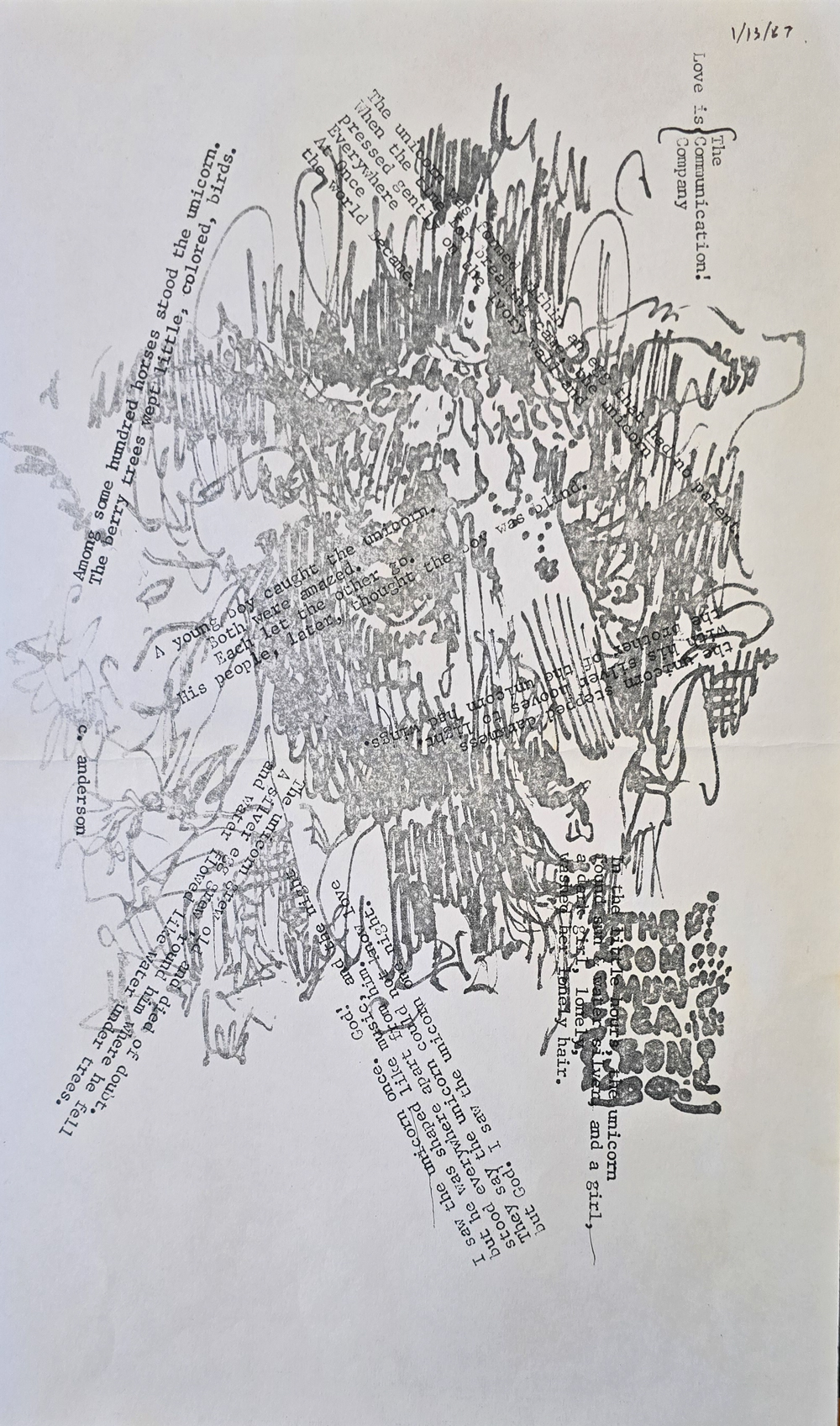
Cat. No.: CC-367 Full record BibCit: By Anderson, Chester. 1/13/1967. Broadside. Legal size. Landscape. San Francisco: Communication Company. Imprint: The Communication! Company. Collation: Tpw text over watermark of drawing (?).. Collection: o-BL/CA. Abstract: Seven paragraphs of prose/poetry on theme of the unicorn
Note: Date is hdw (presumably by Chester). Title is block lettered, and author is "by c. anderson."
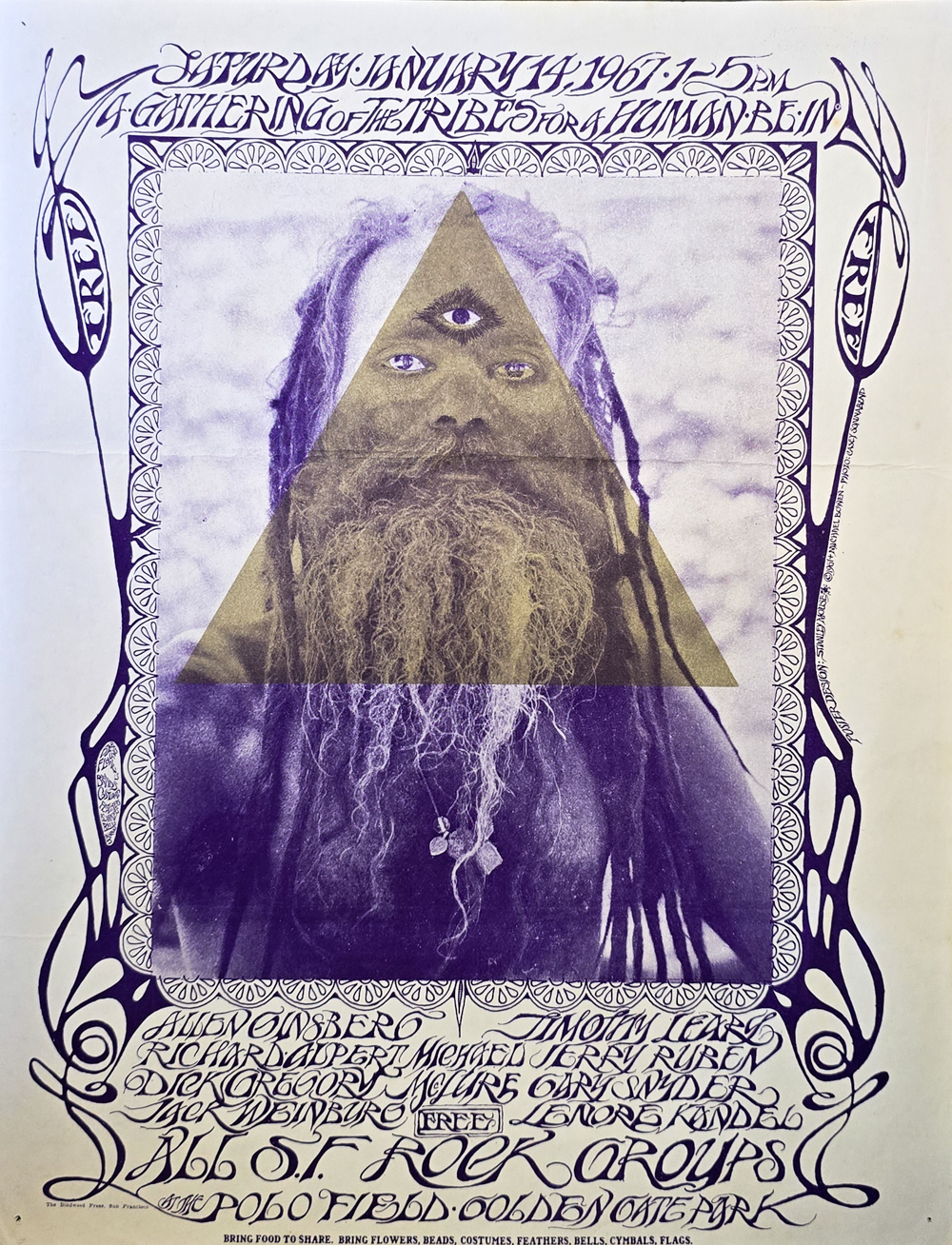
Cat. No.: CC-x02 Full record BibCit: 1/14/1967. Broadside. Lt.. Collection: BL/CAP-o. Abstract: Be-In handbill (the third-eyed Saddhu in purple by Stanley Mouse).
Note: One of the non-Communication Company items that Chester Anderson included in the first packet he sent to his archivist in Florida.
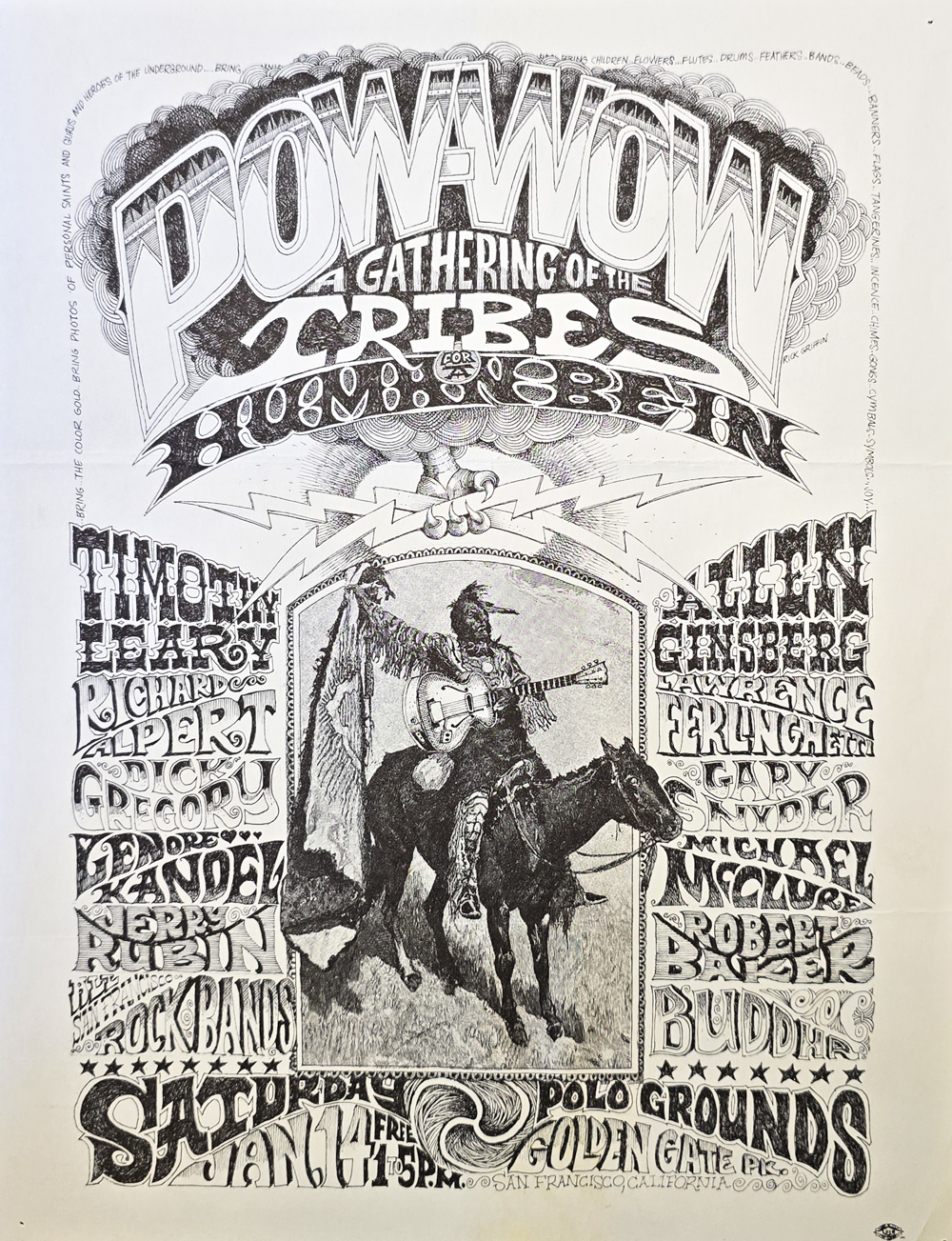
Cat. No.: CC-x03 Full record BibCit: 1/14/1967. Broadside. Lt.. Collection: BL/CAP-o. Abstract: Be-In handbill (the Indian on horeseback with guitar in b/w by Rick Griffin).
Note: One of the non-Communication Company items that Chester Anderson included in the first packet he sent to his archivist in Florida.
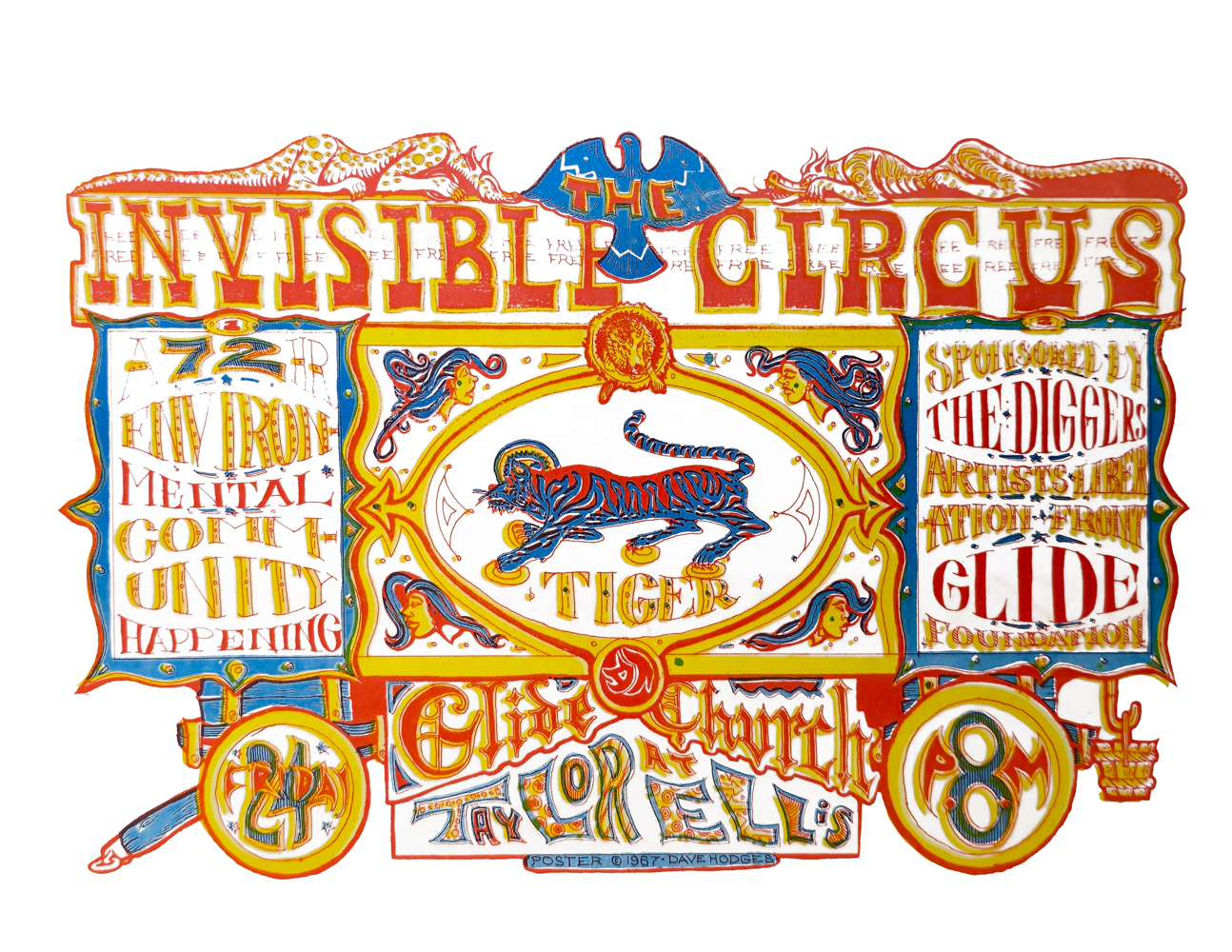
Cat. No.: CC-x07 Full record BibCit: 1/14/1967. Broadside. Lt.. Collation: printed landscape. Collection: BL/CAP-o. Abstract: 1:2/1. 8-1/2" x 11" version of the Invisible Circus poster. On back is hand-drawn map to a location on Graton Rd past Occidental Rd in Sonoma County. "Beecher on mailbox".
Note: One of the non-Communication Company items that Chester Anderson included in the second packet he sent to his archivist in Florida. (February packet.)
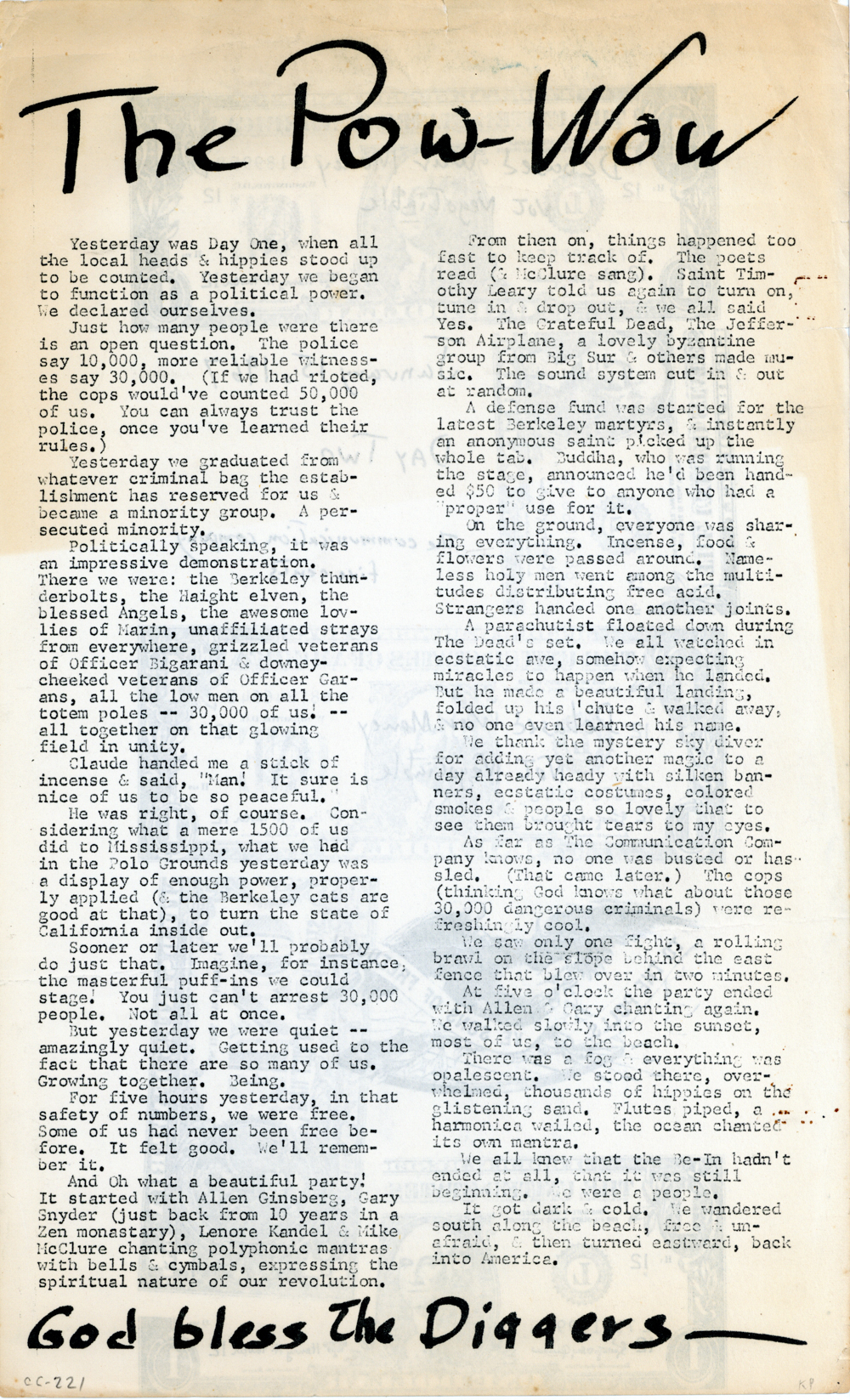
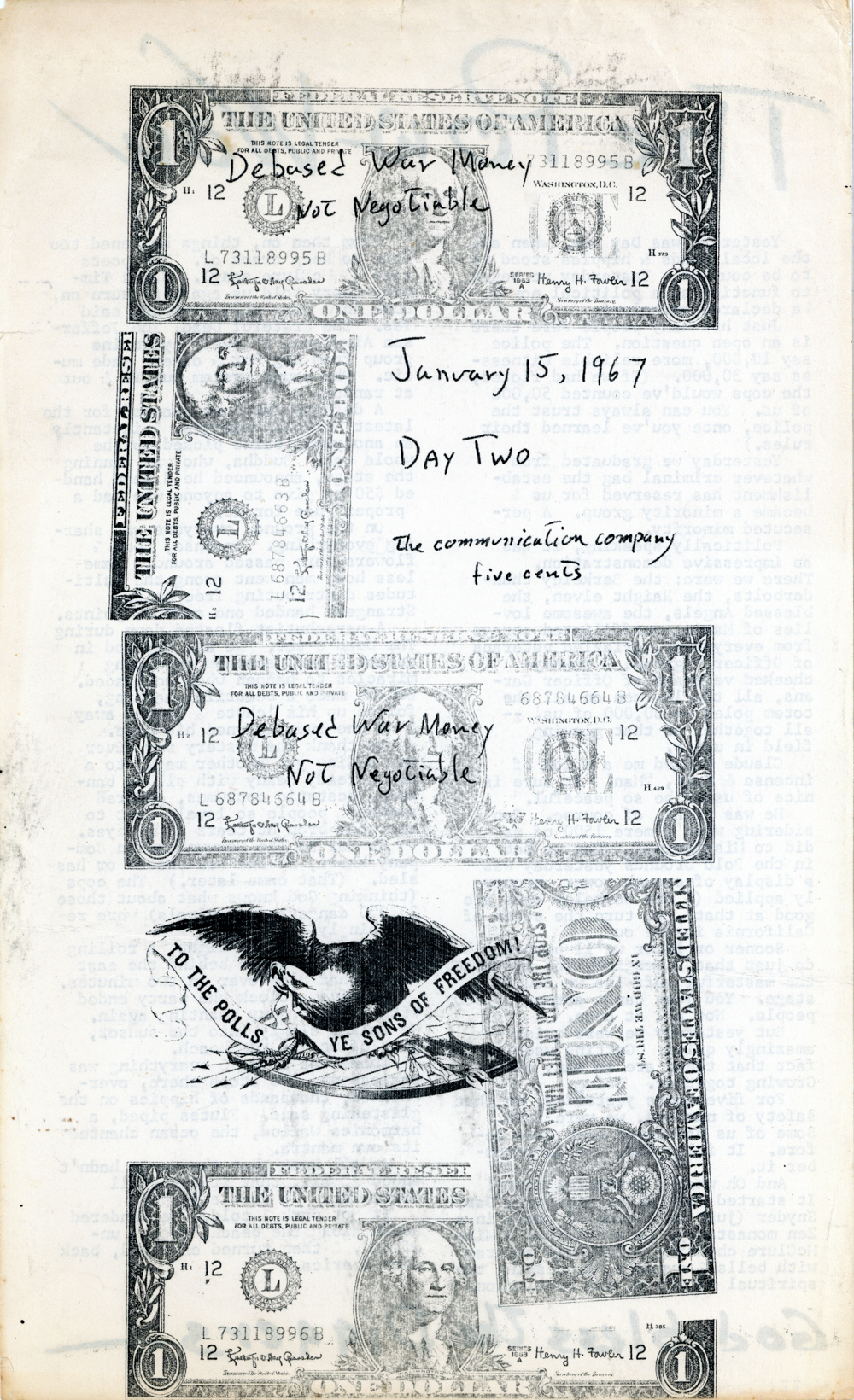
Cat. No.: CC-221a Full record BibCit: By [Anderson, Chester]. 1/15/1967. Broadsheet. Legal size. San Francisco: Communication Company. Imprint: the communication company. Collation: Title and footer in hand letters.. Collection: SOLA-o(KP) | o-BL/CA(variant).
Note: r.s.: Photo-repro of 5 dollar bills with lettering, "Debased War Money | Not Negotiable". On BL/A copy, on R.S. there is the following twp note:
we were going to start a daily newspaper, & this was to be in the first issue, but we ran out of ink. By the time we had more ink, we realized that, both being new to the scene, we didn't have the reportorial staff & community cooperation needed for a daily paper, so we're still [underlined] going to start one someday.
There were more than 25,000 hippies present, turning on & happy at the Human Be-In. The poster for the Be-In, included herewith, is typical Haight/Ashbury poster art. Now very famous, all these hippie posters.
(The myster sky diver, it turns out, was Owsley Stanley, San Francisco's major manufacturer of black market acid.)
Cat. No.: CC-221b Full record BibCit: 1/15/1967. Broadsheet. Legal size. San Francisco: Communication Company. Imprint: the communication company. Collection: SOLA-o(KP).
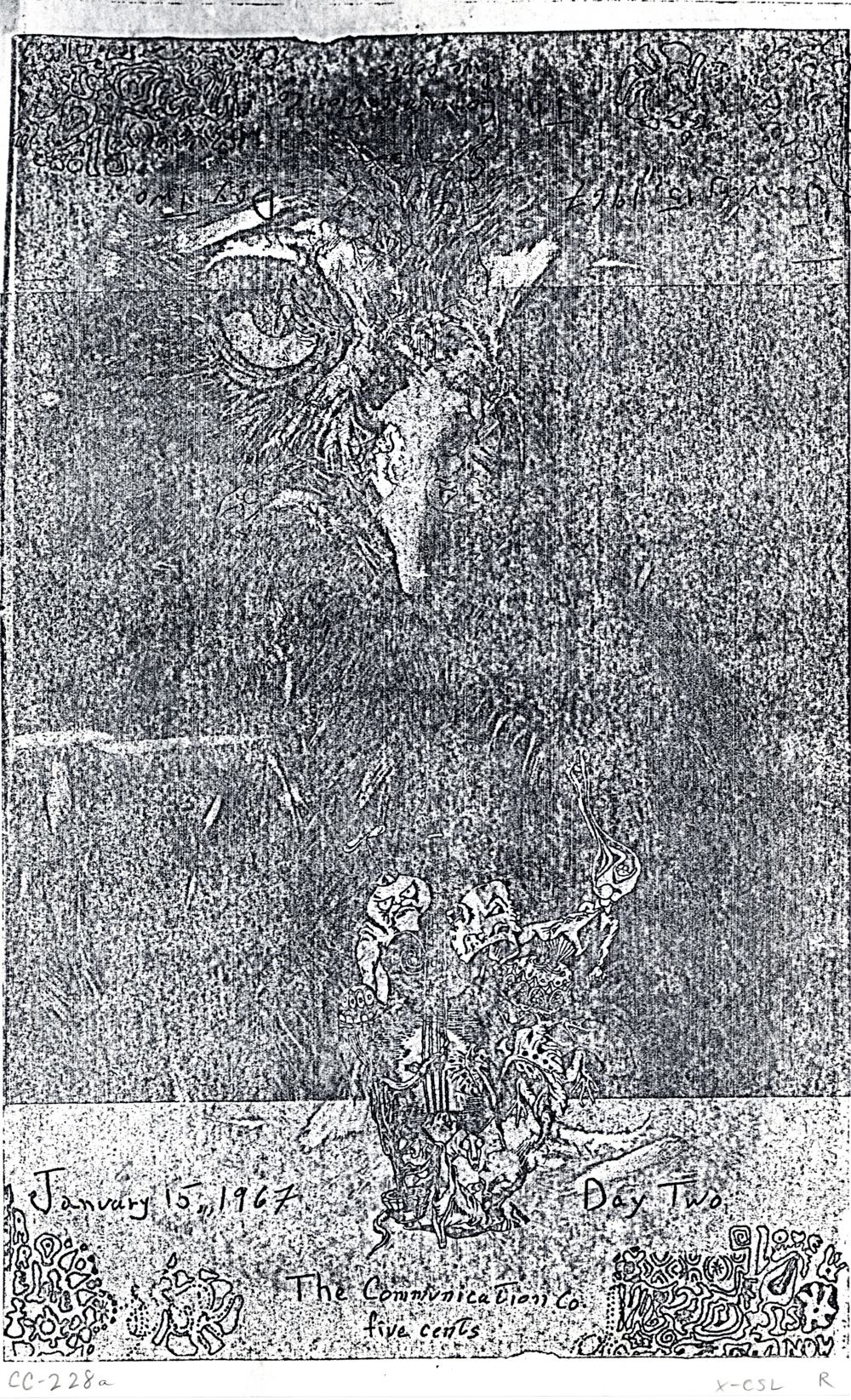
Cat. No.: CC-228 Full record BibCit: 1/15/1967. Broadsheet. Legal size. San Francisco: Communication Company. Imprint: Com Co.. Collection: SOLA-x(CSL).