Including Ephemera, Broadsides, Posters, Street Sheets, Collections, etc. for the
San Francisco Diggers, Communication Company, Free City Collective,
Kaliflower Intercommunal Network, Free Print Shop, Planetedge Manifestation,
Earth/Life Defense Commune, &c.
Category = | Keyword = ALL | Group = ALL | Issue = ALL | New = ALL | Followup = ALL | Order = DATE | Search = EMPTY | Records = 1309 | Page = 32 of 53 [Browsing category-filtered records]
Click thumbnail for large size. Click again to return.
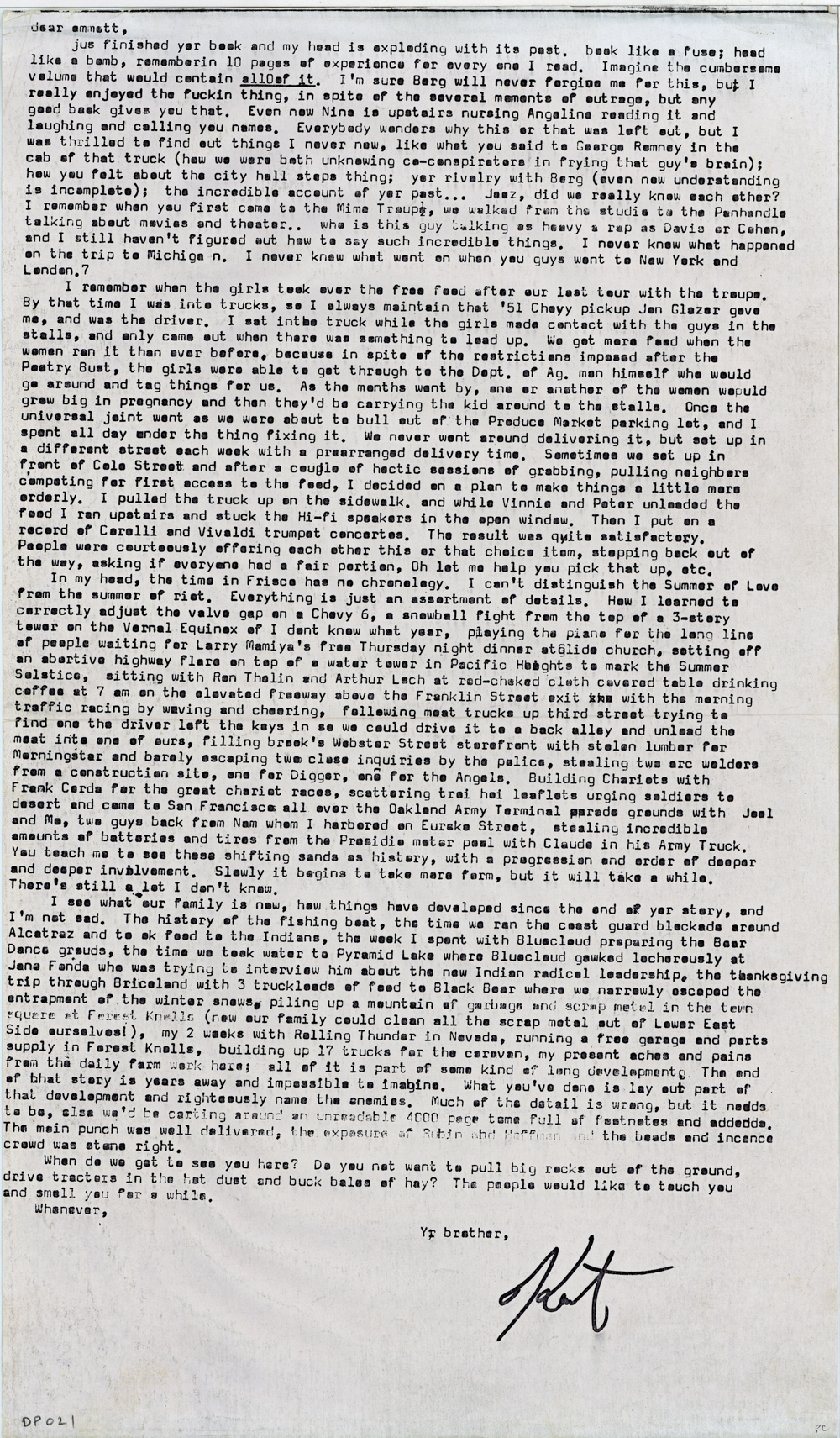
Cat. No.: DP-015 Full record BibCit: n.d., ca. 6/1/1972. Manuscript. Legal size. Collation: Typescript; one page. Collection: SOLA-x(PB). Abstract: This 1972 letter from Kent to Emmett is both a response to Ringolevio and a torrent of memory released by reading it. Kent writes with affection, irritation, and recognition, saying that Emmett’s book has given shape to a period that in his own mind had “no chronology,” only an immense accumulation of scenes: free food runs, trucks, stolen lumber, chariot races, Morningstar, Black Bear, Alcatraz, Pyramid Lake, Forest Knolls, and the continuing evolution of the Digger family after the end of Emmett’s narrative. The letter is especially valuable because it confirms and complicates the history, noting that “much of the detail is wrong” while also affirming that the “main punch” of the book was right, especially its attack on Rubin, Hoffman, and the commodified beads-and-incense version of the counterculture. Most of all, the letter shows how Ringolevio allowed one of the participants to begin seeing the “shifting sands” of lived experience as history: not a finished story, but part of a long development whose ending was still far away.
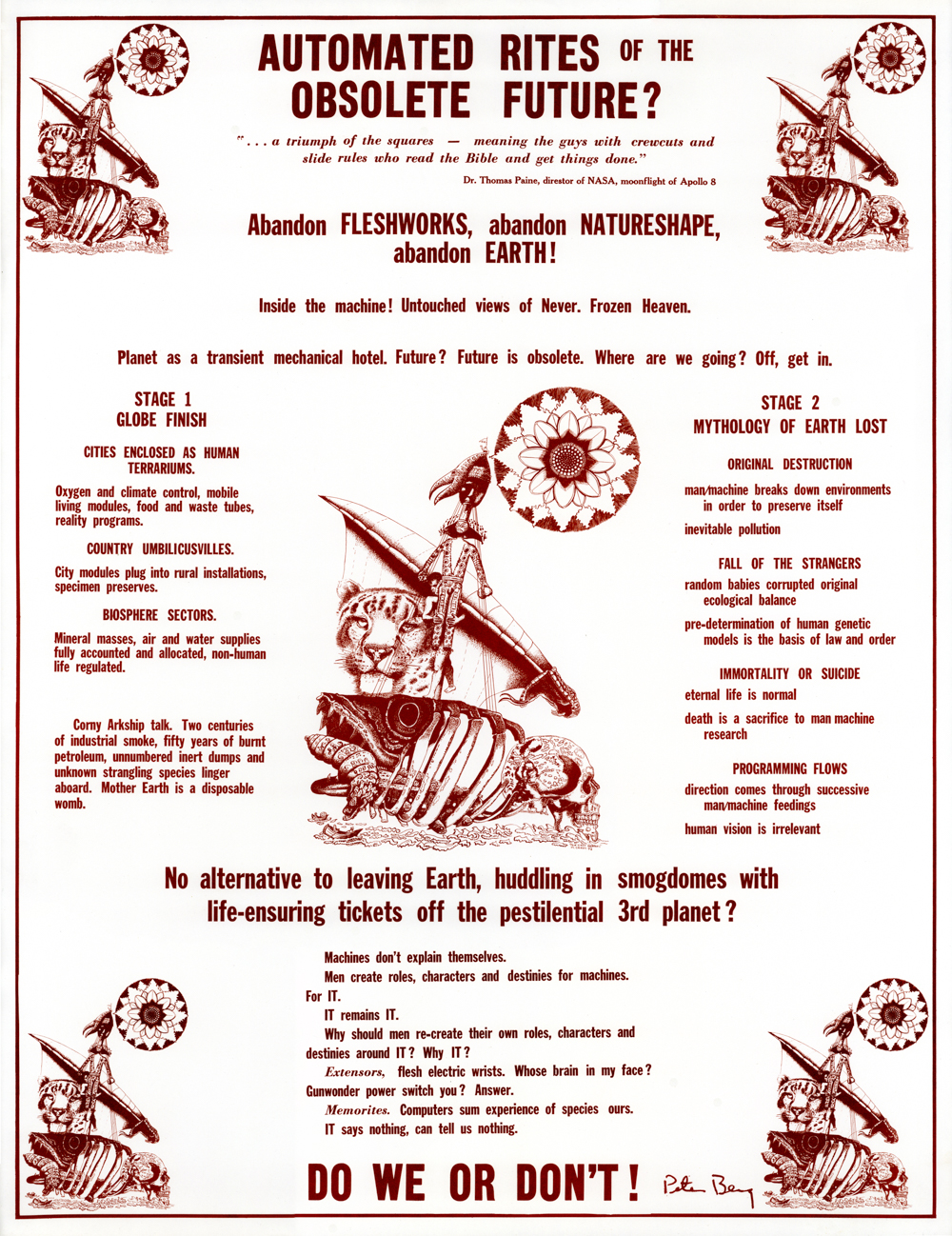
Cat. No.: MI-197206 Full record BibCit: By Berg, Peter. n.d., ca. 6/5/1972. Broadside. 17" x 22". Collection: SOLA-o(PB). Abstract: This poster is a polemic against technological determinism, space-age escapism, and the reduction of human life to systems management. Its two opposing “stages” contrast a mechanized future of climate-controlled cities, resource allocation, industrial waste, and disposable Earth with an older mythic worldview in which human-made systems destroy ecological balance and sacrifice life to the imperatives of “man-machine research.” The repeated totem-like figure, flowers, skeletal forms, and skulls combine psychedelic, occult, and environmental imagery to argue that machines cannot supply meaning, purpose, or human destiny; the emphatic closing question—“DO WE OR DON’T!”—demands that people reclaim responsibility for shaping their own future.
Note: “Automated Rites of the Obsolete Future?” was Peter Berg’s first writing that he signed after his Digger involvement. He carried it to the United Nations Conference on the Human Environment in Stockholm in June 1972. Addressed to the era’s faith in expert planning, automation, and space-age escape, the poster rejects the idea that ecological catastrophe can be managed through technological containment or by treating Earth as disposable. It anticipates Berg’s later bioregional argument that meaningful environmental response begins with human responsibility to the living place one inhabits.