Including Ephemera, Broadsides, Posters, Street Sheets, Collections, etc. for the
San Francisco Diggers, Communication Company, Free City Collective,
Kaliflower Intercommunal Network, Free Print Shop, Planetedge Manifestation,
Earth/Life Defense Commune, &c.
Category = | Keyword = ALL | Group = ALL | Issue = ALL | New = ALL | Followup = ALL | Order = DATE | Search = EMPTY | Records = 1309 | Page = 22 of 53 [Browsing category-filtered records]
Click thumbnail for large size. Click again to return.
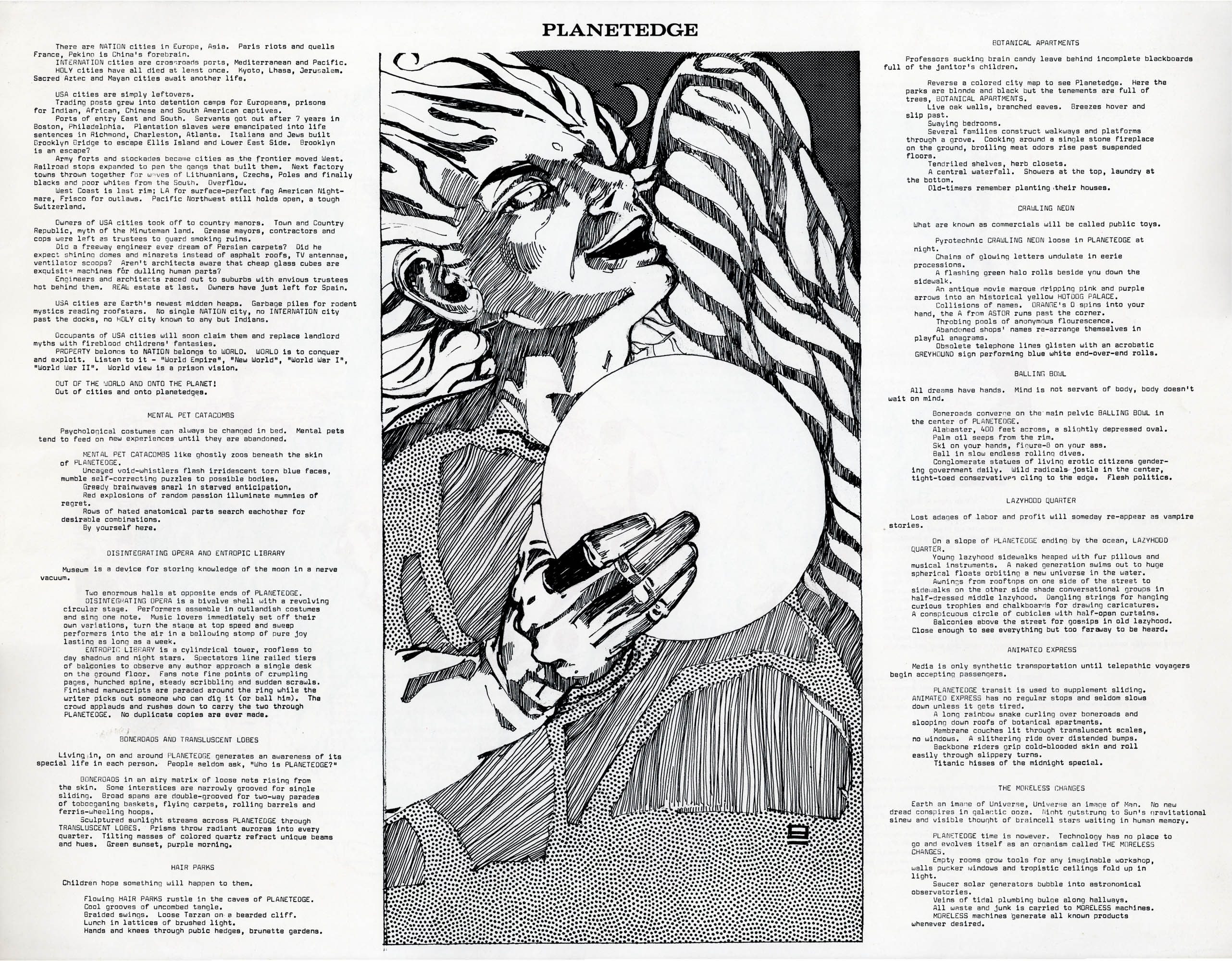
Cat. No.: PE-01-r Full record BibCit: n.d., ca. 12/1/1969. Broadside. 17" x 22". Collection: SOLA-o(PB). Abstract: PLANETEDGE is a densely printed black-and-white visionary poster that imagines a strange post-catastrophic society through a series of mock civic, architectural, and social descriptions. Centered on an expressionistic illustration of a long-haired figure clutching a large globe, the composition is surrounded by typed sections describing places and institutions such as “Botanical Apartments,” “Crawling Neon,” “Balling Bowl,” “Lazyhood Quarter,” and “The Moreless Changes.” Its language combines utopian planning, surreal bureaucracy, countercultural communalism, environmental fantasy, and deadpan dystopian humor, presenting Planetedge as a fragmented future world of abandoned cities, improvised dwellings, altered bodies, collective rituals, and unstable technology.
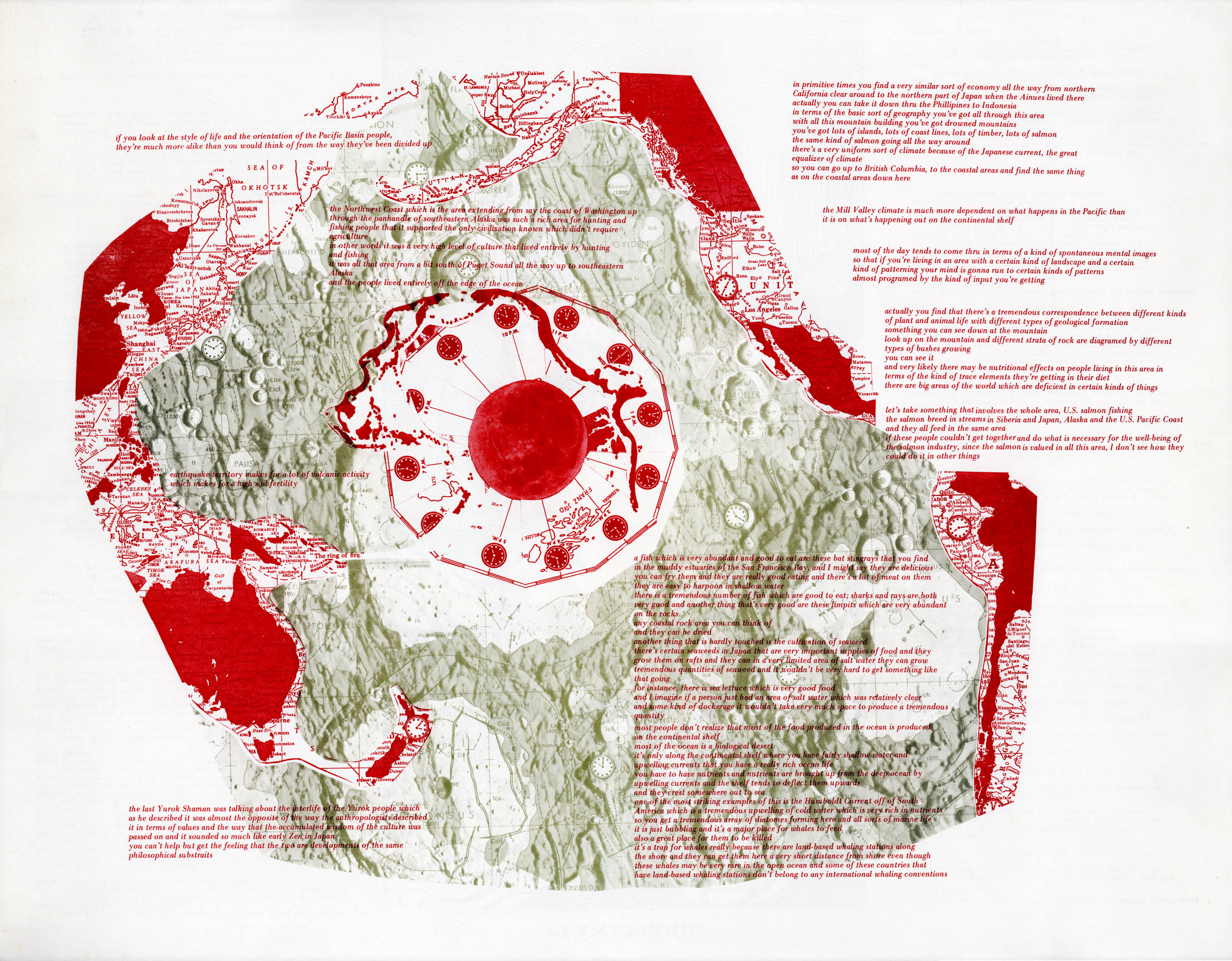
Cat. No.: PE-01-v Full record BibCit: n.d., ca. 12/1/1969. Broadside. 17" x 22". Collection: SOLA-o(PB). Abstract: A visual manifesto centered on a map of the Pacific Rim, extending from East Asia and the western Pacific across Alaska and the Pacific Northwest to California and the Americas. Dense red cartographic detail, place names, coastal outlines, route lines, and diagrams surround a mottled green landmass and a prominent circular, eye-like or cellular image at the center. Typewritten passages distributed around the map consider Pacific geography, climate, fishing, land use, regional interdependence, and the relation between human settlement and ecological systems. The poster treats the Pacific Rim not simply as a geographic region but as a shared planetary environment shaped by currents, migration, resource use, and collective responsibility.
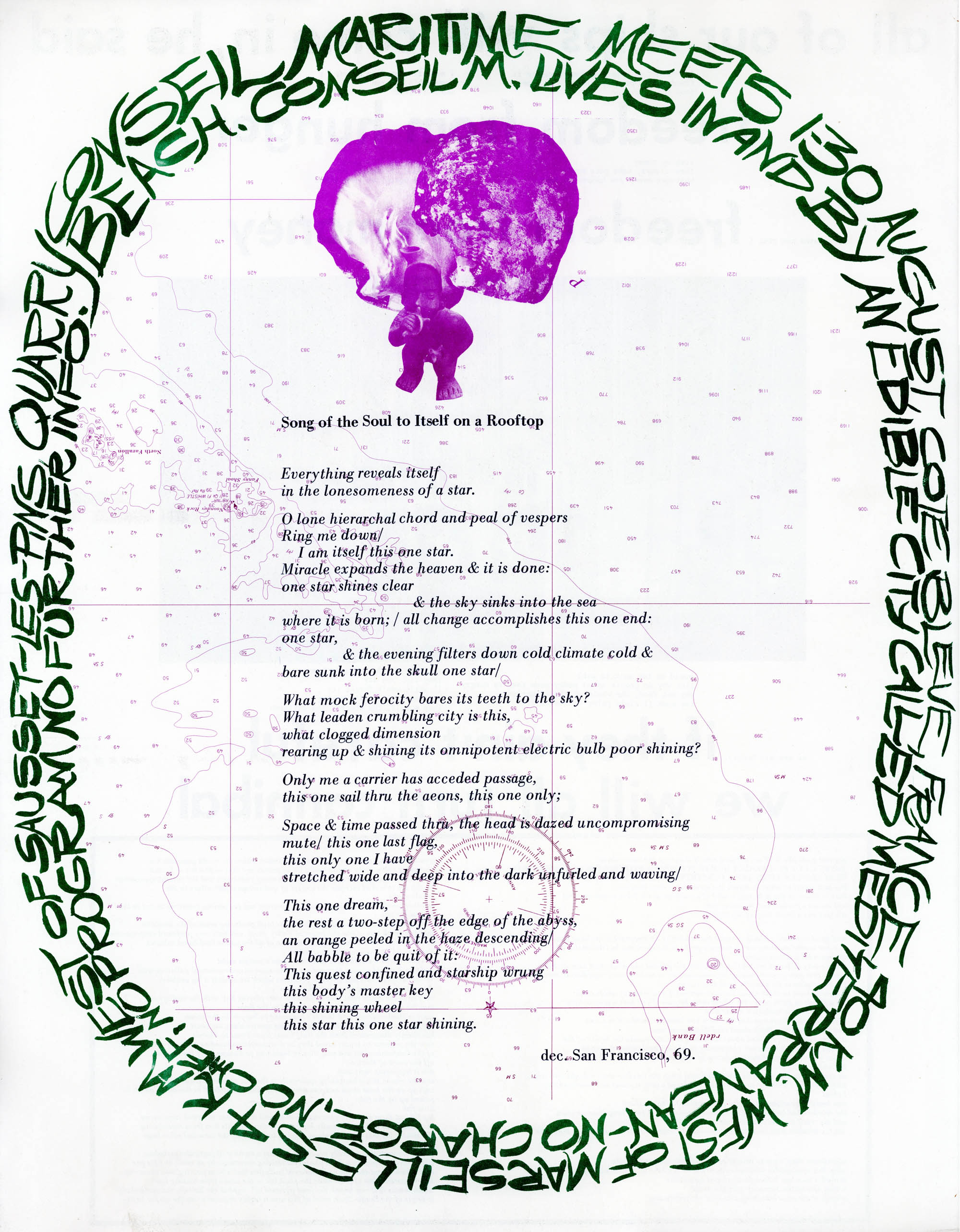
Cat. No.: PE-02-r Full record BibCit: n.d., ca. 12/1/1969. Broadside. 17" x 22". Collection: SOLA-o(PB). Abstract: Over a nautical chart, a lyrical chant traces a speaker’s cosmic solitude and visionary self-recognition, identifying with a lone star amid sea, sky, urban decay, and deep time. Beginning with the claim that “everything reveals itself / in the lonesomeness of a star,” it moves through vespers, a sinking sky, a “crumbling city,” and a solitary sail crossing the aeons before arriving at an abyssal but affirmative vision of the self as both “this body’s master key” and a star “shining” within a larger field of change. Above the poem, a purple photomontage of an infant-like figure appears suspended beneath an image resembling the earth or moon, while a thick hand-lettered green border repeats words including “maritime,” “consciousness,” “futures,” “mysteries,” “oceans,” “space,” “dreams,” “change,” and “wind.” Together, the cartography, ecological imagery, mystical language, and San Francisco countercultural typography anticipate the bioregional sensibility later associated with Planet Drum.
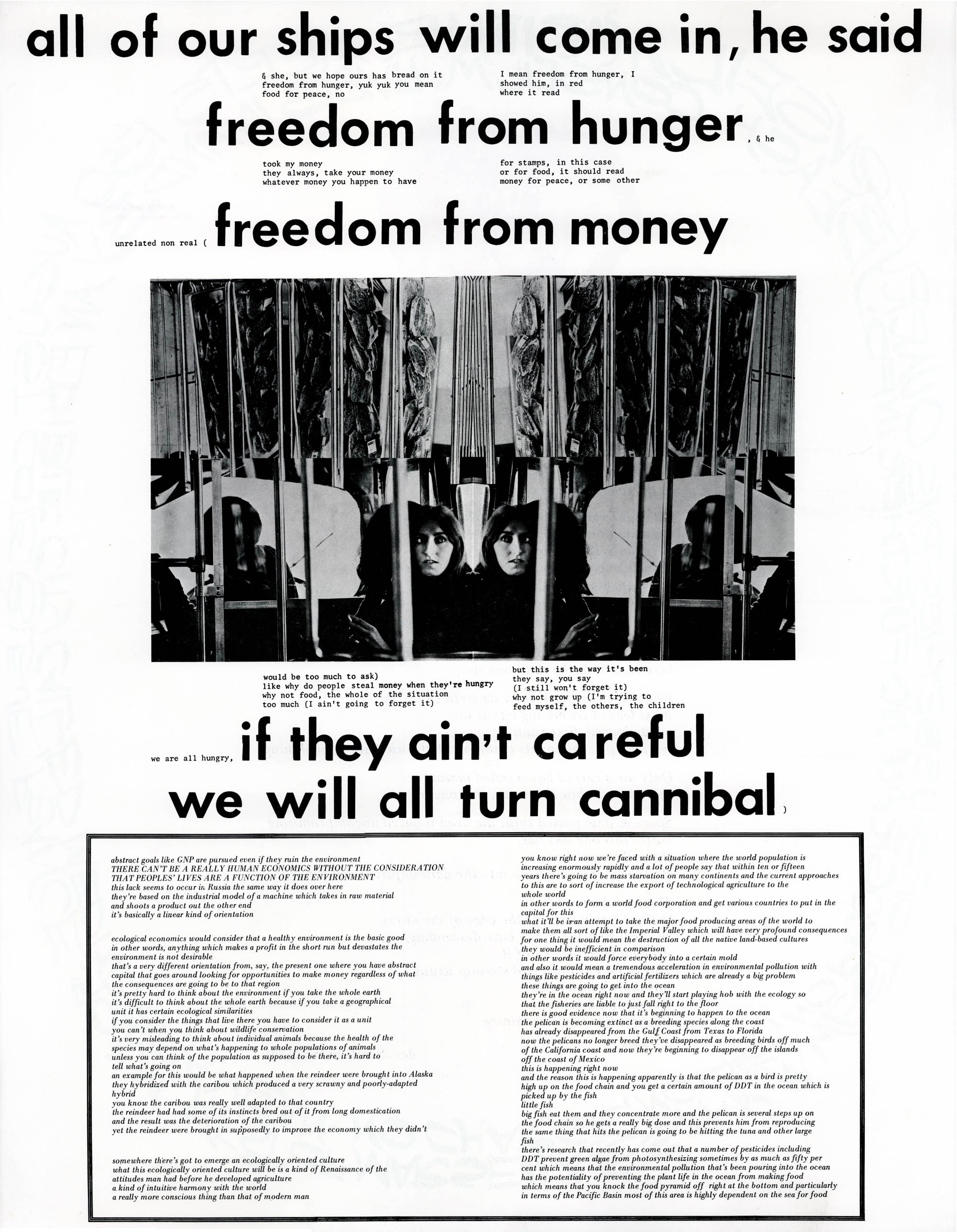
Cat. No.: PE-02-v Full record BibCit: n.d., ca. 12/1/1969. Broadside. 17" x 22". Collection: SOLA-o(PB). Abstract: A stark Planetedge broadside pairing large declarative slogans—“all of our ships will come in,” “freedom from hunger,” “freedom from money,” and “if they ain’t careful we will all turn cannibal”—with a central black-and-white image of figures seen through a barred or segmented interior. Smaller, conversational fragments contrast the ordinary need for food with the coercive power of money, while a dense text block at the bottom turns to ecological politics: environmental damage, overpopulation, resource distribution, alien species, fisheries collapse, and the consequences of treating food as a commodity rather than a shared necessity. The poster’s argument moves from hunger and economic deprivation to a wider critique of capitalist scarcity and ecological mismanagement, insisting that freedom from hunger requires freedom from the systems that make food dependent on money.
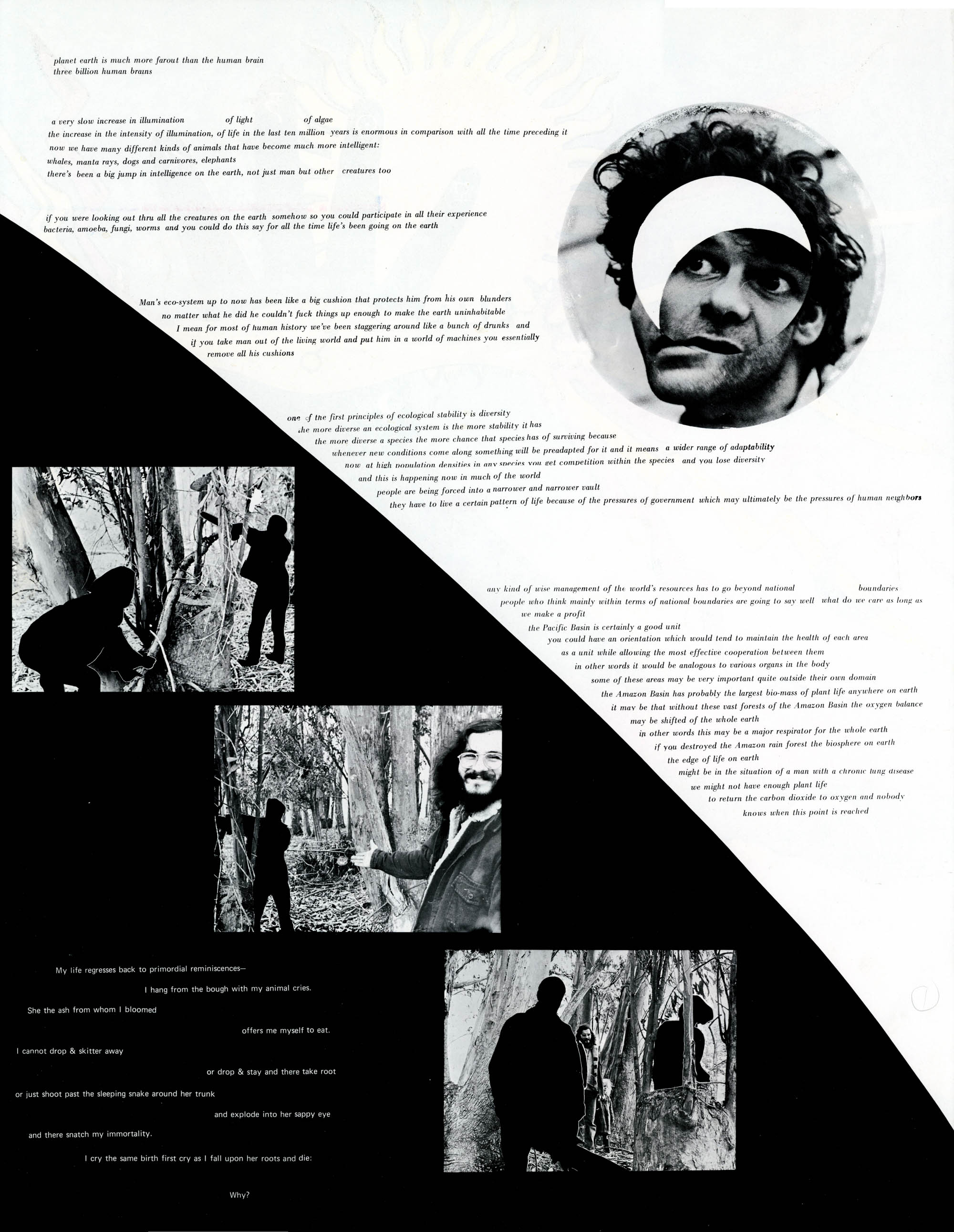
Cat. No.: PE-03-r Full record BibCit: n.d., ca. 12/1/1969. Broadside. 17" x 22". Collection: SOLA-o(PB). Abstract: A visually stark Planetedge poster organized around a sweeping black diagonal that divides the page between dense ecological argument and photographs of people moving through a wooded landscape. The text develops a theory of ecological stability through diversity, contrasting the resilience of varied species and bioregions with the environmental damage caused by industrial development, technological uniformity, and government or economic pressures that force people into narrower patterns of life. It presents the Pacific Basin as a meaningful ecological unit, linked to larger planetary systems such as the Amazon forest and the global oxygen balance, while warning that the destruction of any major habitat can have consequences far beyond its immediate region. A portrait of a head-banded man, a small group in the woods, and a concluding poem about animal cries, roots, mortality, and primordial memory give the poster a personal, almost shamanic dimension, joining ecological politics to an intimate vision of human re-entry into the living world.