Including Ephemera, Broadsides, Posters, Street Sheets, Collections, etc. for the
San Francisco Diggers, Communication Company, Free City Collective,
Kaliflower Intercommunal Network, Free Print Shop, Planetedge Manifestation,
Earth/Life Defense Commune, &c.
Category = | Keyword = ALL | Group = ALL | Issue = ALL | Order = DATE | Search = EMPTY | Records = 1013 | Page = 10 of 41 [Browsing category-filtered records]
Click thumbnail for large size. Click again to return.
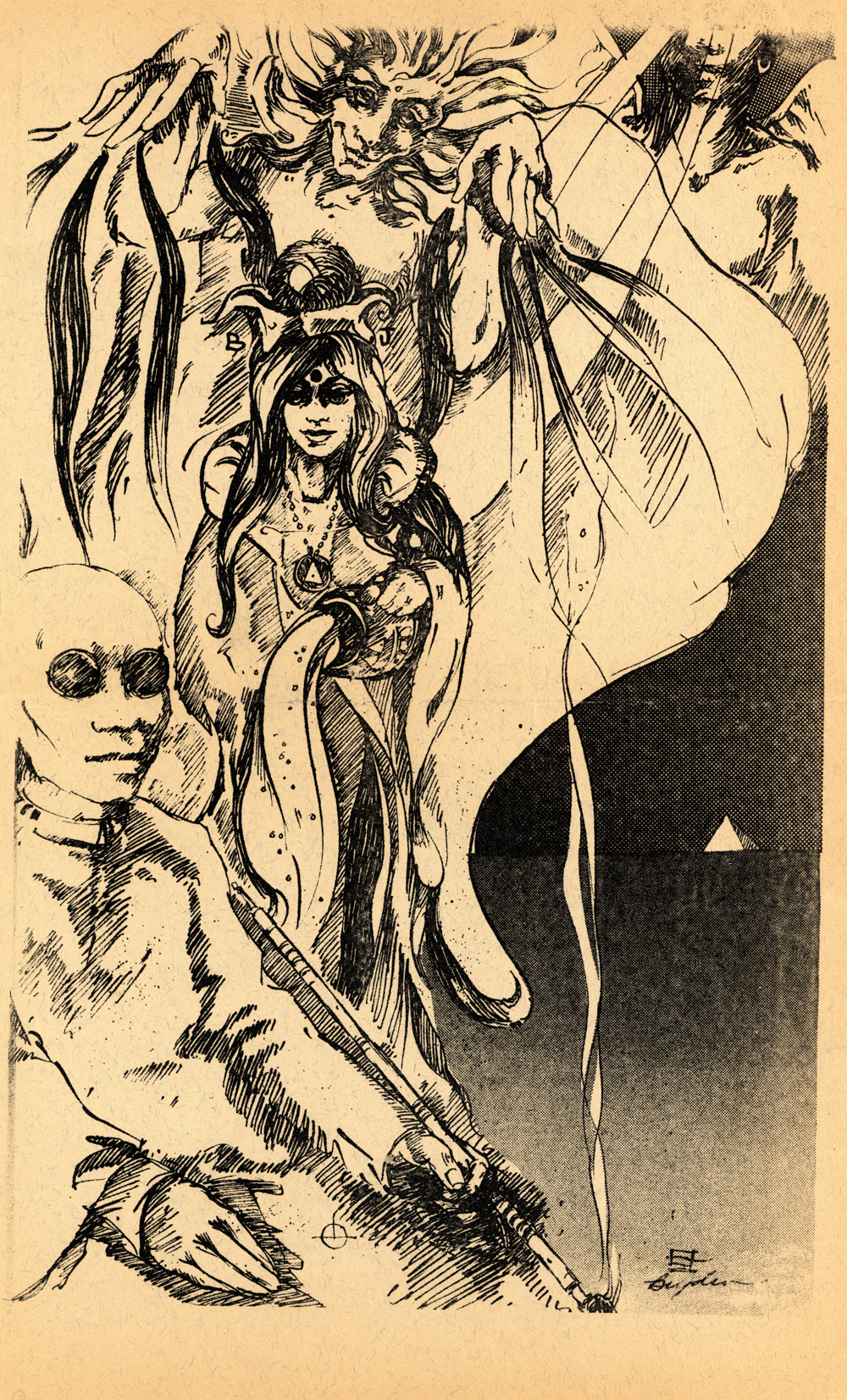
Cat. No.: FC-2-007 Full record BibCit: n.d., ca. 11/1/1967. Broadside. Legal size. San Francisco: Free City Collective. Collection: SOLA-o; SS-o (MH). Abstract: This image introduces a fantastical, almost tarot-like register into the Free City sequence. The horned woman, the bearded sorcerer figure, and the blank-eyed attendant suggest a procession of archetypes drawn from the occult revival, underground comics, and psychedelic poster art, where erotic power, ritual knowledge, and theatrical menace are all held in suspension. In the context of Free City, the piece reads as an emblem of the visionary imagination itself: seductive, ceremonial, and slightly dangerous, as though the new city required not only politics and prophecy but its own mythology.
Note: Drawing by Bryden, one of the few Free City artists to sign their work.
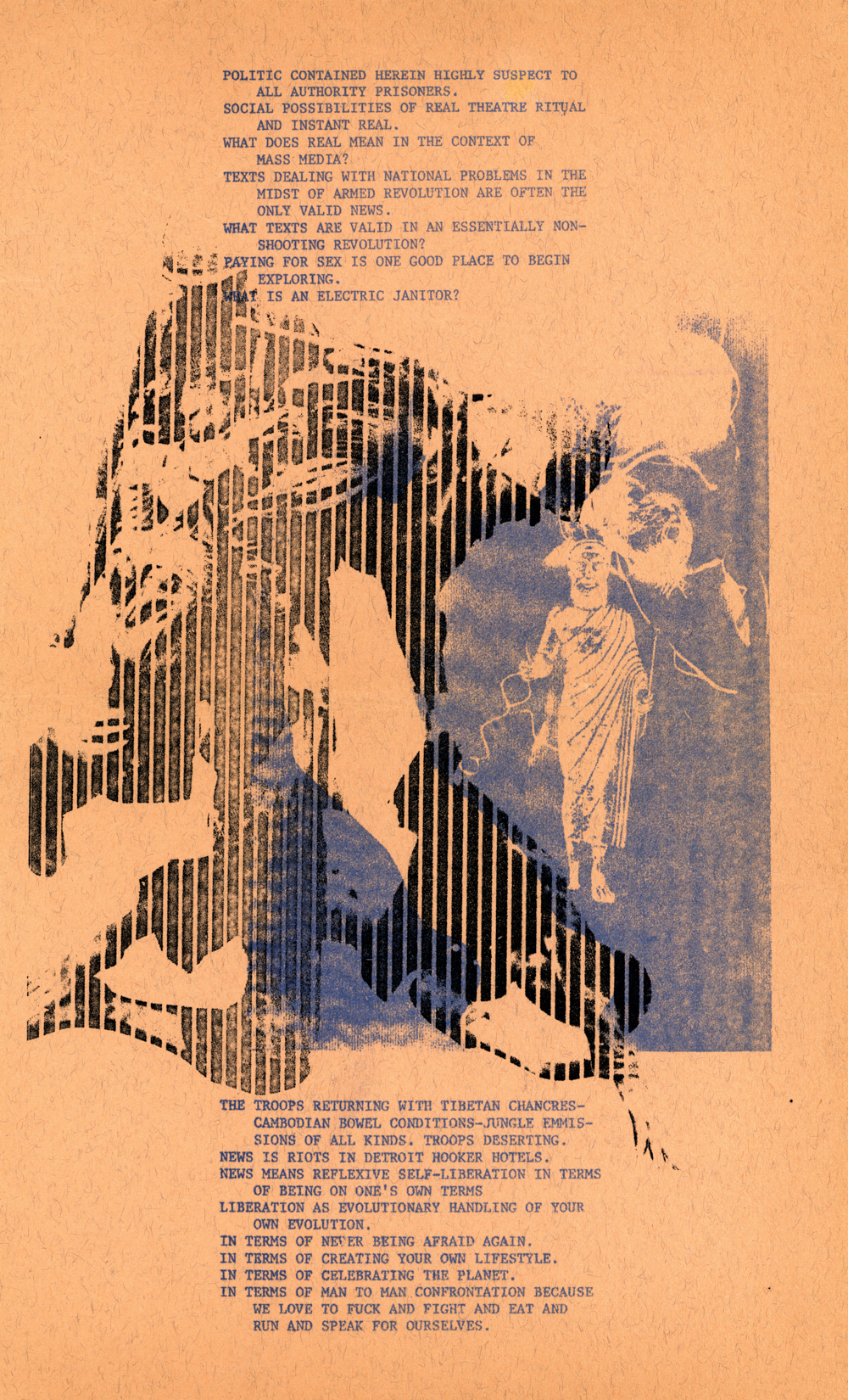
Cat. No.: FC-2-008 Full record BibCit: n.d., ca. 11/1/1967. Broadside. Legal size. San Francisco: Free City Collective. Collection: SOLA-o; SS-o (MH). Abstract: This sheet is one of Free City’s more explicit meditations on the problem of “news” in a revolutionary culture that is not, at least yet, founded on armed struggle. The text rejects the authority of mass media and official politics in favor of “instant real,” social theater, sexual candor, self-liberation, and the making of one’s own life as the valid ground of revolutionary speech. The layered imagery—part prison bars, part planetary or ritual apparition—suggests both confinement and breakthrough, as though the task were to invent forms of consciousness and communication adequate to liberation on one’s own terms.
Note: The design relies on superimposition, with prison-like vertical bars laid over photographic imagery and a small classical figure, reinforcing the sheet’s tension between confinement and revelation.
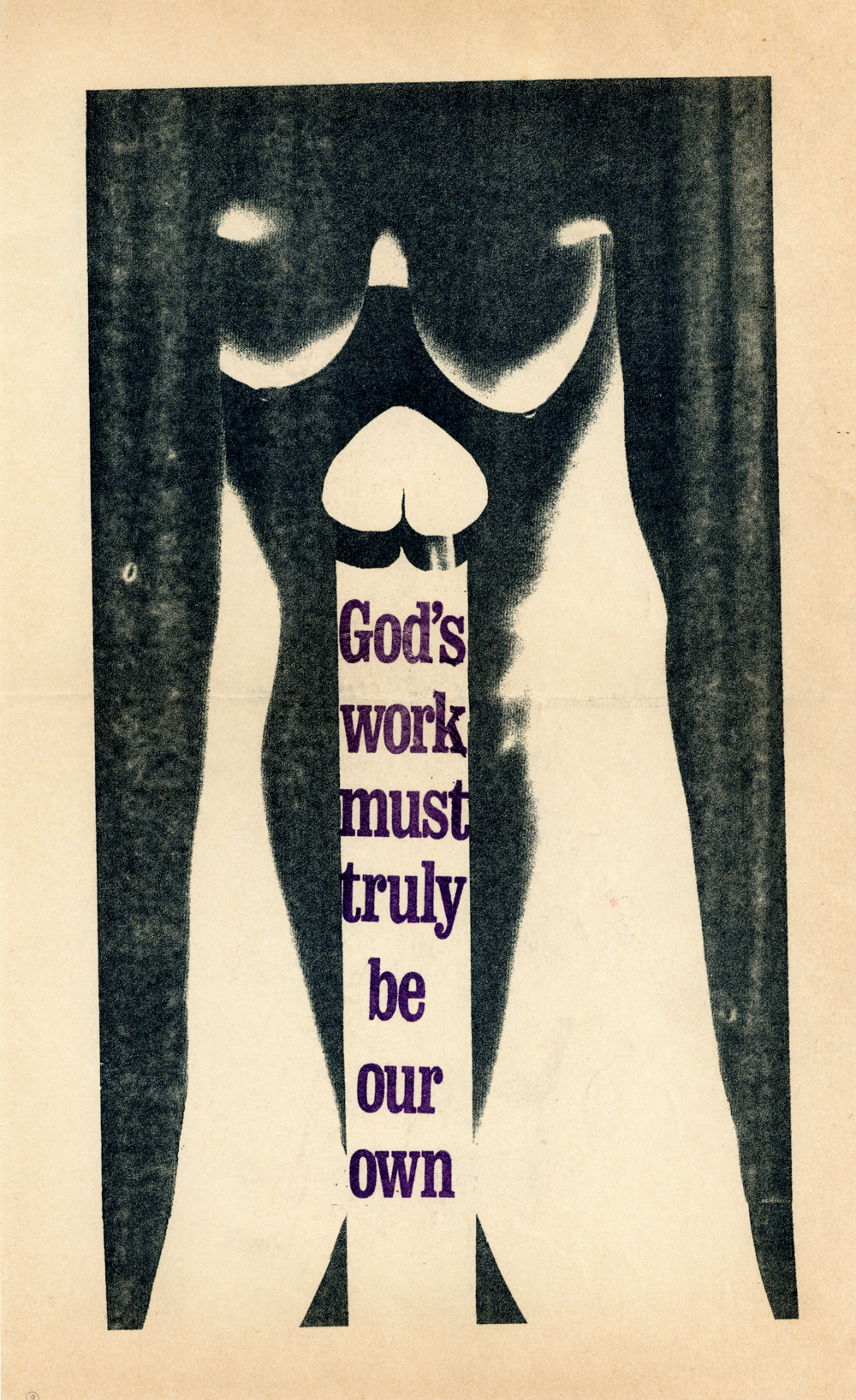
Cat. No.: FC-2-009 Full record BibCit: n.d., ca. 11/1/1967. Legal size. San Francisco: Free City Collective. Collection: SOLA-o; SS-o (MH). Abstract: This sheet reduces its message to a stark sexual icon: a frontal body in which female and male forms are fused, the erect phallus set within an otherwise female torso to create an androgynous or hieratic emblem of generative power. The slogan, “God’s work must truly be our own,” is thus made literal through the body itself, suggesting that creation, liberation, and sacred authority are not to be delegated upward but reclaimed in human form. Spare, confrontational, and deliberately unsettling, the design turns sexual wholeness into manifesto.
Note: One of the more frequently reproduced images from Free City.
Cat. No.: FC-2-010 Full record BibCit: n.d., ca. 11/1/1967. Broadside. Legal size. San Francisco: Free City Collective. Collection: SOLA-o; SS-o (MH). Abstract: As the final sheet in the second Free City set, with only this image on the back of the sheet, the piece reads like a parting shot. A delicate botanical specimen is overprinted with the blunt imperative “Fuck Off,” the joke residing in the contrast between courtesy of form and discourtesy of message. In that final position, the sheet becomes an elegant rebuff to intrusion, authority, or unwanted claim on the self: a deadpan farewell and a last irreverent flourish at the end of the sequence.
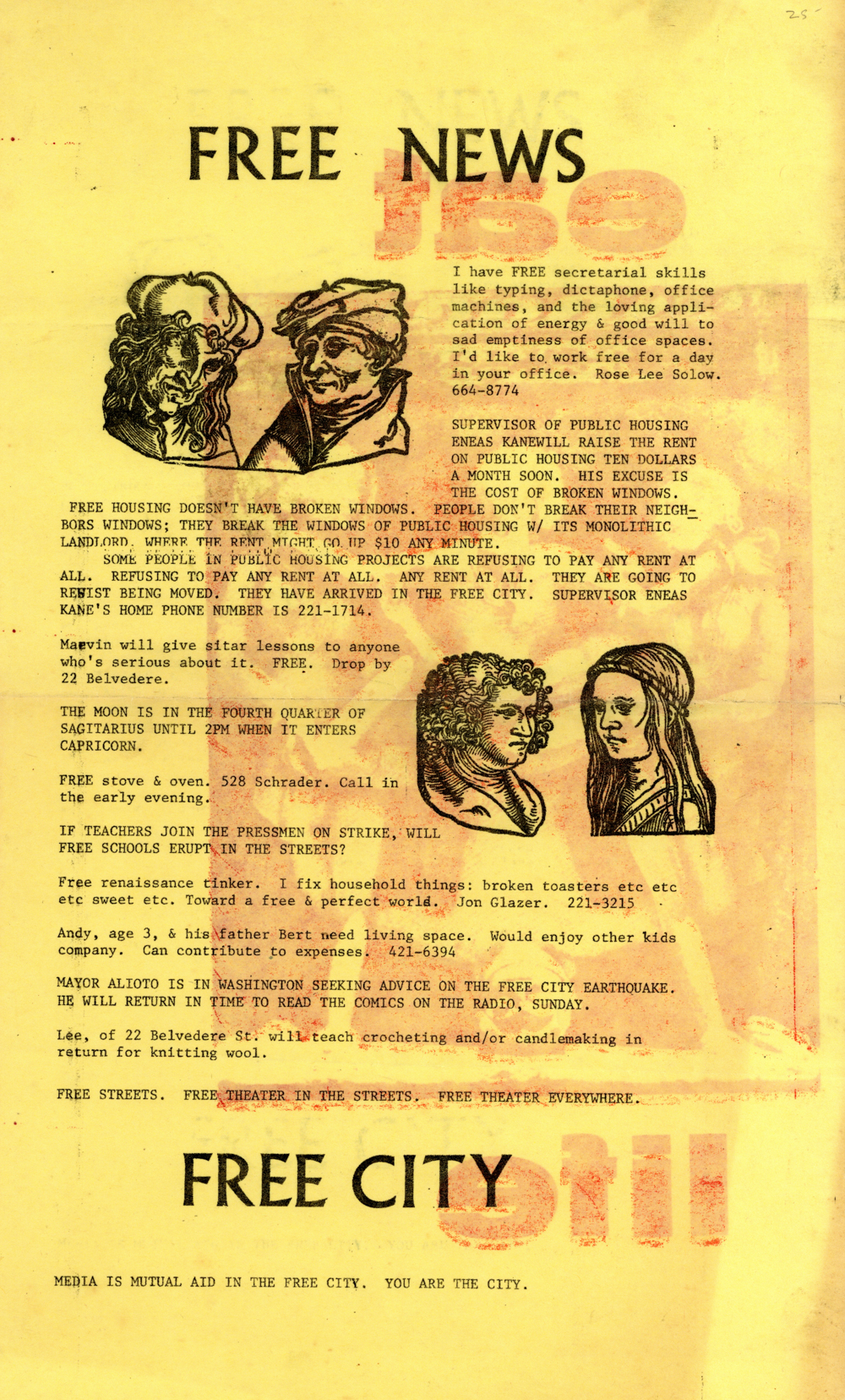
Cat. No.: FC-NEWS-006a Full record BibCit: 1/26/1968. Broadsheet. Legal size. San Francisco: Free City Collective. Collection: SOLA-o. Abstract: This Free News sheet presents the Free City as a lived network of mutual aid rather than a slogan or abstraction. Offers of free labor, housing help, lessons, repair work, childcare, and domestic exchange sit alongside political provocation, astrological timekeeping, and calls for free schools, free streets, and free theater. The effect is to collapse classifieds, manifesto, and street poetry into a single form, where everyday need becomes the ground of social transformation. Its closing line states the principle plainly: “Media is mutual aid in the Free City. You are the city.”
Note: The inserted portrait heads, suggestive of an older, even medieval civic world, reinforce the sheet’s sense that the Free City is not merely a contemporary improvisation but a recovery of older communal forms.
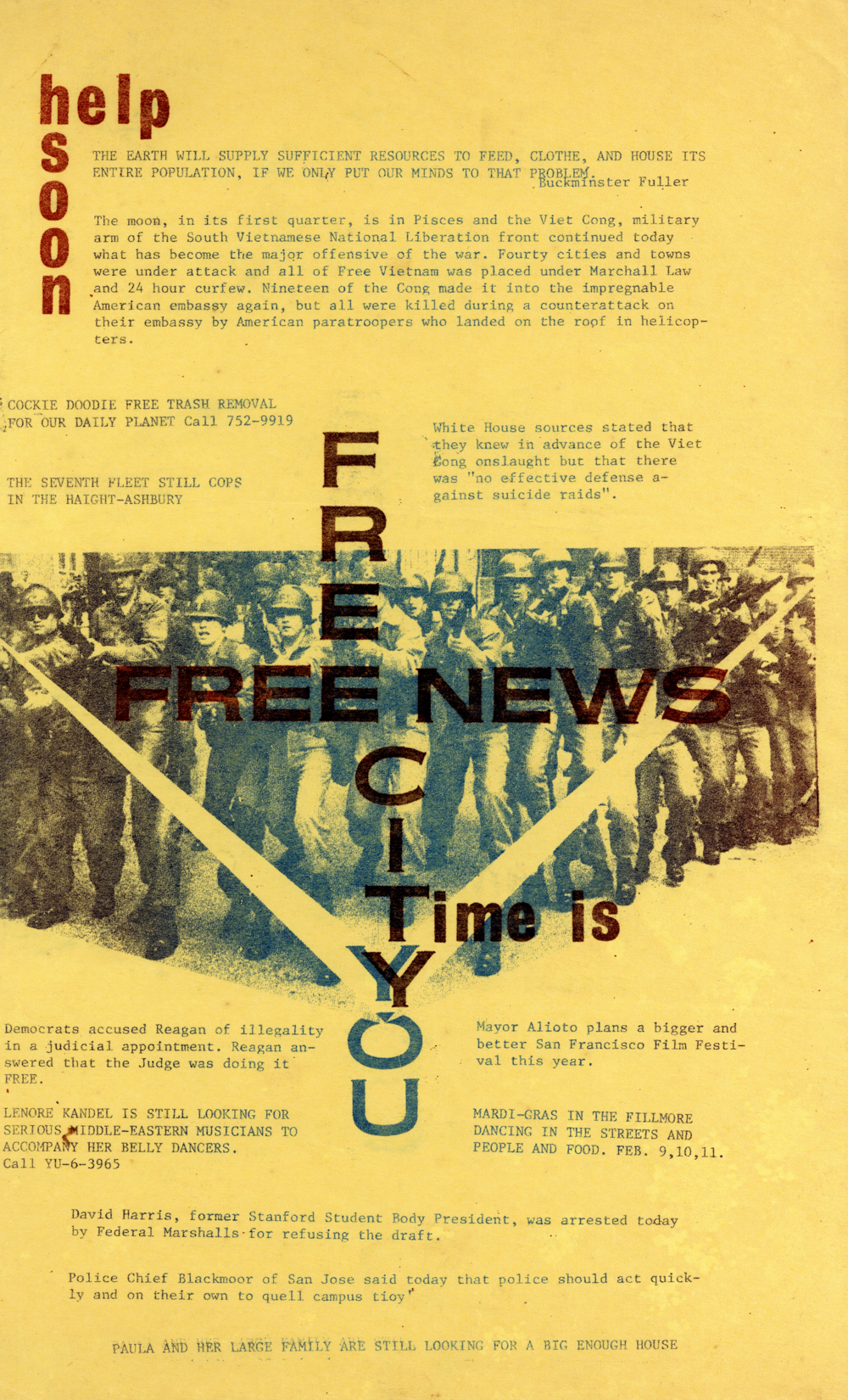
Cat. No.: FC-NEWS-004 Full record BibCit: 2/1/1968. Broadside. Legal size. San Francisco: Free City Collective. Collection: SOLA-o. Abstract: This Free News sheet stages a confrontation between war, authority, and the counter-image of a liberated city. Across a photograph of helmeted police advancing in formation, the words FREE CITY descend vertically while FREE NEWS cuts across the image, turning the page itself into a graphic act of resistance. Around that central collision, the sheet juxtaposes fragments of the Tet Offensive, Vietnam, Reagan, Alioto, Lenore Kandel, Mardi Gras in the Fillmore, housing needs, free trash removal, and street rumor, collapsing official news and local countercultural life into a single field. The result is not a conventional newspaper page but a visual manifesto: the city is figured as a contested zone in which police power, war, festival, need, and free sociality all meet. The phrase “Time is You” gives the sheet its deeper claim, shifting history from the abstractions of the state to the lived agency of the people in the street.
Note: Dating: February 1, 1968. The assault on the US Embassy in Saigon during the Tet Offensive began January 31 with 19 Vietcong successfully invading the compound. The moon in Pisces confirms the dating.
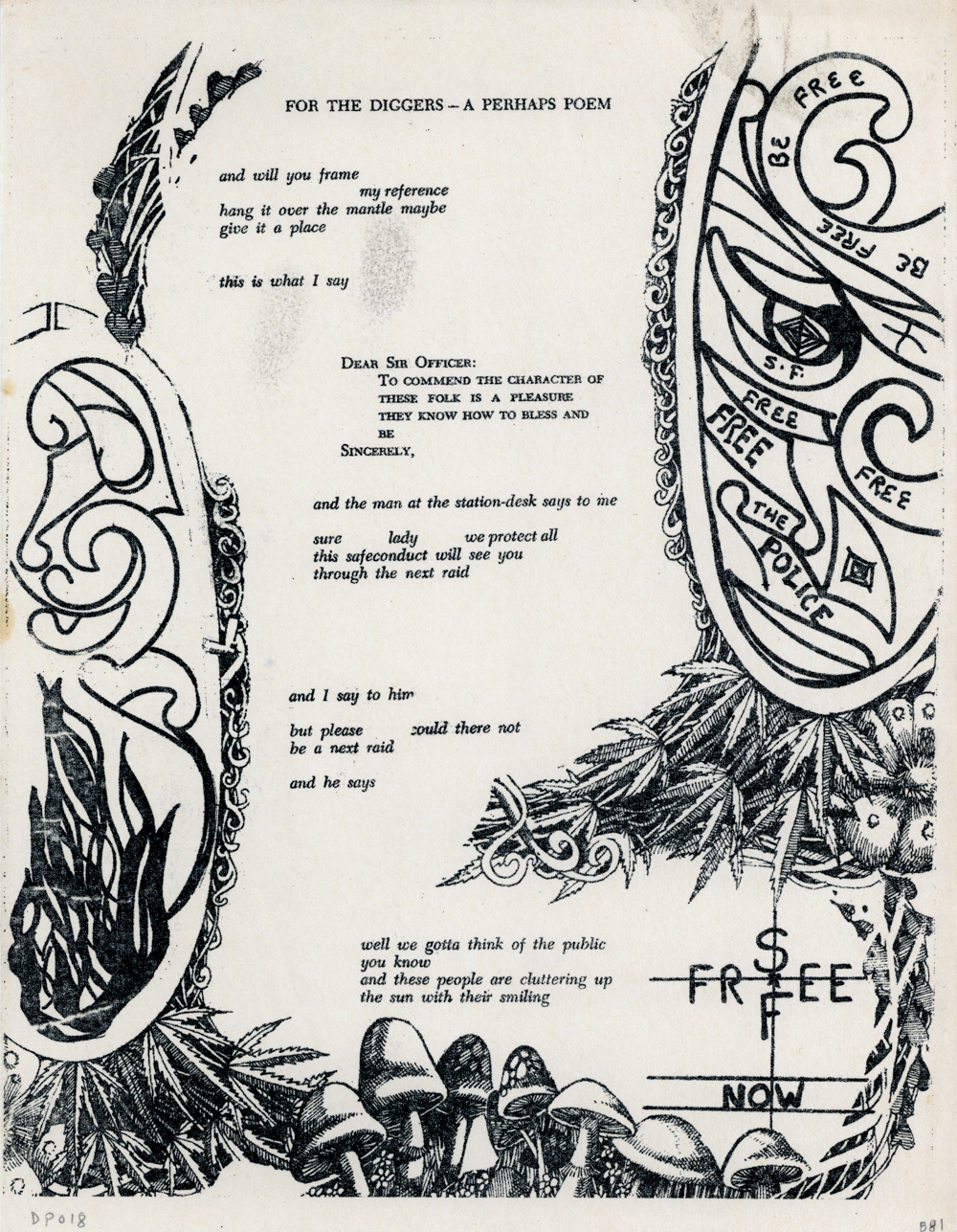
Cat. No.: DR-005 Full record BibCit: n.d., ca. 3/1/1968. Broadside. Letter size. Collection: SOLA-o. Abstract: This sheet folds a short poetic exchange with the police into an ornate graphic field of spirals, leaves, mushrooms, and repeated invocations to “be free.” The poem begins with the language of polite official endorsement—“Dear Sir Officer”—but quickly exposes the absurdity of being promised protection only “through the next raid.” Its quiet irony is one of the sheet’s strengths: the speaker asks, almost gently, whether there might not be a next raid, only to be answered by the bureaucratic logic of public order. The surrounding artwork turns that exchange into a Free City emblem, setting police power, money, and “the public” against the Digger insistence on freedom now.
Note: The SF | FREE | NOW imagery dates this sheet most likely to the Spring 1968 Free City period.
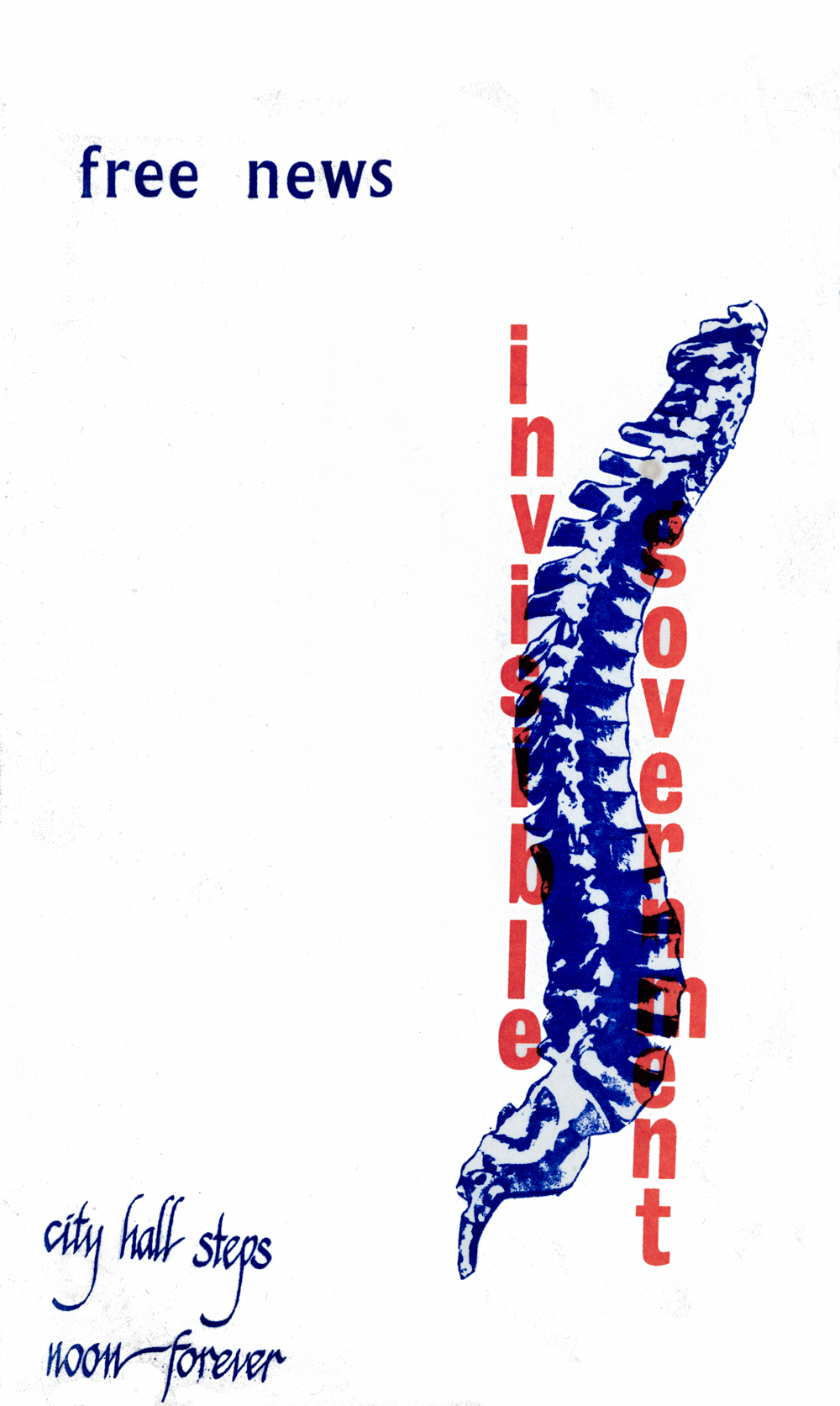
Cat. No.: FC-NEWS-001 Full record BibCit: n.d., ca. 3/1/1968. Broadside. San Francisco: Free City Collective. Collection: SOLA-o. Abstract: A Free News sheet that announces the daily happenings at San Francisco's City Hall.
Note: The daily gatherings on the City Hall steps began around the spring equinox of 1968.
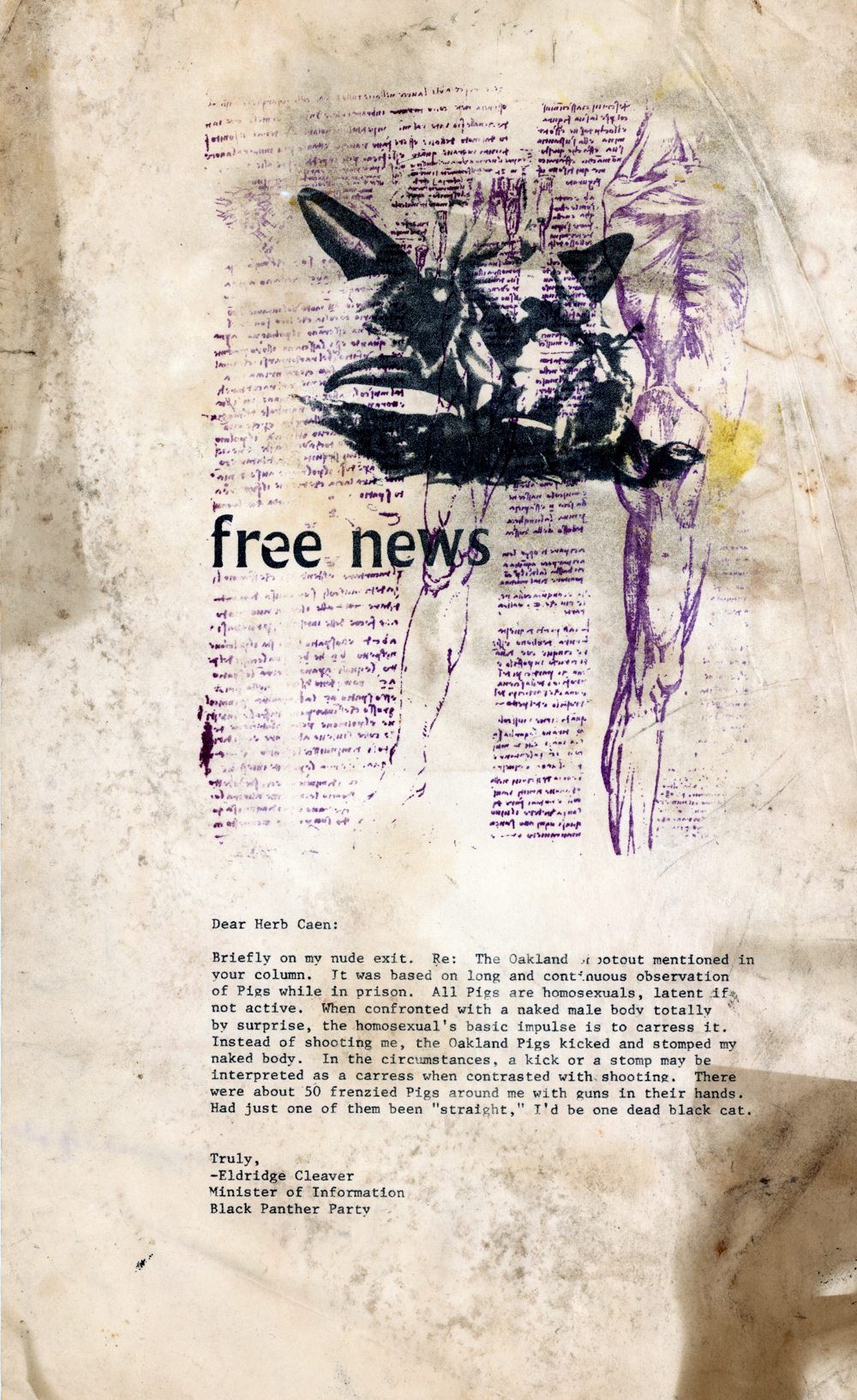
Cat. No.: FC-NEWS-005 Full record BibCit: n.d., ca. 4/15/1968. Broadside. Legal size. San Francisco: Free City Collective. Collection: SOLA-o. Abstract: This Free News sheet layers nude figuration and political mockery into a single charged image. Beneath the spectral purple and black composition appears Eldridge Cleaver’s letter to Herb Caen on the Oakland shootout, turning the naked body into an instrument of irony directed against police power, sexual panic, and public hypocrisy. The piece works less as straightforward reportage than as a visual provocation, fusing underground print aesthetics with the volatile politics of the street.
Note: Re: Dating. Herb Caen mentioned the Oakland shootout in his column on April 15, 1968. "When young Bobby Hutton and Eldridge Cleaver were trapped by the cops in that Oakland house, the experienced Cleaver told the kid: 'Take off all your clothes before we walk outside — that way they can't claim you were trying to pull a gun and shoot you." Cleaver thereupon stripped but Hutton was too shy: he kept his shorts on. And was shot dead. The naked Cleaver was wounded."
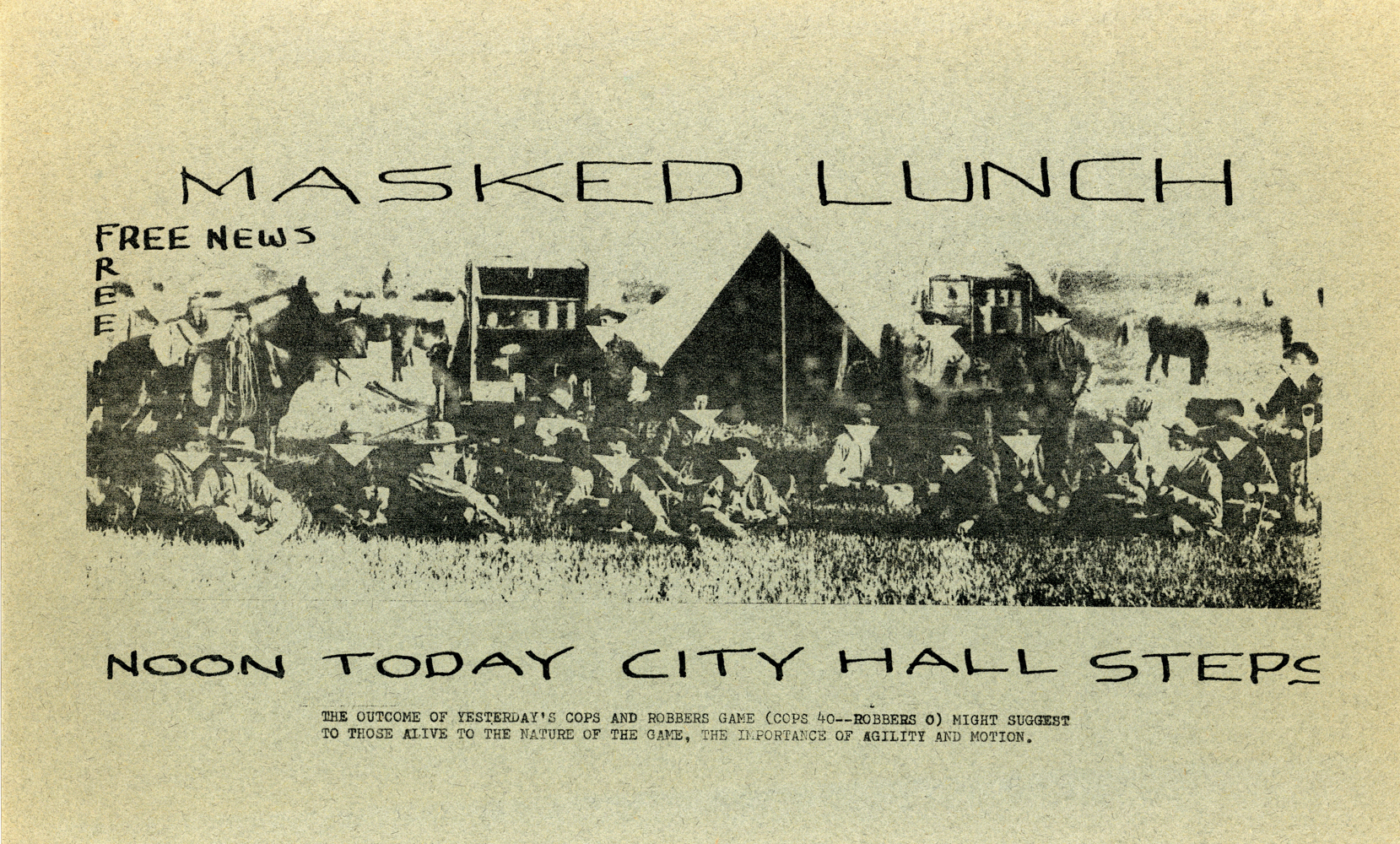
Cat. No.: FC-NEWS-003 Full record BibCit: 5/8/1968. Broadside. Legal size. San Francisco: Free City Collective. Collection: SOLA-o. Abstract: Announcement of a mass "mask-in" at City Hall to protest the "Poetry Bust" the previous day when Ron Thelin was arrested after Judge Axelrod confronted him for wearing a bandanna covering his face. Four others were also arrested, including Ama (aka Thomas C. Baker III) of Willard Street Commune (for wearing an American flag); Israel Jackson, also of Willard Street (for interfering with a police officer); Phyllis Wilner (for interfering with a police officer); and, Charles Perkel (for using profanity). The photograph appears to depict a nineteenth-century mining camp, over which a Free City printer has superimposed triangular masks on each face, converting a historical image into a contemporary emblem of anonymity, collectivity, and social theater.
Note: See: Sixties Date Machine. Also: "Hippies Make Faces at City Hall" by Dick Hallgren, S.F. Chronicle, May 9, 1968, p. 3.
Cat. No.: FC-OTHER-DP68-001 Full record BibCit: n.d., ca. 6/1/1968. Pamphlet. Letter size. 24 pp.. [The Realist]. Abstract: The anthology of digger articles and street sheets compiled by Emmett Grogan and published by The Realist. This is the "digger" or "free" edition. The cover is a full-page graphic of the "running man" symbol (Native American swastika). Other than the cover, all pages are the same as the Realist edition.
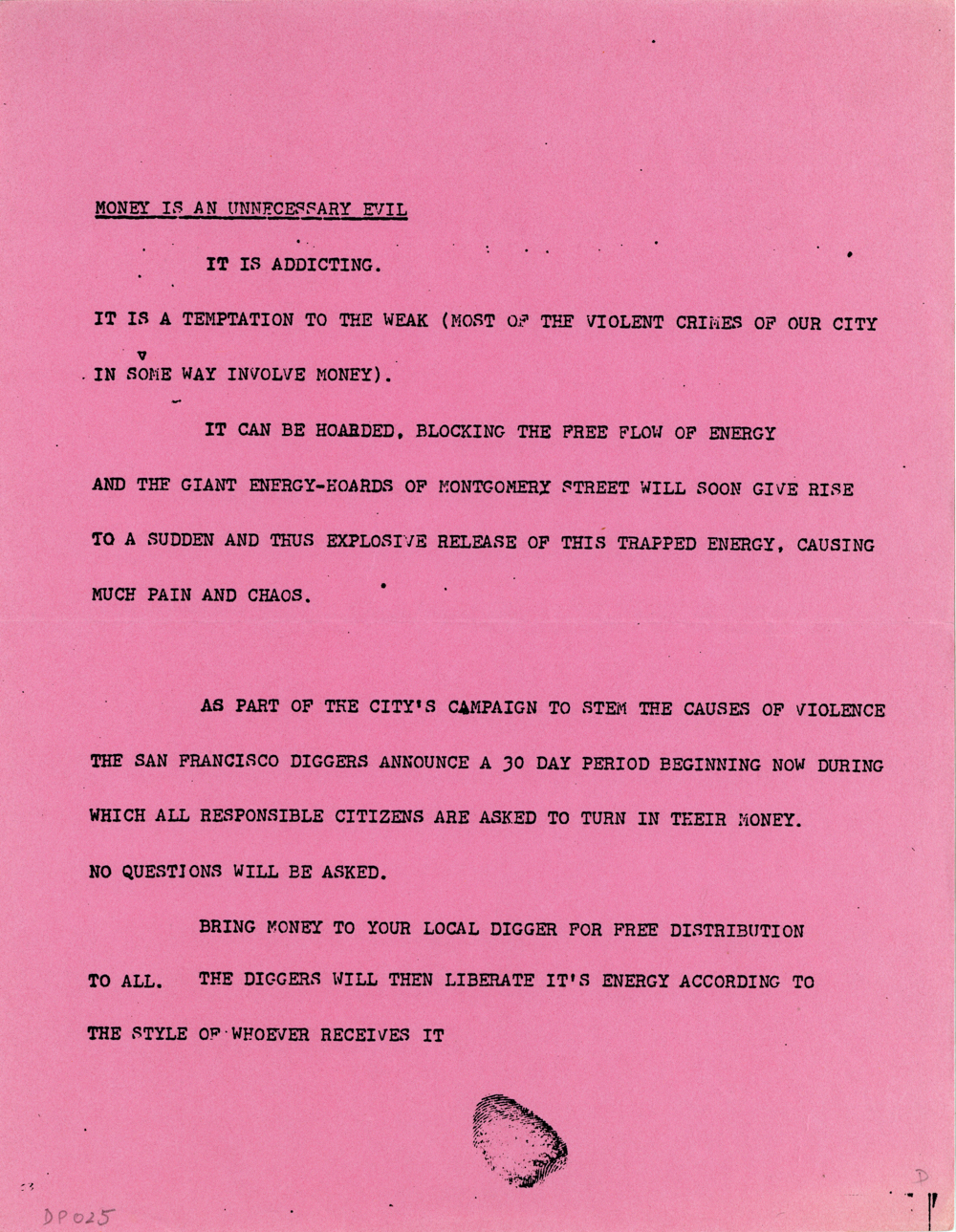
Cat. No.: DP-018 Full record BibCit: n.d., ca. 7/24/1968. Broadside. Letter size. Collection: SOLA-o. Abstract: This sheet is a classic Digger parody of civic reform language, recasting money itself as a social toxin and then proposing, with deadpan seriousness, a thirty-day campaign to rid the city of it. By calling money an “unnecessary evil,” addictive, corrupting, and productive of violence, the piece turns conventional public-safety rhetoric inside out, while its warning about hoarded wealth on Montgomery Street gives the satire a distinctly San Francisco target. The joke, of course, is inseparable from the Digger principle behind it: money is not simply to be condemned but released, redistributed, and stripped of its frozen power. In that sense, the sheet is both mock proclamation and real provocation, using humor to expose the unnaturalness of accumulation and to imagine the “free flow of energy” in place of financial control.
Note: Dating: see San Francisco Express Times, July 24, 1968, p. 2. Under the title, "Turn In Your Money," the Express Times notice reproduces the broadside’s language closely, but not exactly. It converts the Digger proclamation into a short newspaper item, shifting several sentences into reported speech and correcting “it’s” to “its.”
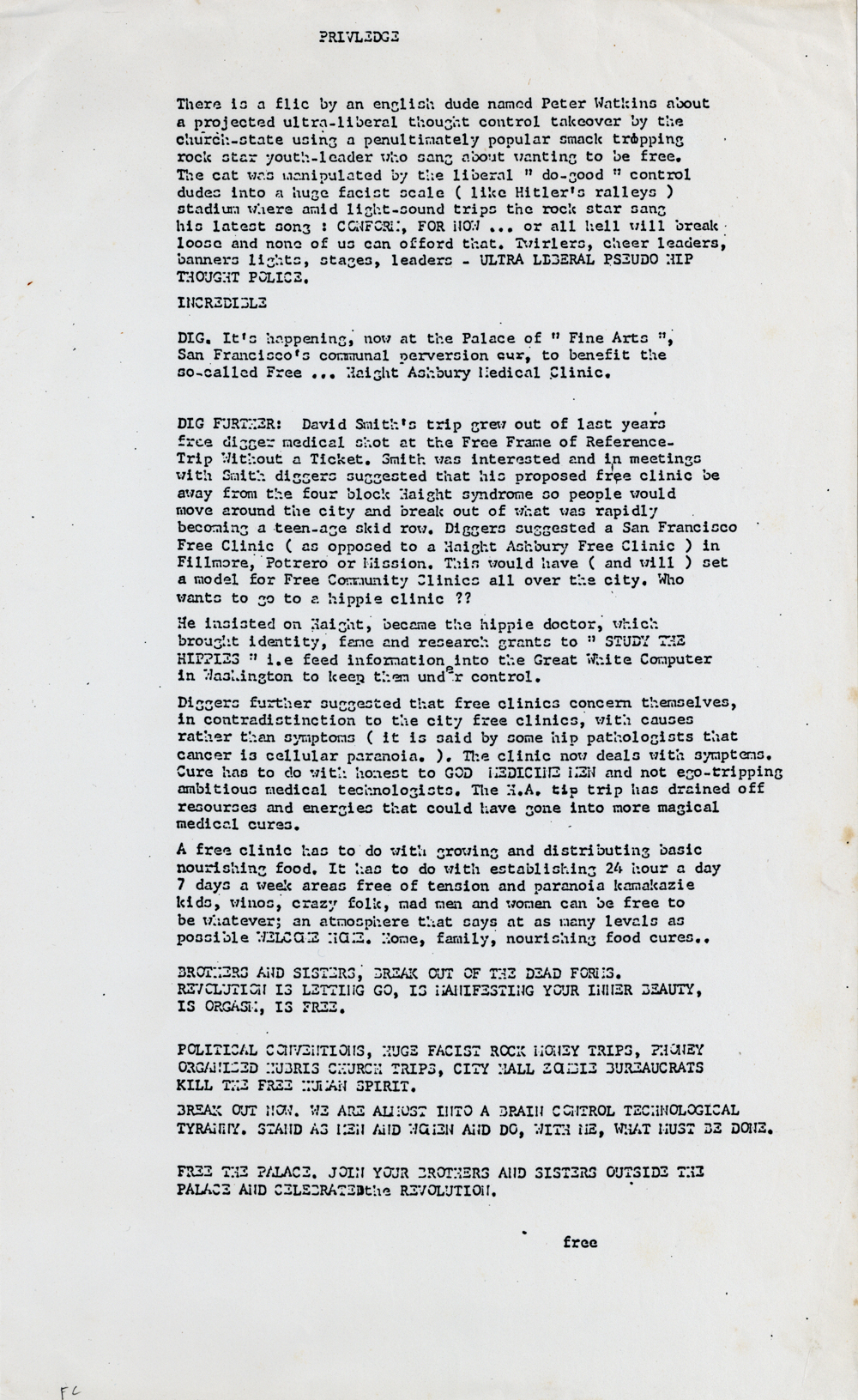
Cat. No.: DR-003 Full record BibCit: n.d., ca. 8/28/1968. Broadside. Legal size. Collection: SOLA-o. Abstract: This Digger sheet attacks the benefit for the Haight Ashbury Free Medical Clinic at the Palace of Fine Arts as a “huge fascist rock money trip,” turning the idea of charity back against the liberal machinery of foundations, bureaucrats, celebrities, and managed dissent. Beginning with Peter Watkins’s film Privilege, the piece reads the benefit as a similar spectacle of social control: rebellious youth culture repackaged as a harmless public ritual under the supervision of the very institutions it should be resisting.
The sheet is especially important for the Digger critique of “free clinics” that dealt only with symptoms rather than causes. A truly free clinic, the writer insists, would have to be part of a larger transformation: free food, free shelter, twenty-four-hour areas free of tension and paranoia, and a social atmosphere where people could “go” rather than be processed. The final call—“Free the Palace”—is not simply a protest against one benefit but a demand to break out of the “dead forms” of institutional benevolence and return Free to the street.
Note: The benefit for the Free Clinic was scheduled to happen the weekend of August 30, 1968. It was apparently a disaster due in large part to neighbors of the Palace of Fine Arts and the SF Recreation and Parks Department. See "Haight Clinic Dies," Berkeley Barb, Sept. 13, 1968, p. 7. Possible author of this piece: Arthur Lisch of the Diggers who was notoriously confrontational. See "Free Moe Free Arthur Free" by Marvin Garson, San Francisco Express Times, July 31, 1968, p. 12.
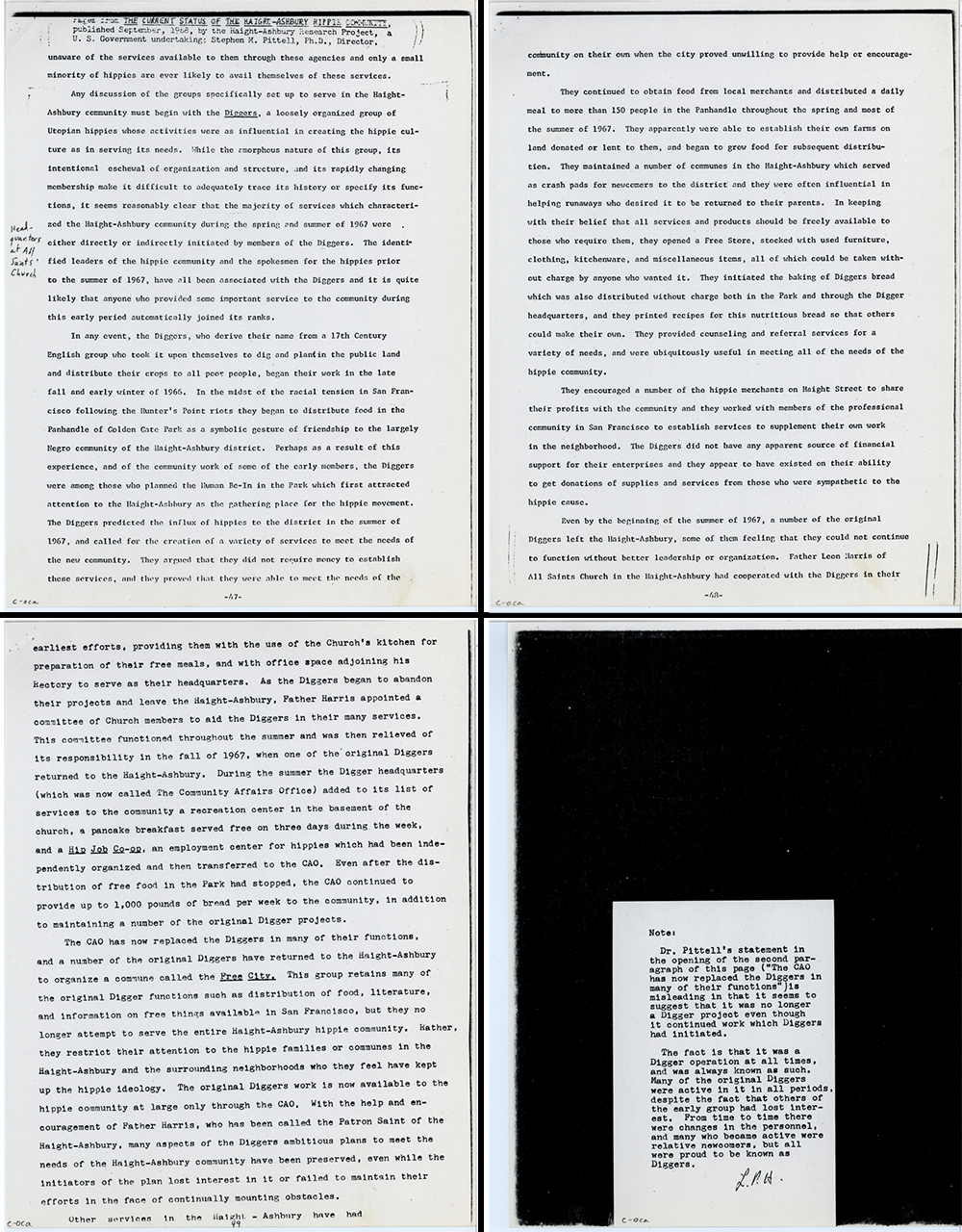
Cat. No.: DR-010b Full record BibCit: By Stephen M. Pittell. n.d., ca. 9/1/1968. Leaflet. Collation: 3 sht; stapled; additional typed note. Collection: SOLA-o(LH). Abstract: Father Leon Harris of All Saints Church sent me this excerpt in 1974. It comes from "The Current Status of the Haight-Ashbury Hippie Community," published in September 1968 by the Haight-Ashbury Research Project, a U.S. Government undertaking directed by Stephen M. Pittell, Ph.D.
The report treats the Diggers as the central source of organized service activity in the Haight-Ashbury during the crucial period from late 1966 through the spring and summer of 1967. It describes them as a loosely organized group of “Utopian hippies” whose work was not merely expressive or theatrical, but practical: free food distribution, crash pads, a Free Store, baked bread, recipes for making bread, referrals, and informal aid for newcomers and runaways. The report emphasizes that many of the services associated with the Haight-Ashbury scene either began with the Diggers or were strongly influenced by them.
The report also traces the Diggers’ relationship with All Saints Church. It states that Father Leon Harris cooperated with the Diggers in their earliest efforts, providing use of the church kitchen for free meals and office space adjoining the rectory for their headquarters. After the original Diggers began to leave the Haight, Harris appointed a committee of church members to continue assisting Digger-related services. This committee eventually became known as the Community Affairs Office, or CAO.
The excerpt then describes a transition from the original Digger operations to the CAO. During the summer of 1967, the Digger headquarters—now called the Community Affairs Office—expanded its work to include a recreation center in the church basement, a free pancake breakfast three days a week, and a Hip Job Co-op. Even after free food distribution in the Panhandle stopped, the CAO reportedly continued to distribute up to 1,000 pounds of bread per week and maintained several of the original Digger projects.
Note: The report’s interpretation, however, seems to have troubled Leon Harris. In his attached note, Harris objects to Pittell’s statement that “the CAO has now replaced the Diggers in many of their functions.” Harris calls that wording misleading because it suggests that the Diggers were no longer a Digger project, even though many of the activities being described were continuations of work that Diggers had initiated. He clarifies that this was “a Digger operation at all times,” though many of the original Diggers were not active in all periods, and some later activists were not necessarily known as Diggers.
The document helps untangle the continuity between the All Saints Church office, the Digger Free Bakery, and the Community Affairs Office. It shows that the April 1967 “split” or departure from All Saints was not the end of Digger activity there. Instead, the relationship continued and changed form, with Harris and the church becoming important institutional supports for free food, referral, recreation, and other neighborhood services rooted in the original Digger impulse.