Including Ephemera, Broadsides, Posters, Street Sheets, Collections, etc. for the
San Francisco Diggers, Communication Company, Free City Collective,
Kaliflower Intercommunal Network, Free Print Shop, Planetedge Manifestation,
Earth/Life Defense Commune, &c.
Category = | Keyword = ALL | Group = ALL | Issue = ALL | Order = DATE | Search = EMPTY | Records = 1013 | Page = 8 of 41 [Browsing category-filtered records]
Click thumbnail for large size. Click again to return.
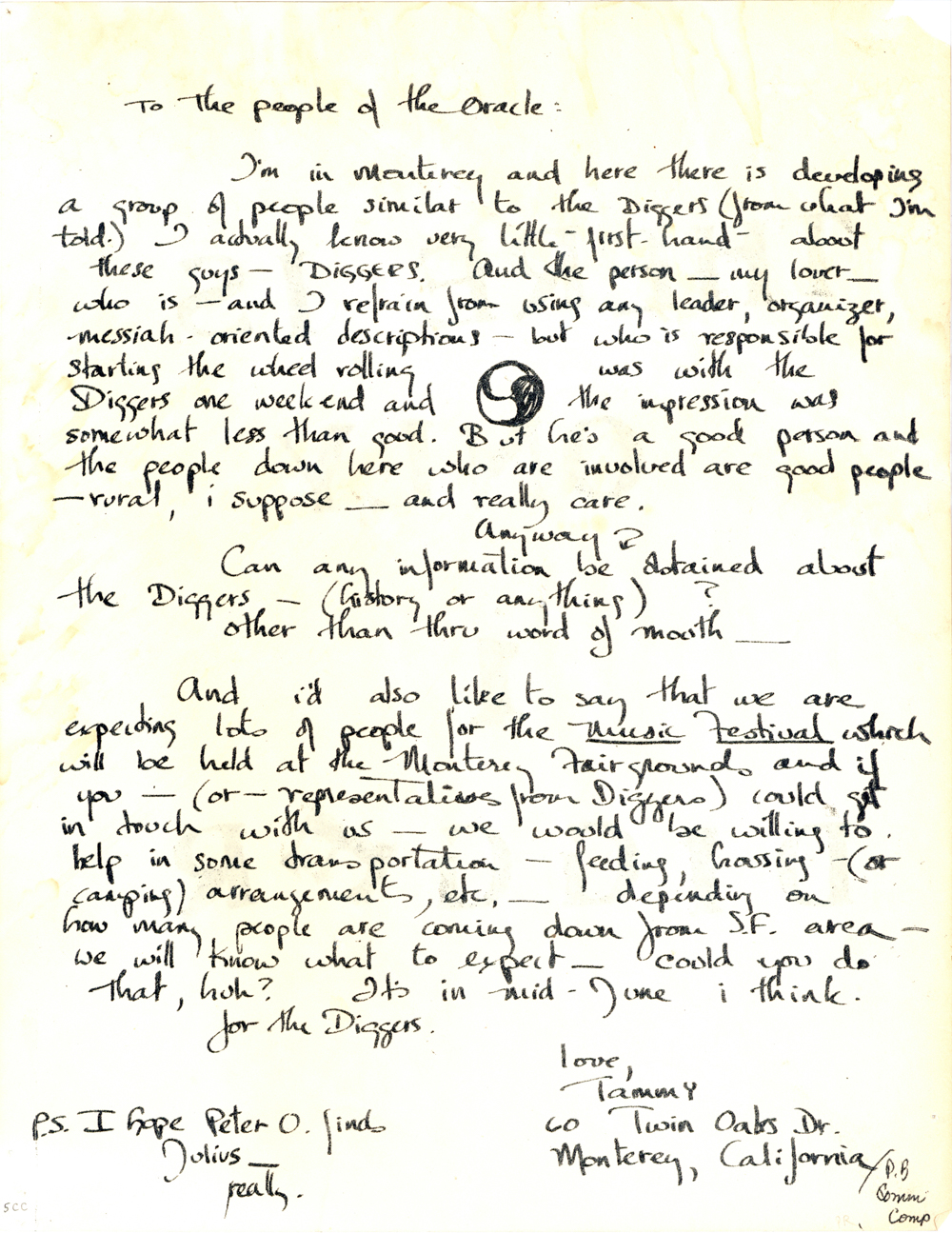
Cat. No.: CC-005b Full record BibCit: n.d., ca. 5/31/1967. Broadsheet. Letter size. San Francisco: Communication Company. Imprint: P.B/Comm/Comp. Collection: SOLA-oPR|SS-oL. Abstract: A letter from Tammy in Monterey who asks, "Can any information be obtained about the Diggers (history or anything)? other than thru word of mouth .." She knows local Diggers-type group who will put people up during upcoming Monterey music festival.
Note: R.s.: "There is only 1 digger." Dating based on comment about Peter Orlovsky which appeared in the Oracle #6 (February 1966).
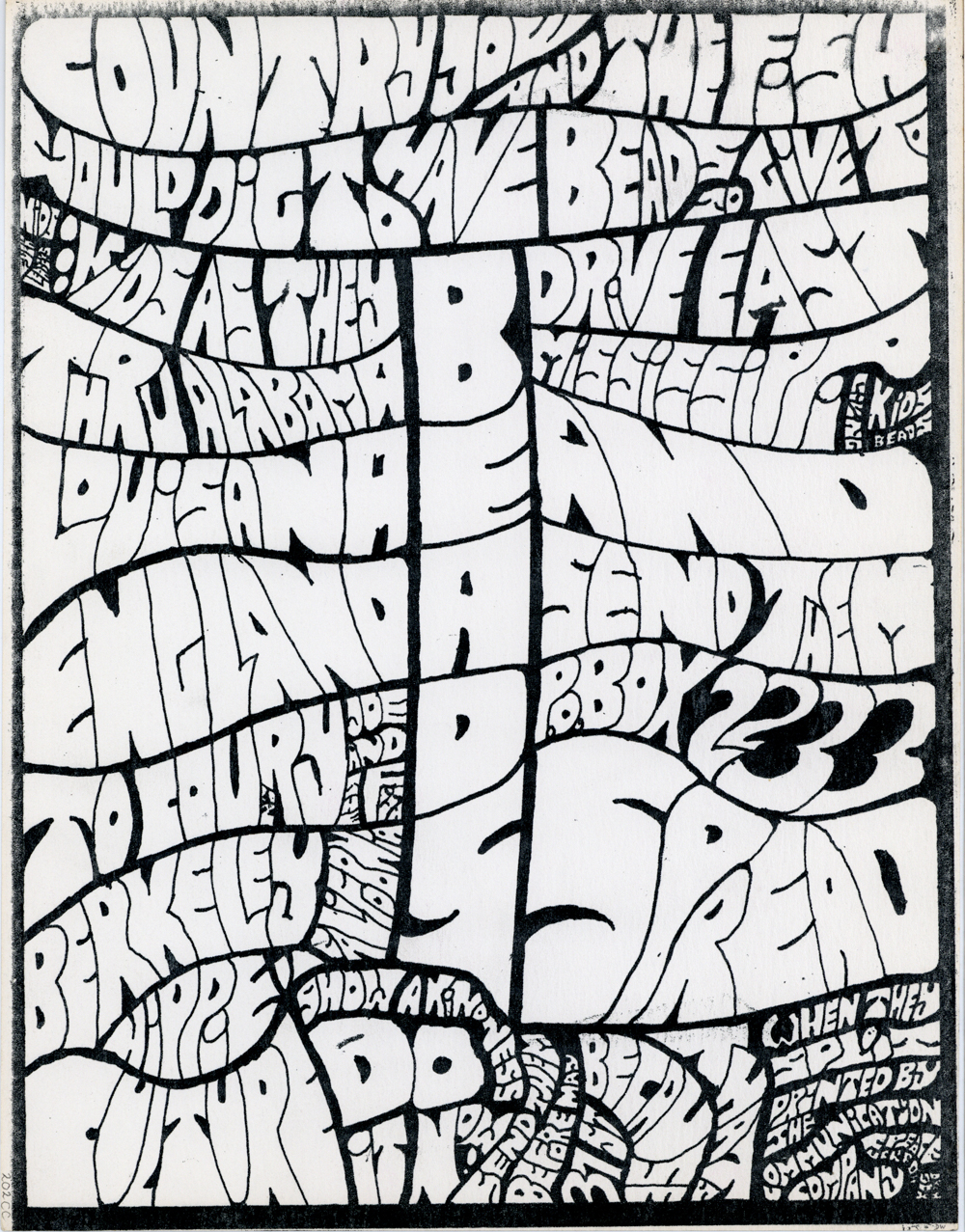
Cat. No.: CC-202 Full record BibCit: N.d., ca. 5/31/1967. Broadside. Letter size. San Francisco: Communication Company. Collation: Lettering in psychedelic style. 1/c.. Collection: SOLA-o(DW). Abstract: Soliciting donations of beads to give away on their upcoming tour. "Send before May 31." "Spread hippie culture. Show a kindness. Do it now before May 31st because that's when they split."
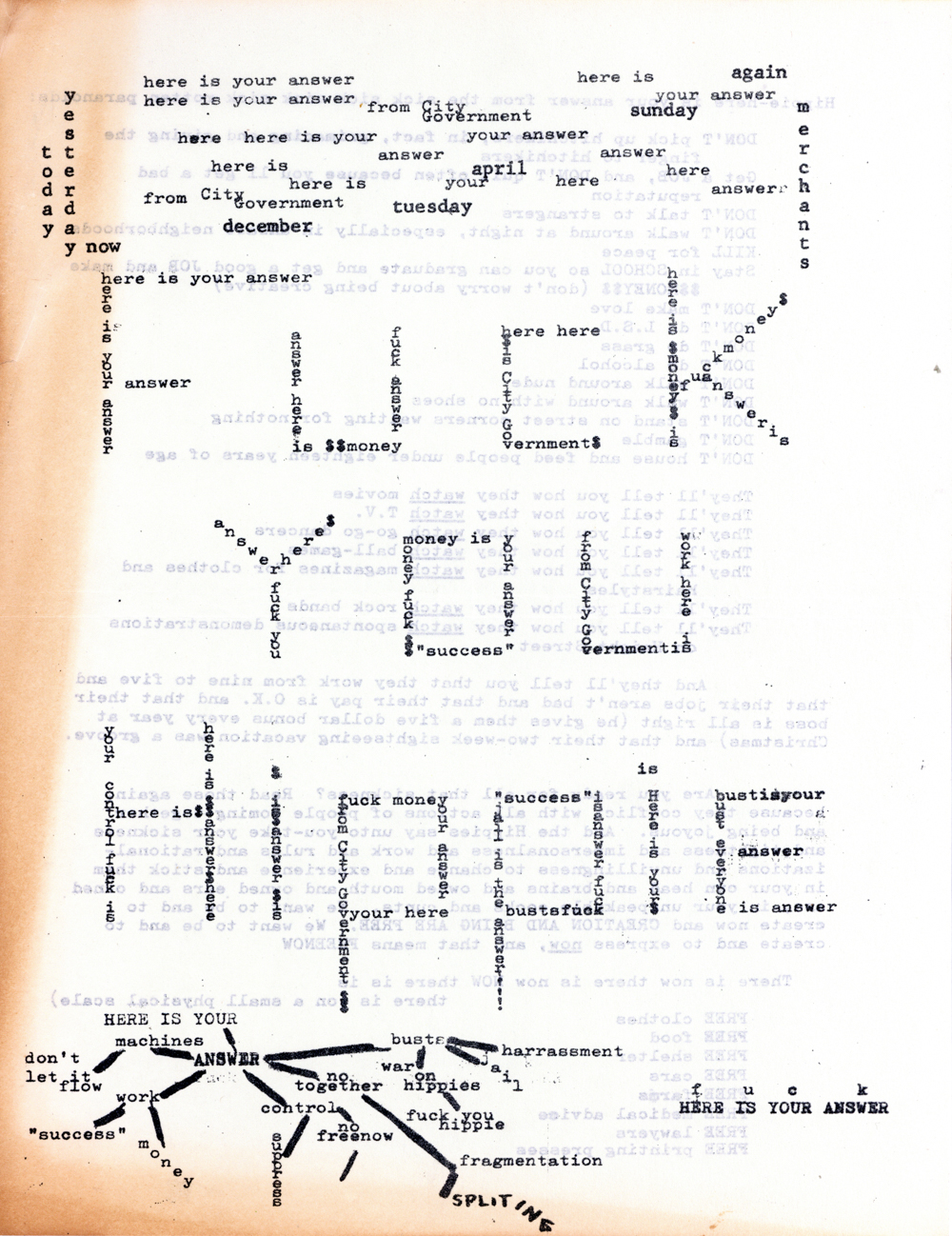
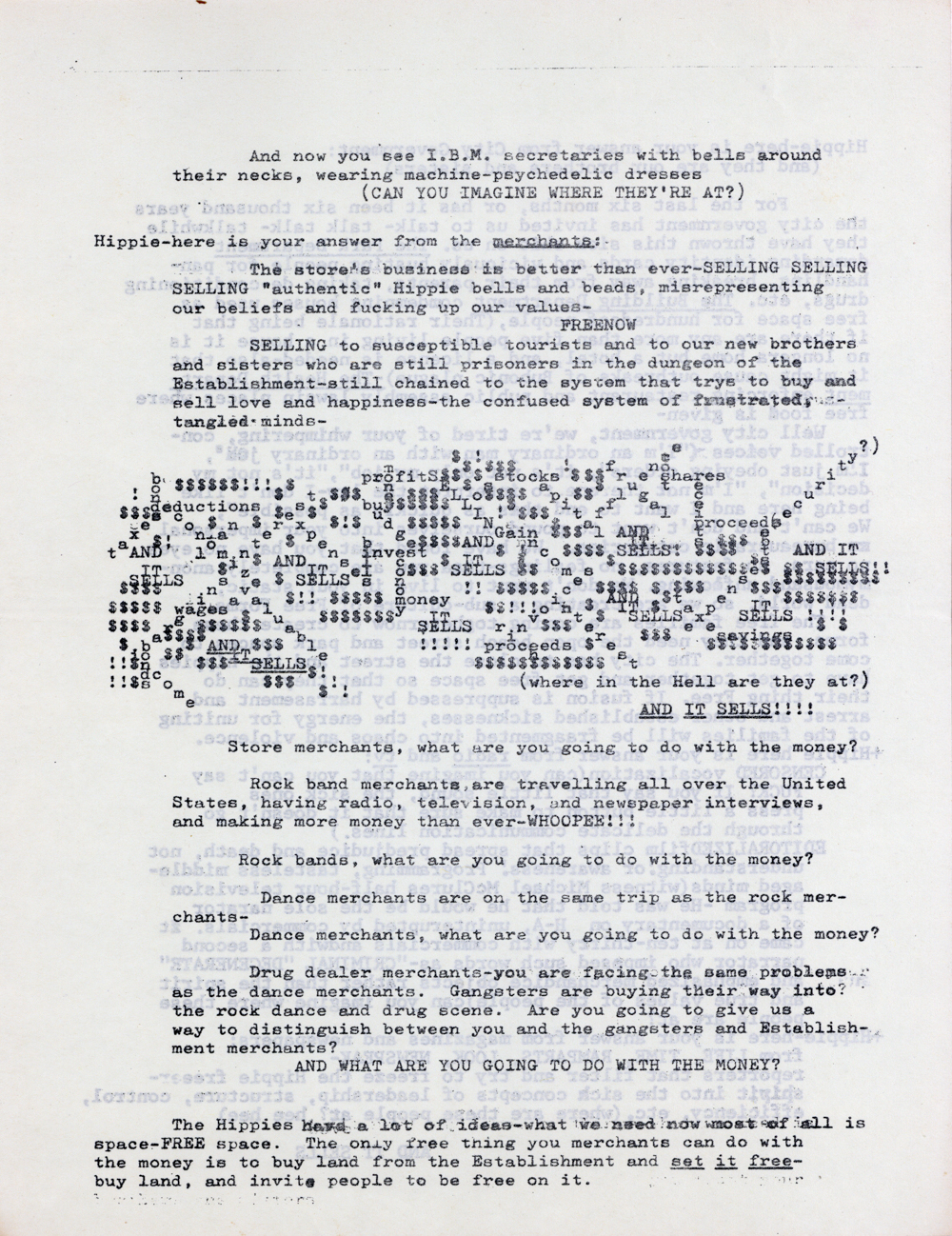
Cat. No.: DP-007a Full record BibCit: n.d., ca. 6/1/1967. Broadsheet. Letter size. Collection: SOLA-o. Abstract: This (recto) sheet reduces the Digger indictment to a visual and verbal blast, repeating “here is your answer” until the answer from City Government, merchants, and the machinery of success becomes unmistakable: “FUCK YOU HIPPIE.” The page uses typewriter graphics, scattered words, dollar signs, and a word-flow diagram to show how the official and commercial response to the Haight translated into busts, harassment, jail, suppression, and fragmentation. Its attack is not only on money but on the whole chain of values—work, success, control, profit—that turns living energy into managed social order. In its compressed form, the sheet reads like a diagram of repression, with “no freenow” as the final negation of the Digger demand for free space, free food, and free life.
Note: The dating is presumed because of the inventory of free services listed on the reverse side, which would have reflected the level of Digger activity after six months or so.
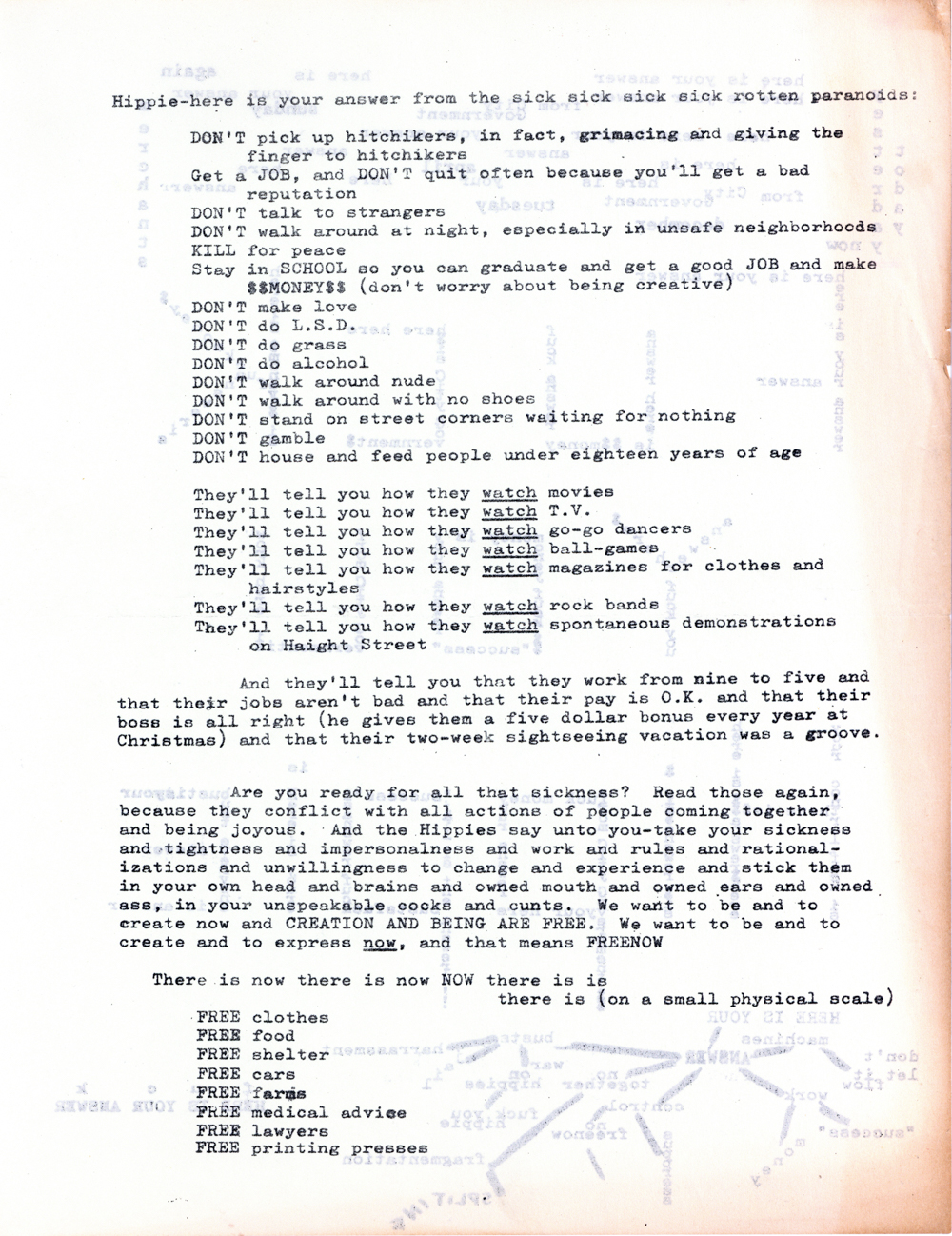
Cat. No.: DP-007b Full record BibCit: n.d., ca. 6/1/1967. Broadsheet. Letter size. Collection: SOLA-o. Abstract: The text on this side turns the phrase “here is your answer” toward the everyday commandments of the straight world: don’t hitchhike, don’t talk to strangers, get a job, stay in school, don’t make love, don’t take drugs, don’t stand around waiting for nothing, don’t shelter the young. Against that catalog of fear, caution, work, property, surveillance, and passive spectatorship, the Digger voice answers with the counter-principle that creation and being are free. The piece is especially striking in the way it opposes “watching” to living: watching movies, television, ball-games, go-go dancers, rock bands, even spontaneous demonstrations, becomes a symptom of a sick culture that has forgotten how to act, share, risk, and come together joyously. Its final inventory of free clothes, free food, free shelter, free cars, free farms, free medical advice, free lawyers, and free printing presses moves the sheet from denunciation into declaration: FREENOW was not a slogan only, but an already emerging infrastructure of liberation.
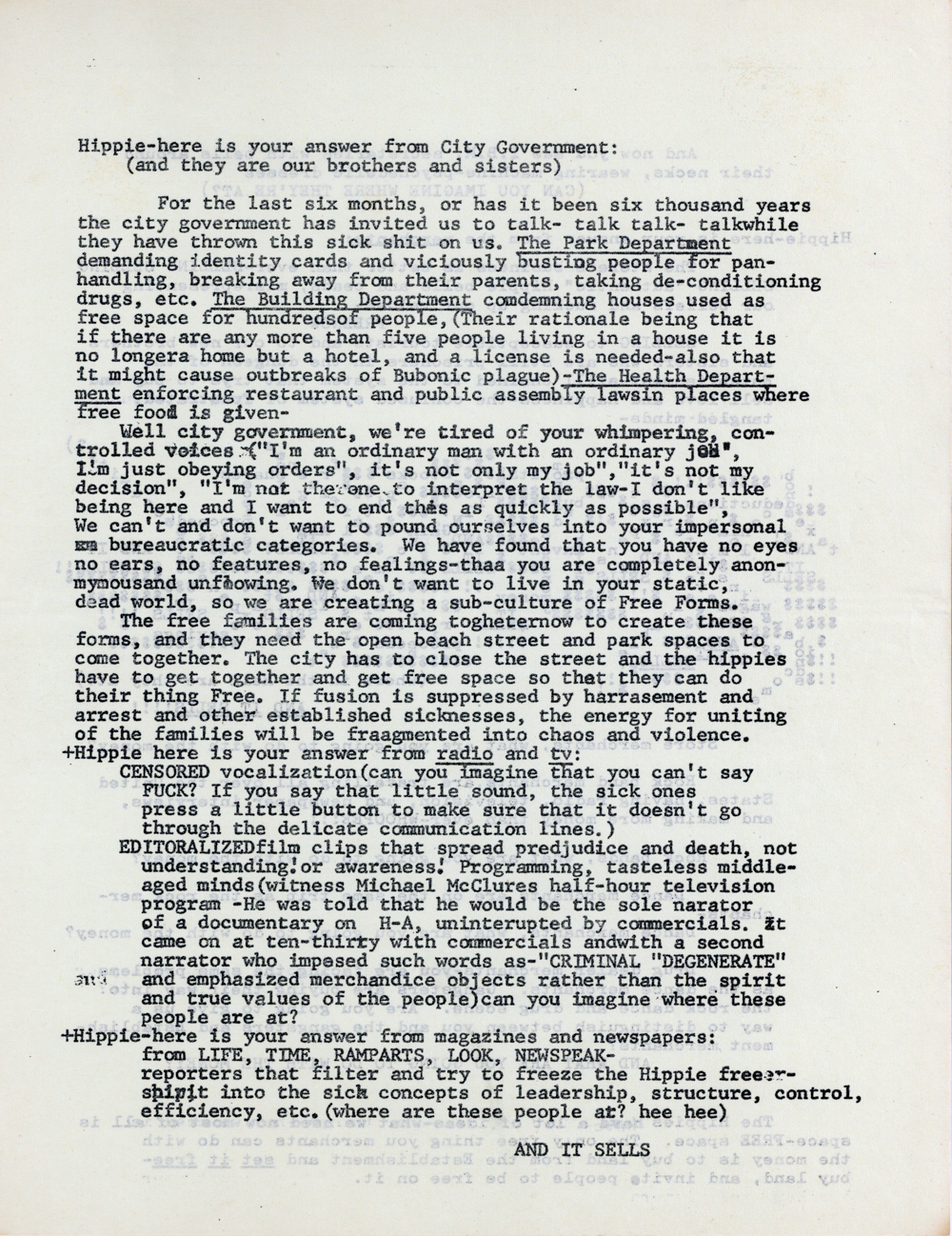
Cat. No.: DP-008a Full record BibCit: n.d., ca. 6/1/1967. Broadsheet. Letter size. Collection: SOLA-o. Abstract: The text on this side of the broadsheet answers the official and media response to the Haight with a fierce Digger refusal of bureaucracy, censorship, and imposed categories. City Government invites “talk-talk-talk” while the Park Department demands identity cards, the Building Department condemns houses used as free space, and the Health Department turns free food into a violation; meanwhile radio, television, magazines, and newspapers censor language, editorialize images, and try to freeze the hippie free-spirit into the familiar categories of leadership, structure, control, and efficiency. What the Diggers insist on instead is the creation of “Free Forms,” the coming together of free families in open beach, street, and park spaces where people can gather and do their thing Free. The warning is clear: if that fusion is suppressed by harassment and arrest, the energy of coming together will be broken into chaos, violence, and fragmentation.
Cat. No.: DP-008b Full record BibCit: n.d., ca. 6/1/1967. Broadsheet. Letter size. Collection: SOLA-o. Abstract: The reverse side turns from government and media repression to the commercialization of the Haight, where “authentic” hippie bells, beads, dresses, music, dances, and drugs are all being turned into merchandise. The sheet mocks the new “machine-psychedelic” style and follows the money through stores, rock bands, dance promoters, and drug dealers, asking each of them the same blunt question: what are you going to do with the money? This is not simply an attack on commerce, but on the way the market misrepresents the hippie vision and sells it back to tourists and newcomers still “chained to the system.” The Digger answer is exact and practical: if money is being made from the scene, then use it to buy land from the Establishment and set it free, creating the free space that the people most needed.
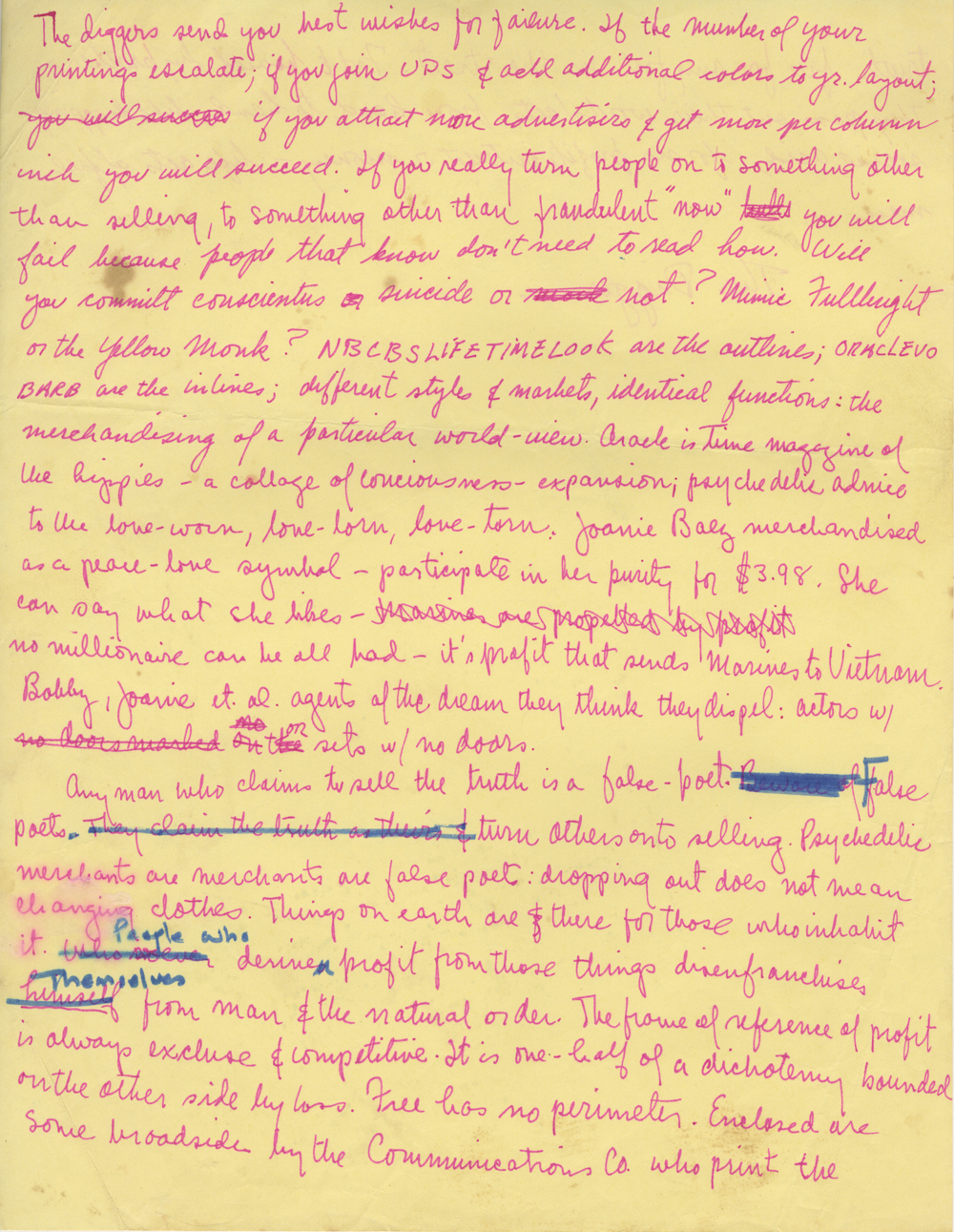
Cat. No.: DP-009 Full record BibCit: n.d., ca. 6/1/1967. Manuscript. Letter size. Collation: Handwritten; 2 pages. Collection: SOLA-x(PB). Abstract: This handwritten Digger draft is a remarkable attack on underground success itself, addressed to a publication that is being warned against becoming merely another marketable voice of the “now.” The letter sends “best wishes for failure,” because success—more printings, more advertisers, more color, more money per column inch—would only mean joining the same merchandising system as NBC, CBS, Life, Time, Look, the Oracle, and other media forms that package a world-view for sale. Its central argument is pure Digger: anyone who claims to sell the truth becomes a “false-poet,” and psychedelic merchants are still merchants, however liberated their costume or language may appear. Against the profit frame, with its necessary twin of loss, the Diggers offer Free as something without perimeter, embodied in Communication Company broadsides printed and handed out freely in the street as “life acts of free men.”
Note: Likely written by Peter Berg. Dating is a guesstimate.
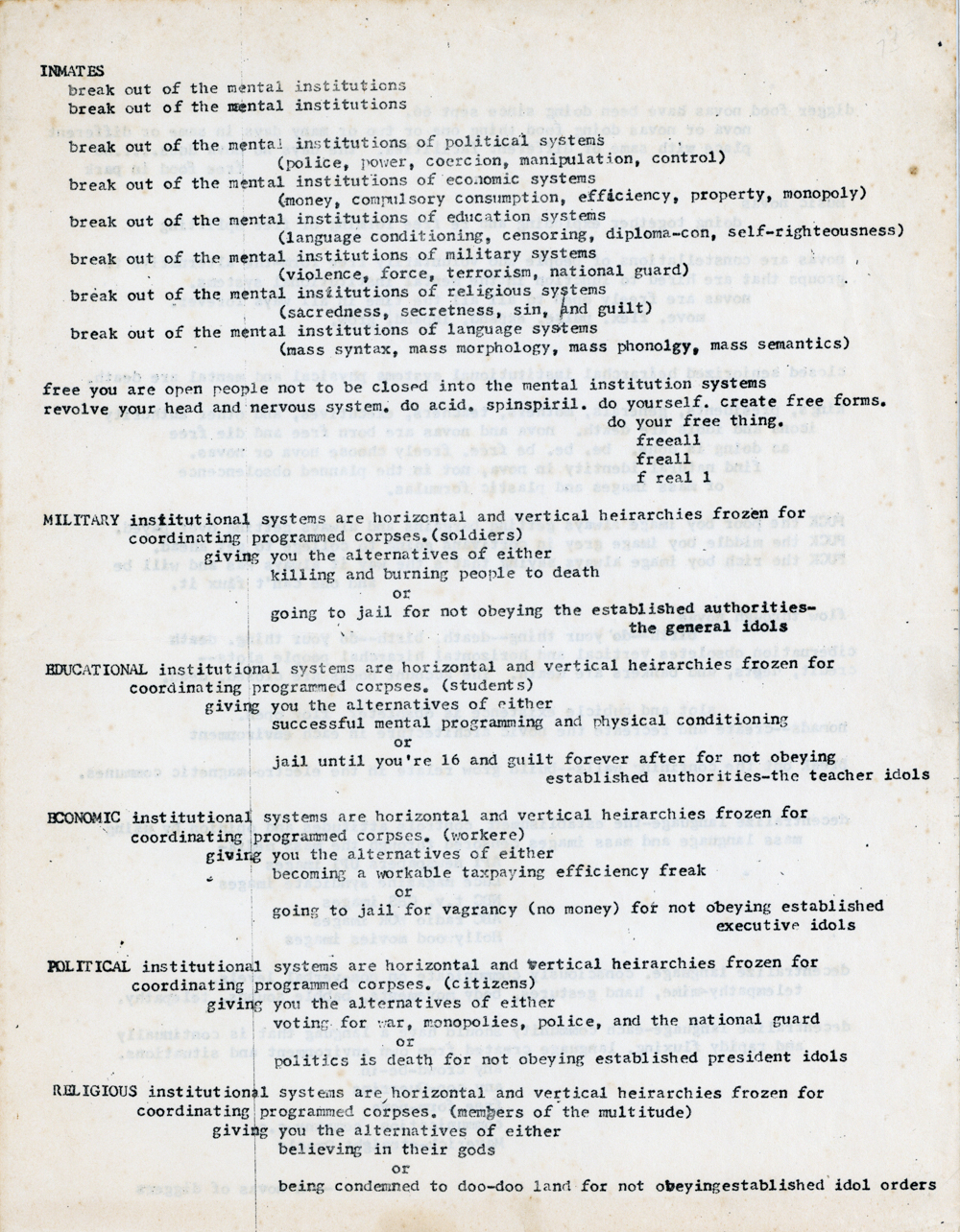
Cat. No.: DP-011a Full record BibCit: n.d., ca. 6/1/1967. Broadsheet. Letter size. Collection: SOLA-o(MG). Abstract: This broadsheet is one of the clearest Digger statements of total refusal, casting the major systems of American life—political, economic, educational, military, religious, and even linguistic—as “mental institutions” designed to produce obedient, programmed corpses. In a voice that is at once comic, incantatory, and deadly serious, it calls on people to “break out” of these closed hierarchies of coercion, property, conditioning, guilt, and war, and to recover the possibility of acting, feeling, and creating freely. The repeated contrast is between institutional life, which freezes people into roles, and “free forms,” which open the way to self-invention, shared liberation, and what the Diggers elsewhere called FREENOW. The sheet stands as a compact manifesto of psychic and social jailbreak, insisting that the real revolution begins with refusing the systems that colonize the mind.
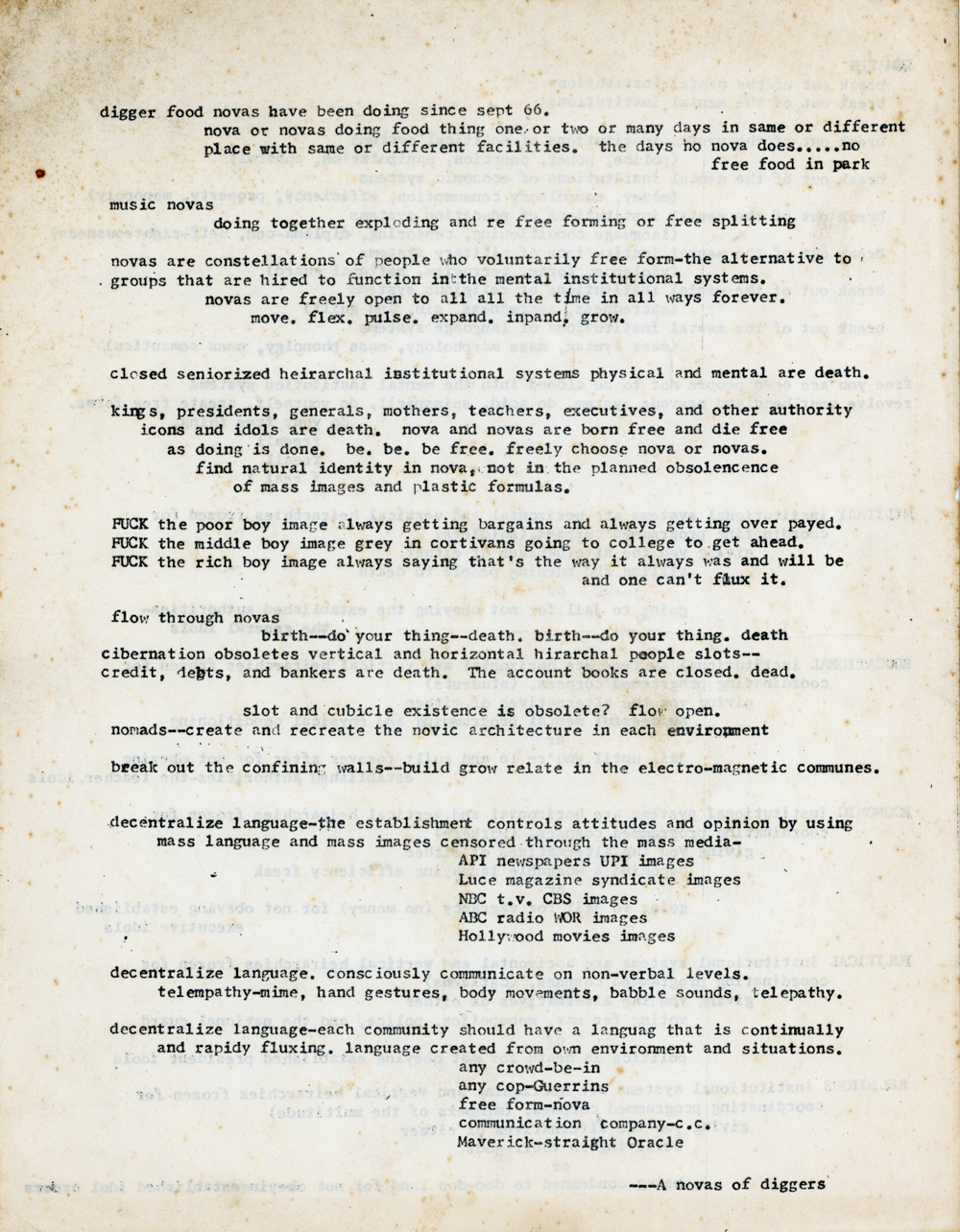
Cat. No.: DP-011b Full record BibCit: n.d., ca. 6/1/1967. Broadsheet. Letter size. Collection: SOLA-o(MG). Abstract: The reverse side develops the Digger idea of the “nova” as a freely forming constellation of people, offered as the living alternative to the closed, seniorized, hierarchical systems condemned on the front. Drawing on the example of the free food “novas” already functioning since September 1966, the sheet imagines social life as fluid, pulsating, decentralized, and open to all, in place of the deadening slots, cubicles, images, and authority roles imposed by the Establishment. Its attack extends from class identities and money to language itself, calling for communities to create their own rapidly changing forms of speech, gesture, and nonverbal communication outside the control of mass media and mass syntax. In this vision, the nova becomes both a social form and a way of being: nomadic, improvisatory, anti-hierarchical, and rooted in the continual remaking of free communal life.
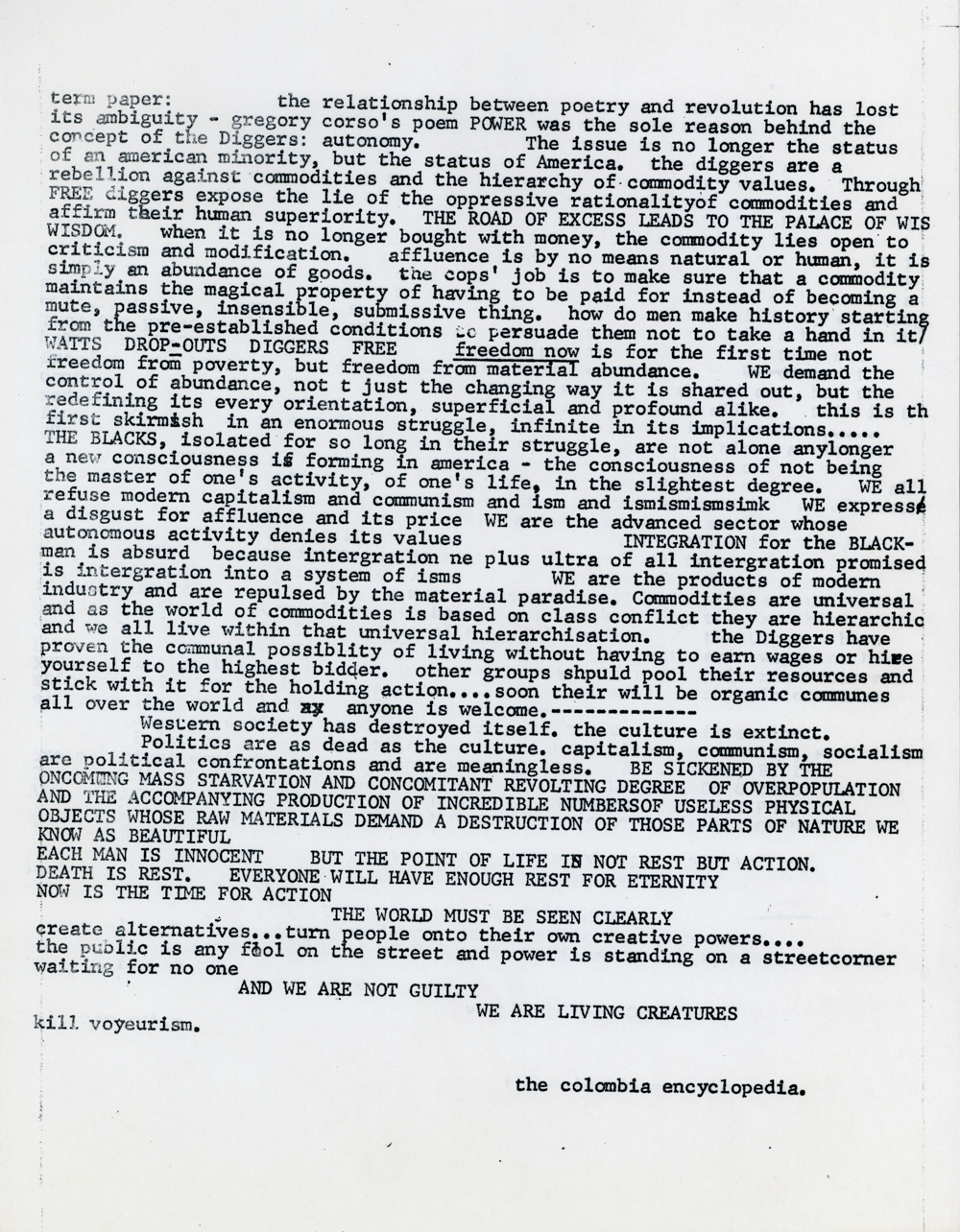
Cat. No.: DP-012 Full record BibCit: n.d., ca. 6/1/1967. Broadside. Letter size. Collection: SOLA-o(LH). Abstract: This sheet is a dense Digger “term paper” on poetry, revolution, and commodities, beginning with the startling claim that Gregory Corso’s poem “Power” supplied the original Digger concept of autonomy. Its argument moves beyond the politics of minority status to a broader refusal of America itself as a system organized around commodities, wage labor, hierarchy, and the magical requirement that everything must be paid for. In this frame, FREE becomes both tactic and revelation: by taking goods out of the money system, the Diggers expose the falseness of commodity values and open abundance itself to criticism, modification, and communal use. The sheet links Watts, drop-outs, Blacks, and Diggers within a new consciousness opposed not only to poverty but to the deadening material paradise of modern affluence, ending with a call to create alternatives, recover one’s own creative powers, and act in the world without guilt.
Note: “The public is any fool on the street” was an early recurring Digger phrase, first taken from a San Francisco Chronicle columnist who used it disparagingly in reference to interviews with Black students during the Hunters Point uprising. The Diggers inverted the phrase, turning the columnist’s contempt into a democratic axiom: the public is not an audience, institution, or managed constituency, but anyone present and alive in the street.
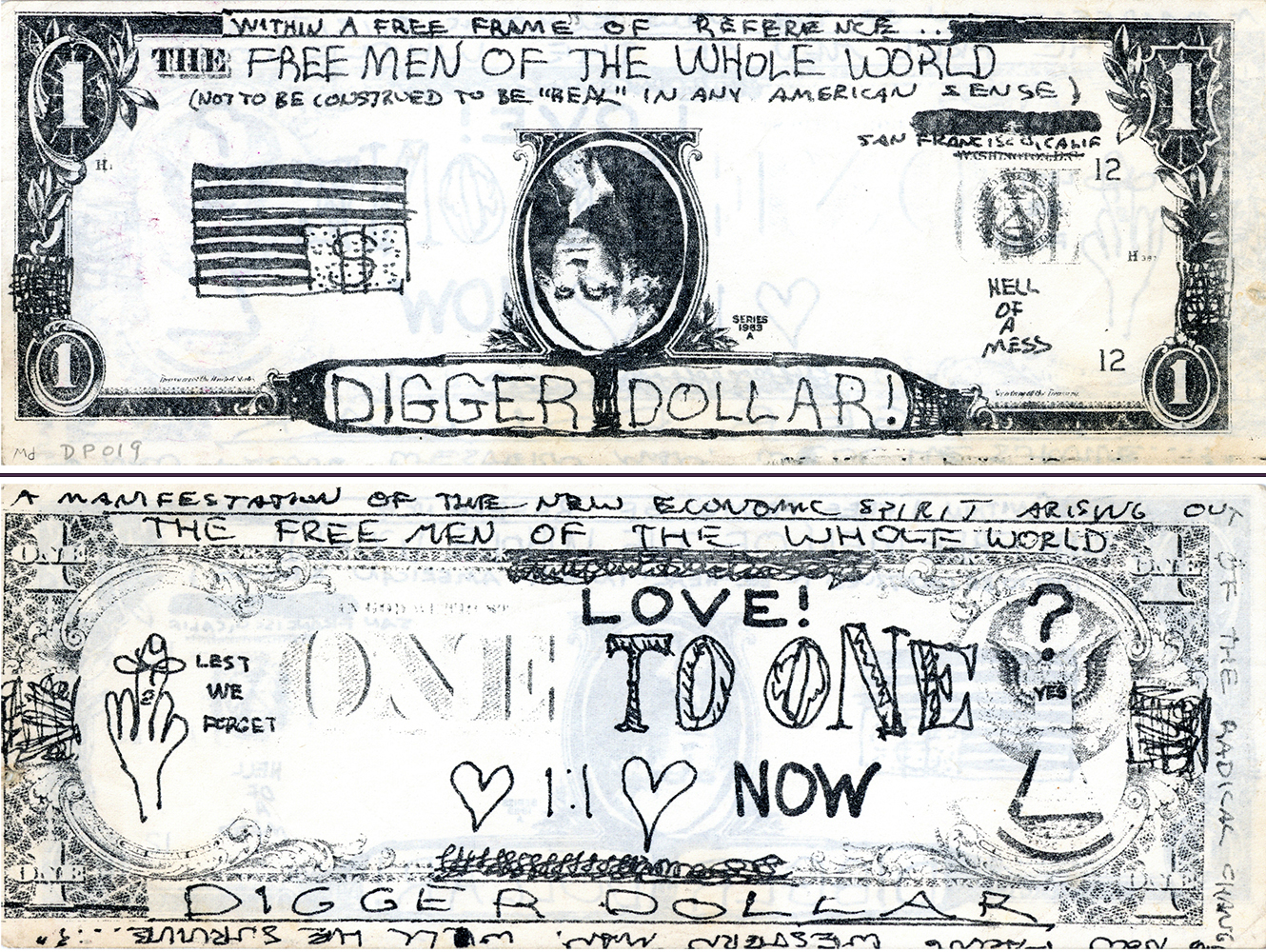
Cat. No.: DP-025a/b Full record BibCit: n.d., ca. 6/1/1967. Broadsheet. 3" x 8.5". Collection: SOLA-o(PW). Abstract: A Digger Dollar issued by the “Free Men of the Whole World,” transforming the form of paper money into a declaration of the new free economy. The bill keeps the frame of official currency while subverting every part of it: the dollar portrait is inverted, the denomination becomes “1:1,” and the value is named as love, time, and the free exchange of human energy. As with much Digger printing, the piece works by turning the symbols of the money system back against themselves, making “free” not an absence of value but the beginning of another standard of value altogether.
Note: No basis for the dating except the use of "Free Frame of Reference," the name of the first and second Digger free stores.
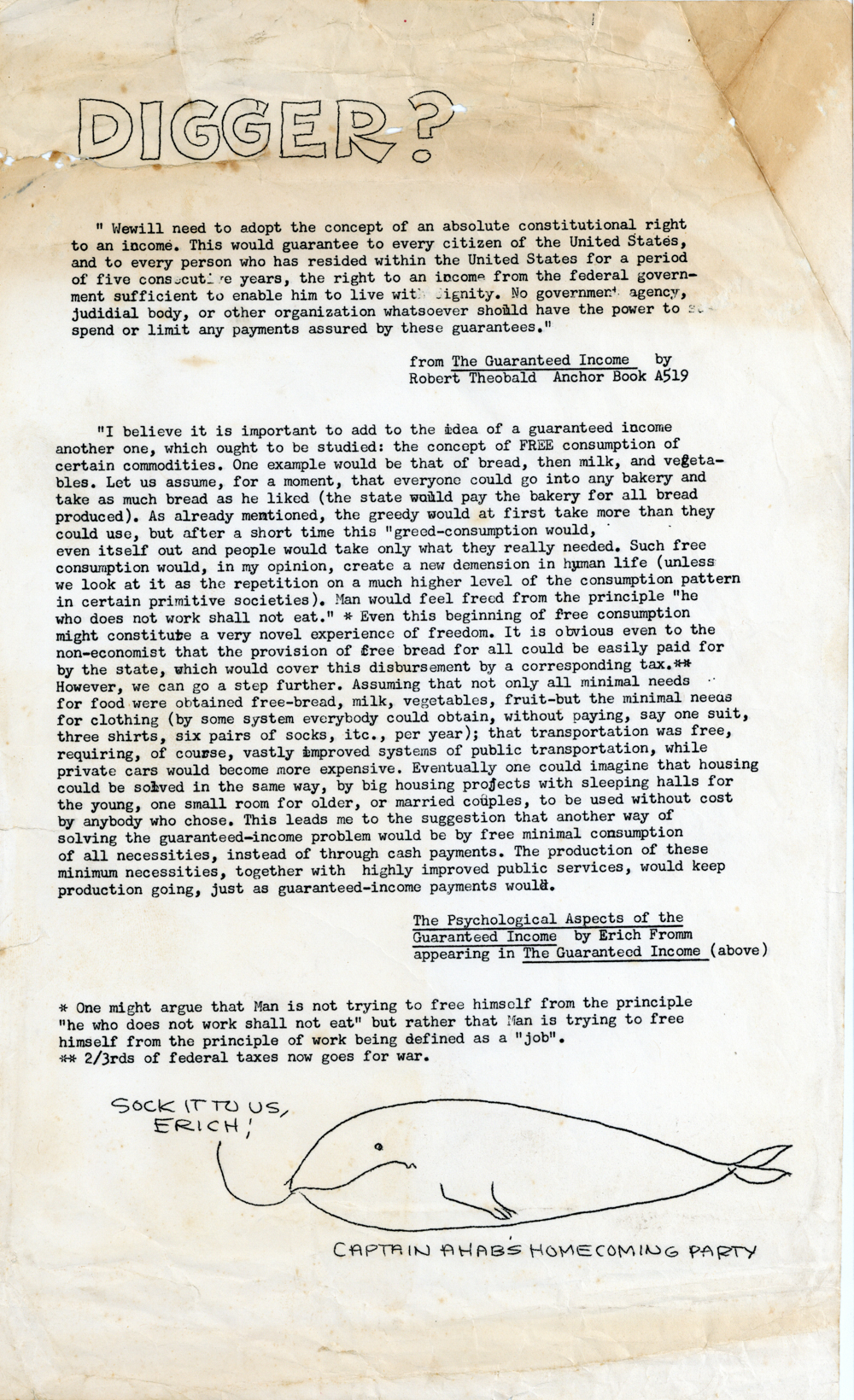
Cat. No.: DR-002 Full record BibCit: n.d., ca. 6/1/1967. Broadside. Legal size. Collection: SOLA-o. Abstract: This sheet brings together Robert Theobald on guaranteed income and Erich Fromm on the psychological meaning of free consumption, placing both in direct conversation with the Digger practice of Free. The argument moves beyond cash assistance toward a more radical proposition: that essential goods and services—bread, milk, vegetables, clothing, transportation, and eventually housing—could be made freely available, dissolving the punitive distinction between work and survival. The added hand lettering and whale drawing give the piece a characteristic Digger informality, turning economic theory into a street-level provocation. “Sock it to us, Erich!” catches the tone exactly: serious ideas, freely pirated, made immediate, comic, and usable.
Note: No imprint or date. The sheet most likely dates from 1967 and may have been produced by the Communication Company, although it has not been identified in any known Com/Co collection. Its title, “Digger?”, seems to ask whether Theobald and Fromm were themselves articulating a Digger position. Its use of borrowed radical text, playful hand lettering, and street-level Digger framing place it squarely within the early Digger/Free milieu. (The Anchor Book A519 edition mentioned was published in 1967, a year after Theobald's book was first published.)
Cat. No.: DR-011a Full record BibCit: n.d., ca. 6/1/1967. Broadsheet. Letter size. Collection: SOLA-o. Abstract: There was apparently a free food operation at The Committee Theater in North Beach, although I have not been able to find anything about it (yet). Whether this was a one-time shot or not is unknown.
Cat. No.: DR-011b Full record BibCit: n.d., ca. 6/1/1967. Broadsheet. Collection: SOLA-o. Abstract: There was apparently a free food operation at The Committee Theater in North Beach, although I have not been able to find anything about it (yet).
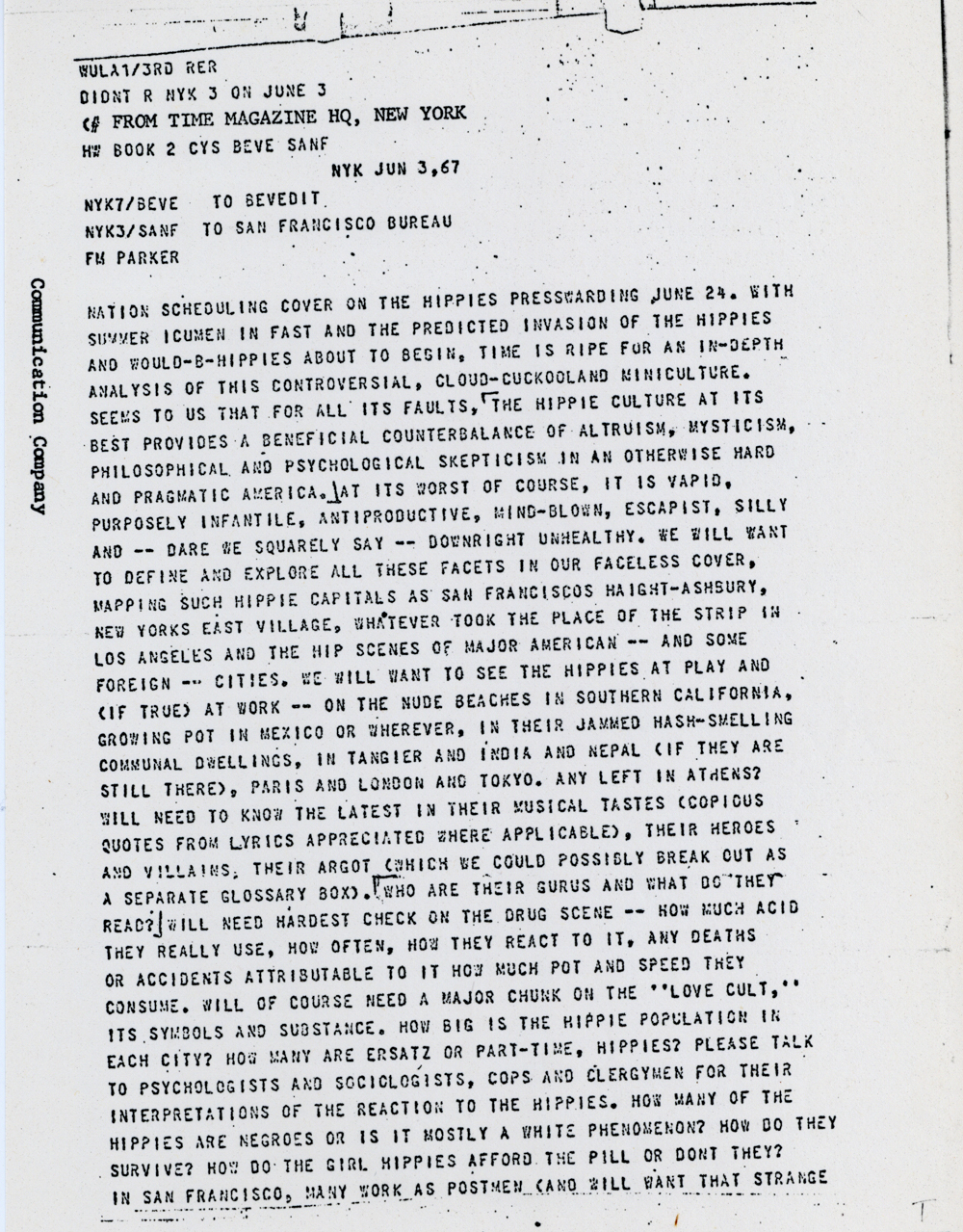
Cat. No.: CC-039a Full record BibCit: N.d., ca. 6/3/1967. Broadsheet. Letter size. San Francisco: Communication Company. Imprint: CC. Collection: SOLA-xSS | SS-oT. Abstract: Cable heading (at top of page): "From "Time Magazine Hq, New York .. Jun 3,67 .. to San Francisco Bureau". Instructions on gathering material for "an in-depth analysis of this controversial, cloud-cuckooland miniculture."
"Will need substantial paragraph or two in cover tracing the history of the phenomenon.. Will want to talk about the hippie businessman, the people who feed off the hippies.. How much do they make -- any fortunes yet?"
Note: Certain lines underlined, sections outlined, by ComCo.
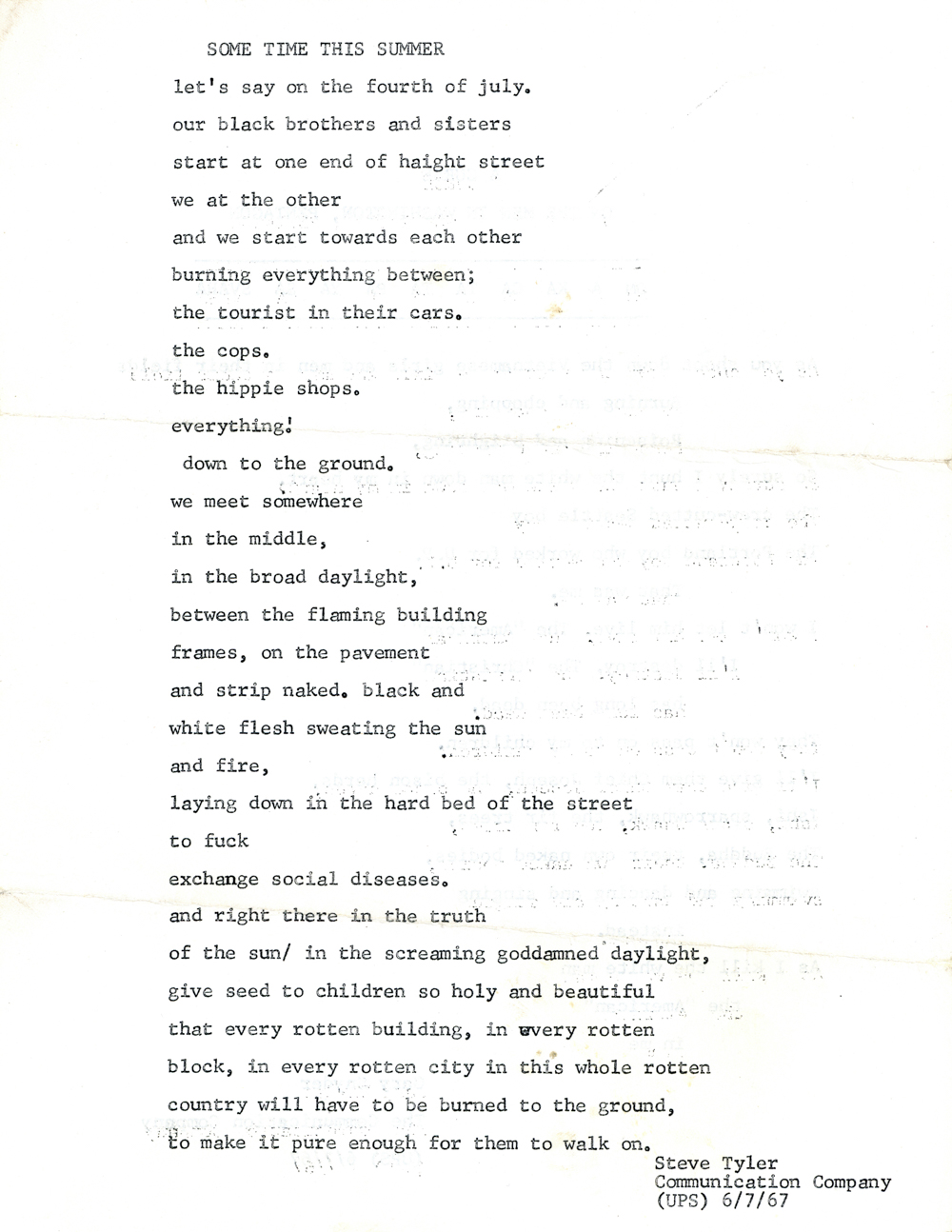
Cat. No.: CC-068A Full record BibCit: By Tyler, Steve. 6/7/1967. Broadside. Legal size. San Francisco: Communication Company. Collection: SS-o(T) | SOLA-x(SS). Abstract: A poem by Steve Tyler about a fantasy interracial riot that burns down Haight Street.
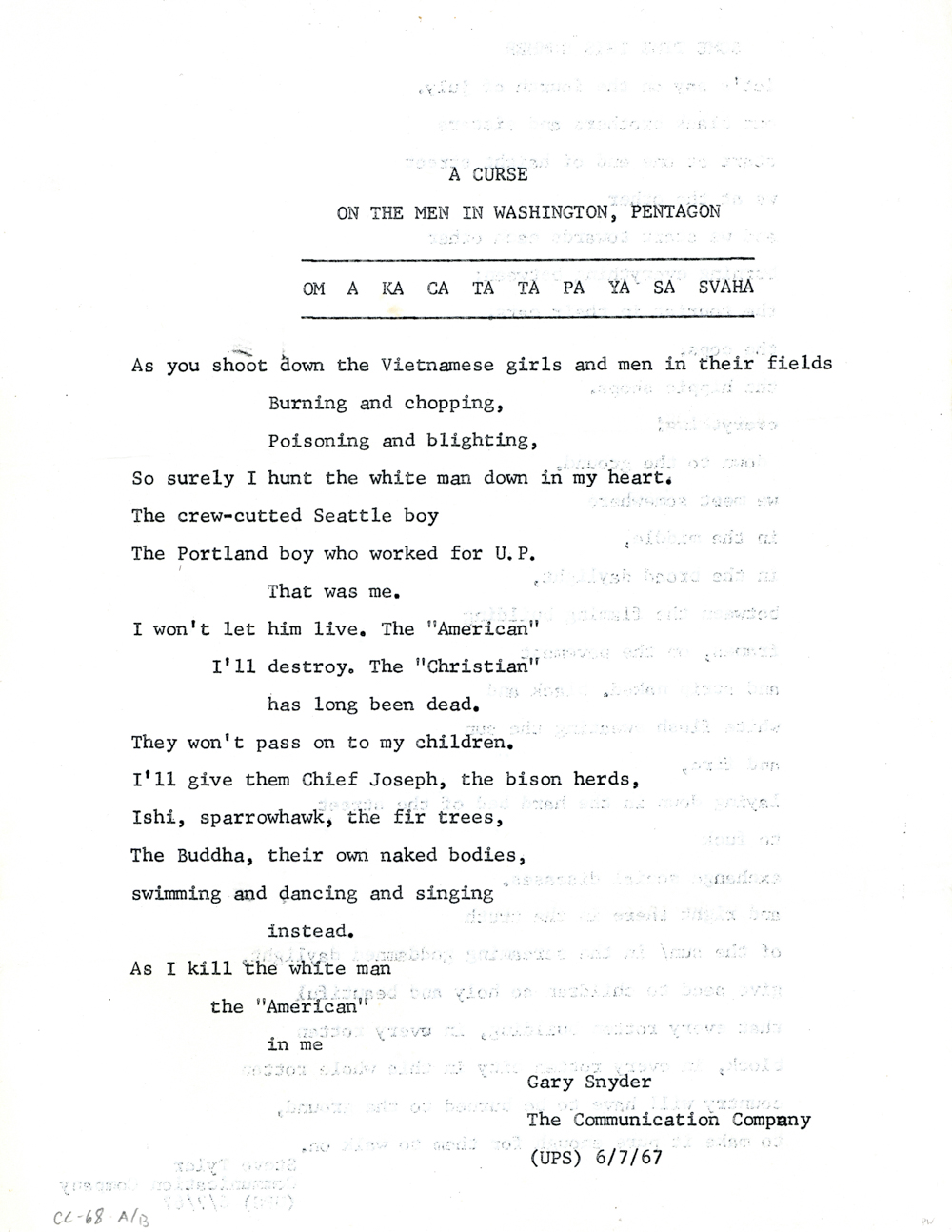
Cat. No.: CC-068B Full record BibCit: By Snyder, Gary. 6/7/1967. Broadside. Legal size. San Francisco: Communication Company. Collection: SS-o(T) | SOLA-x(SS)SOLA-o(PW,variant, letter size, 2 cop);o-SOLA(AA, legal size). Abstract: An incantation, war cry. Mentions the Ghost Dance. Signed "[Pisces-like symbol] SNYDER".
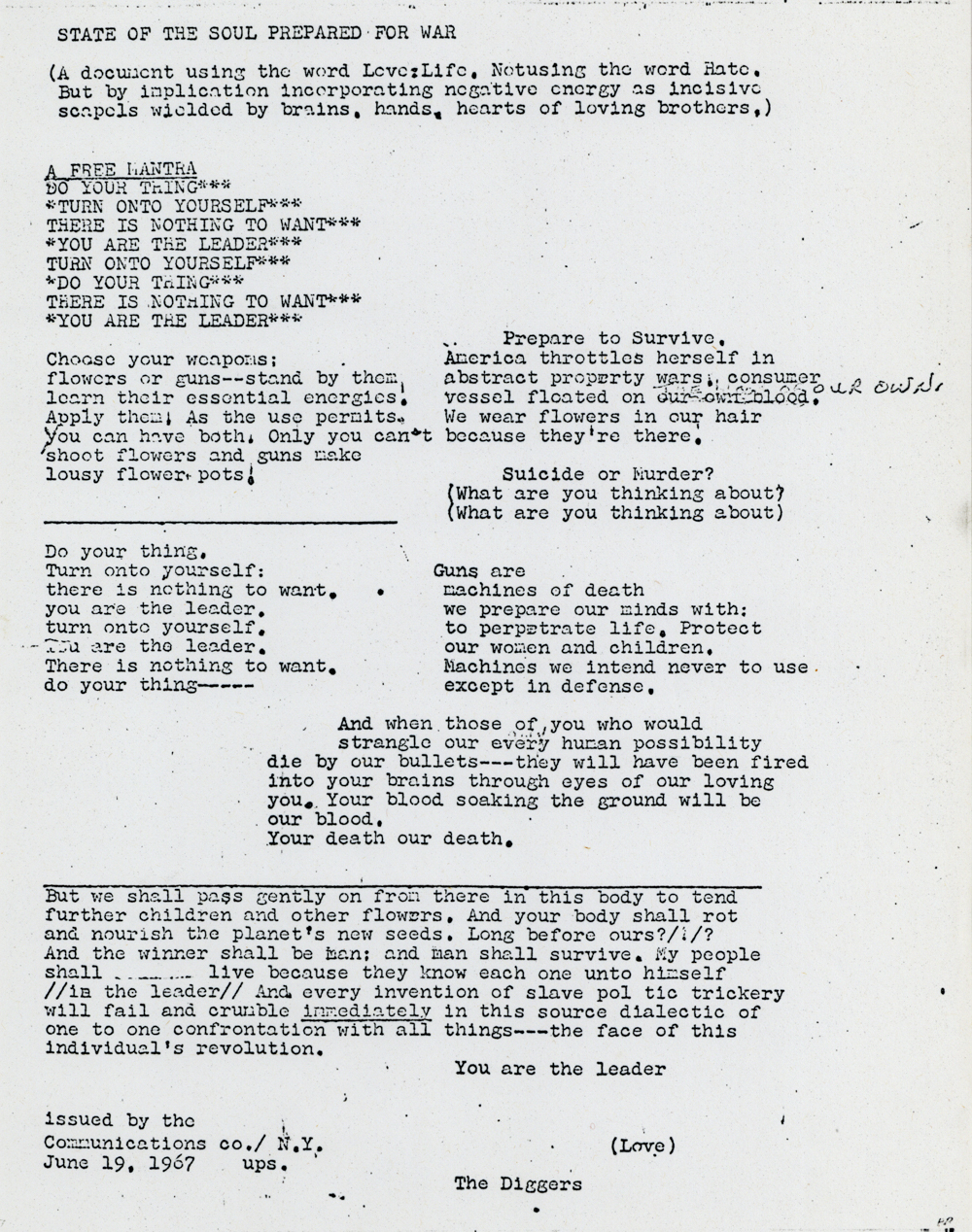
Cat. No.: CC-044 Full record BibCit: 6/19/1967. Broadside. Letter size. New York: Communications co.. Imprint: Comm's co./ N.Y.. Collection: SOLA-xxSS | SS-xB. Abstract: Reprint with minor variations of CC-043. Signed "(Love) The Diggers". [Internal and historical evidence suggests this is a reprint.]
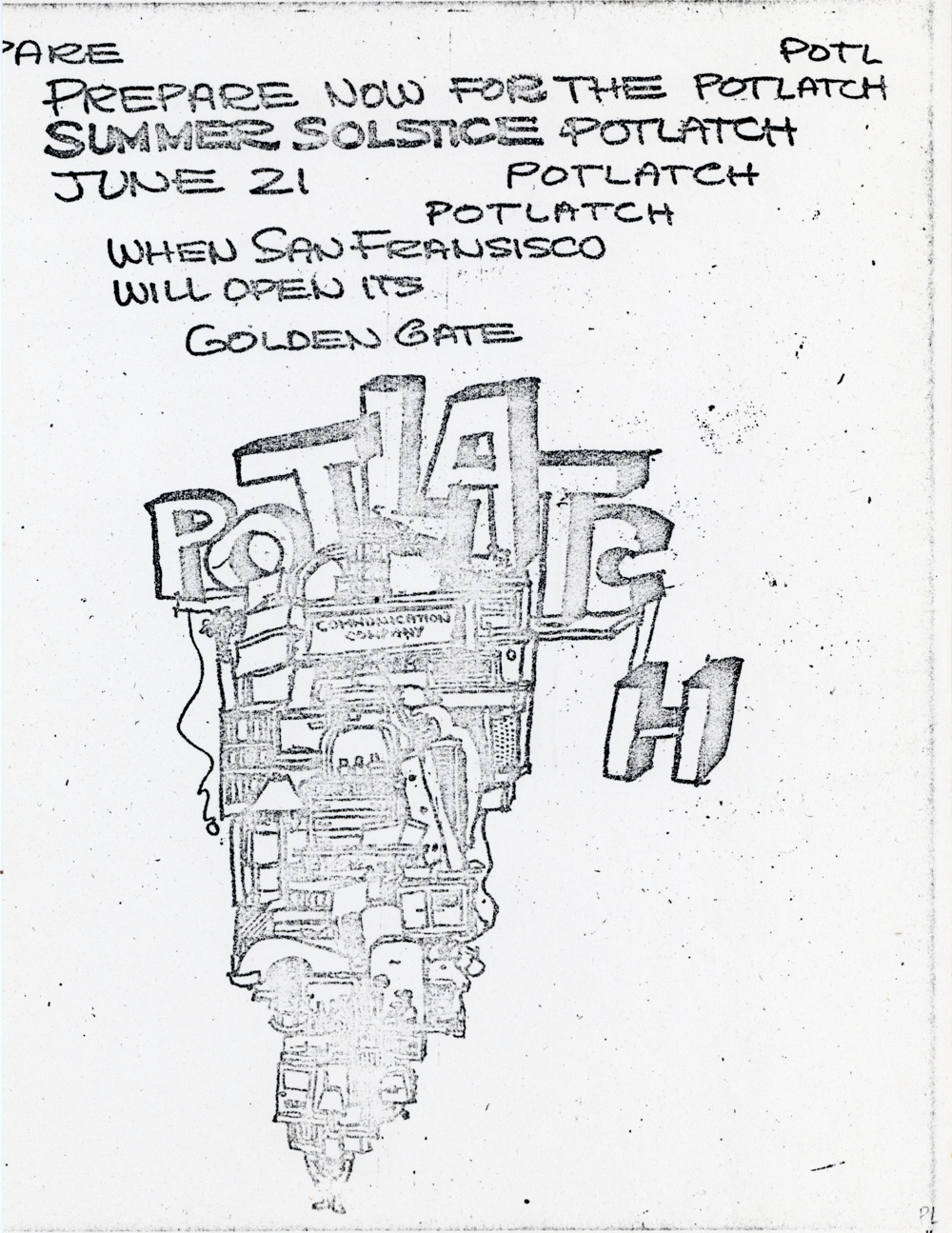
Cat. No.: CC-007 Full record BibCit: N.D., ca. 6/21/1967. Broadside. Letter size. San Francisco: Communication Company. Imprint: CC. Collation: 1/c, black ink on GrPa. Collection: SOLA-xSS/SS-oL. Abstract: Title continues: ".. JUNE 21 POTLATCH|.| WHEN SAN FRANCISCO| WILL OPEN ITS| GOLDEN GATE" Ilustration at bottom depicts human figure carrying a load of possessions on the head. In bold letters: "POTLATCH"
Cat. No.: CC-177 Full record BibCit: By Anon. [Peter Berg]. 6/28/1967. Pamphlet. 7"x8-1/2". San Francisco: Communication Company. Imprint: Communication Company SF 2nd Edition. Collation: 2 sht. 8 pp.(each sheet Legal size printed lenthwise).. Collection: SOLA-o(BC 1977) | o-en(PB).
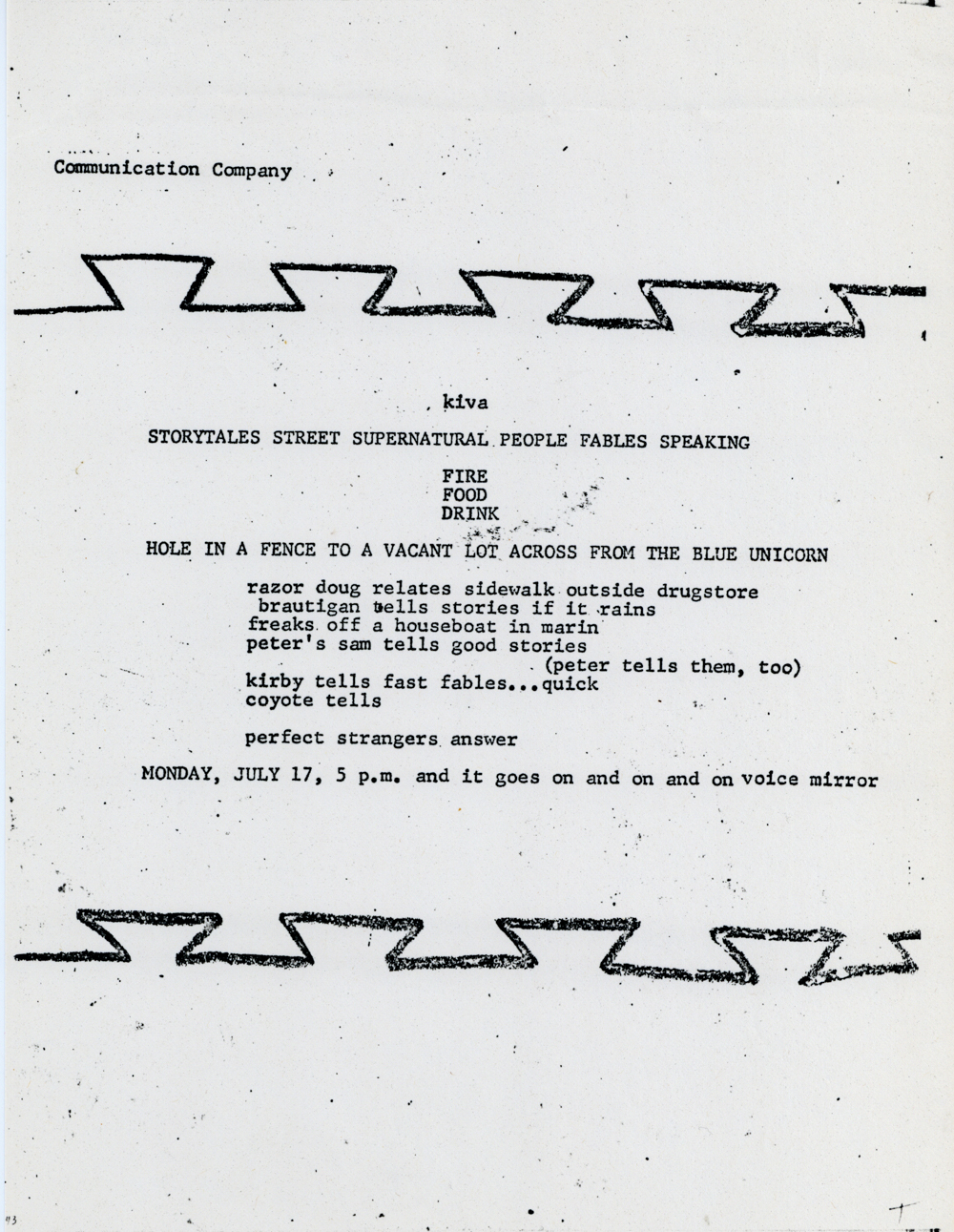
Cat. No.: CC-040 Full record BibCit: N.d., ca. 7/17/1967. Broadside. Letter size. San Francisco: Communication Company. Imprint: CC. Collection: SOLA-xSS | SS-oT. Abstract: Announces storytelling event: "Hole in a fence to a vacant lot across from the Blue Unicorn" with "razor doug .. brautigan .. peter's sam .. kirby .. coyote". "Monday, July 17, 5 p.m. and it goes on and on and on voice mirror"
Note: Typewritten. Handlettered Southwest Indian-design lines at top and bottom.
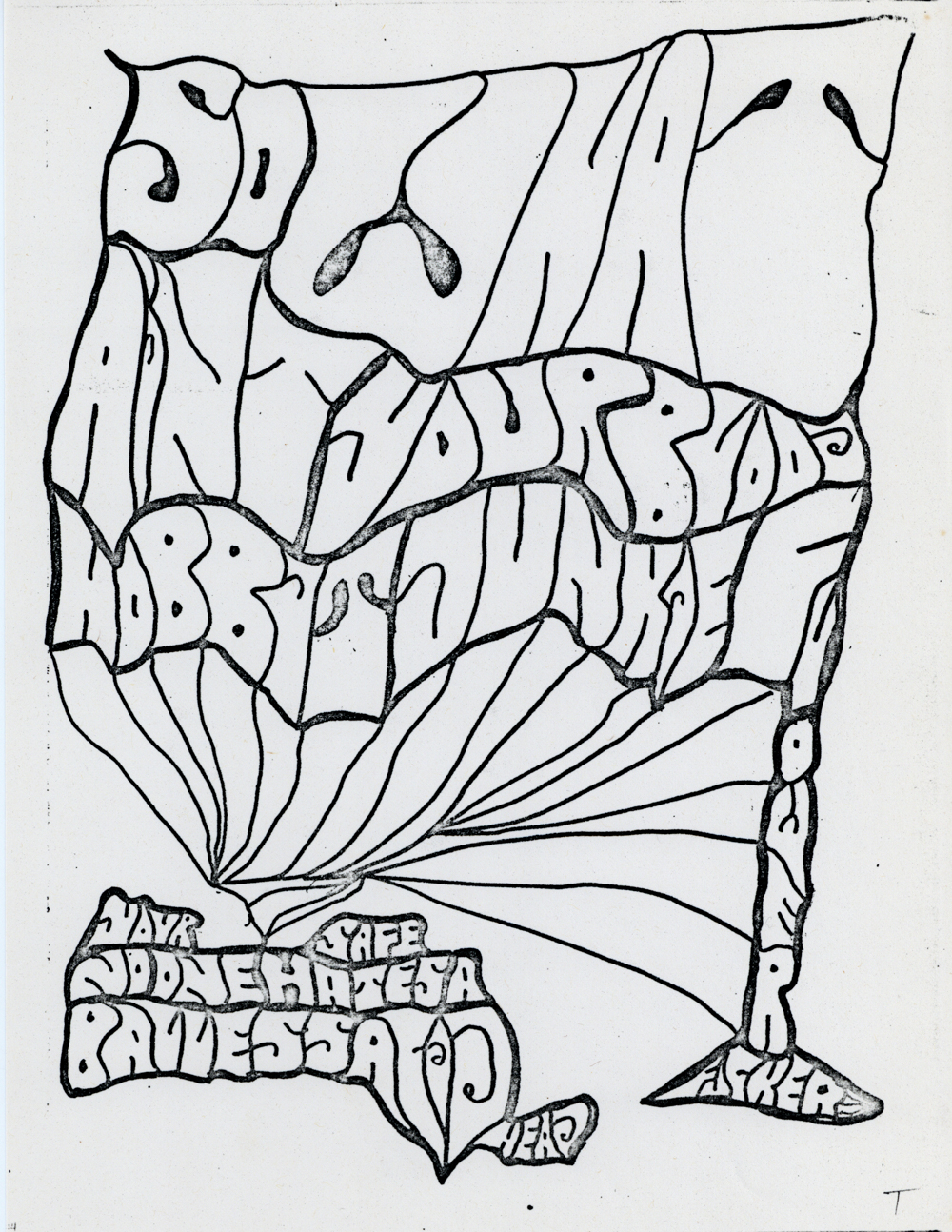
Cat. No.: CC-041a Full record BibCit: 7/28/1967. Broadsheet. Letter size. San Francisco: Communication Company. Imprint: cc (ups). Collection: SOLA-xSS | SS-oT. Abstract: Advice on street behavior, police brutality, possibility of race riots. "Please: if anything starts to happen, cut out. .. Please maintain your cool. Don't panic. Just split. .. be advised".
R.s., in psychedelic lettering: "So what | ain't your blood | hobbit junkie | flower fucker | your safe no one hates a balless acid head"
Note: Two handlettered I Ching hexagrams (# 38 - Opposition, # 11 - Peace).
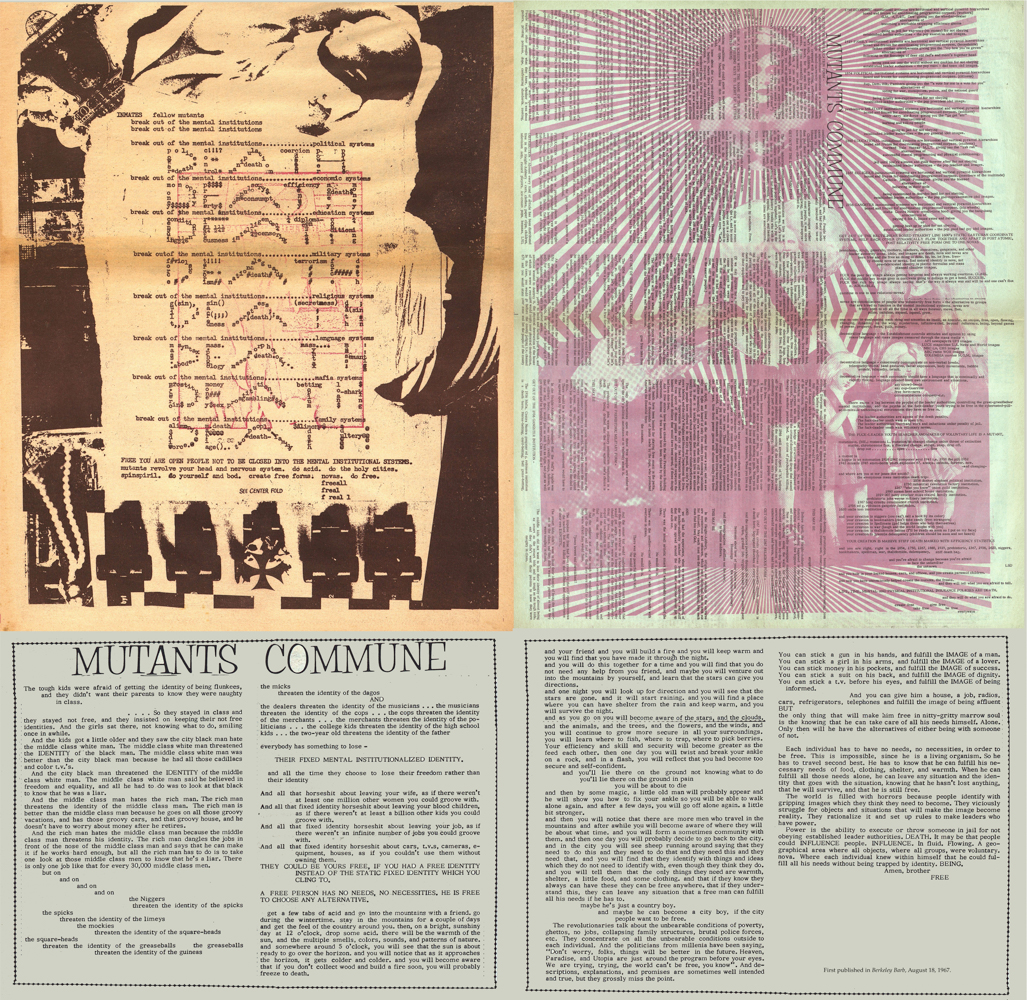
Cat. No.: DP-023 Full record BibCit: Berkeley Barb, 8/18/1967, p. 1, 8-9. Collection: SOLA-o. Abstract: “Mutants Commune” is one of the most elaborate Digger statements of social jailbreak, extending the earlier “Inmates” language into a full-scale attack on the institutional forms that produce obedient identities: politics, economics, education, military life, religion, language, family, and even gangster systems. The text names these as “mental institutions,” each one a boxed hierarchy for coordinating “programmed corpses,” and answers them with the Digger idea of the nova: voluntary, fluid, one-to-one constellations of people who form, dissolve, and re-form outside fixed roles. What makes the piece especially important is the way it combines critique with speculative social design—free education, free distribution, free services, communal child-rearing, voluntary association, decentralized language, and a life beyond property, wage work, marriage, and identity. The “mutant” here is not a freak in the old sense but the new person produced by the technological, psychedelic, post-atomic world, the “fuck-leader youth” who refuses the inherited death forms and tries to create free, give free, take free, and be free everyways.
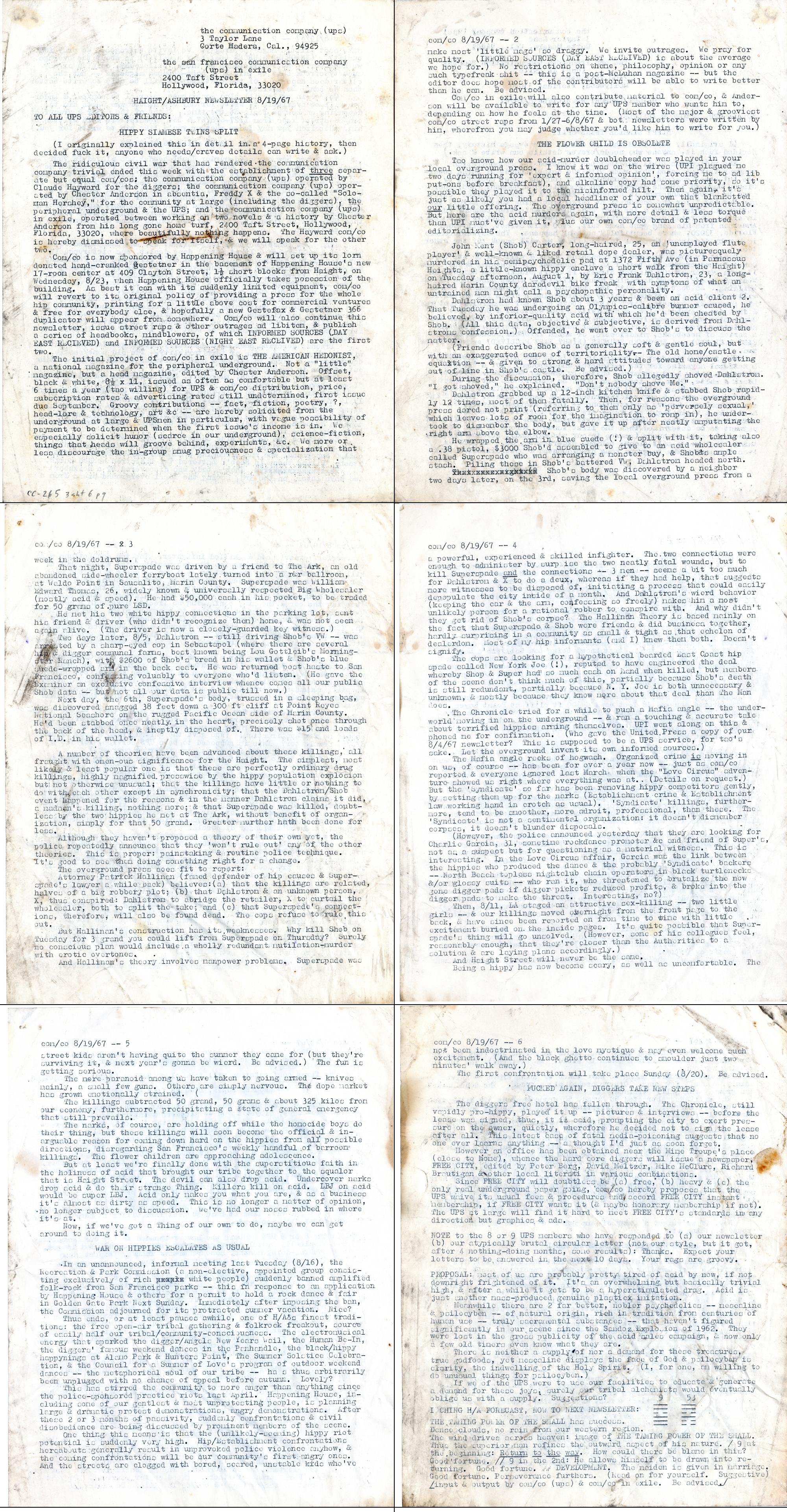
Cat. No.: CC-265 Full record BibCit: By Anderson, Chester. 8/19/1967. Leaflet. Letter size. 3 shts; 6 pgs. Corte Madera, Cal.: Communication Company. Imprint: includes ComCo/UPS ("in exile") from Corte Madera, CA and Hollywood, FL. Collection: SOLA-o(LH). Abstract: This six-page Haight/Ashbury Newsletter of August 19, 1967, written by Chester Anderson, reads as both street report and factional document from the breakup of the Haight underground. Issued under the Communication Company imprint, it moves through the split between Com/Co and the Diggers, the forced appropriation of Com/Co’s mimeograph equipment, the murder of Shobol, the atmosphere of retaliation and suspicion that followed, police pressure, speed, paranoia, and the steady unraveling of the Haight scene. The tone is immediate, aggrieved, and insiderly, mixing reportage, accusation, and political interpretation. What emerges is not the utopian Haight of popular memory but a movement world breaking apart over control of resources, authority, and the meaning of “free,” with Anderson writing from the wounded edge of that fracture.
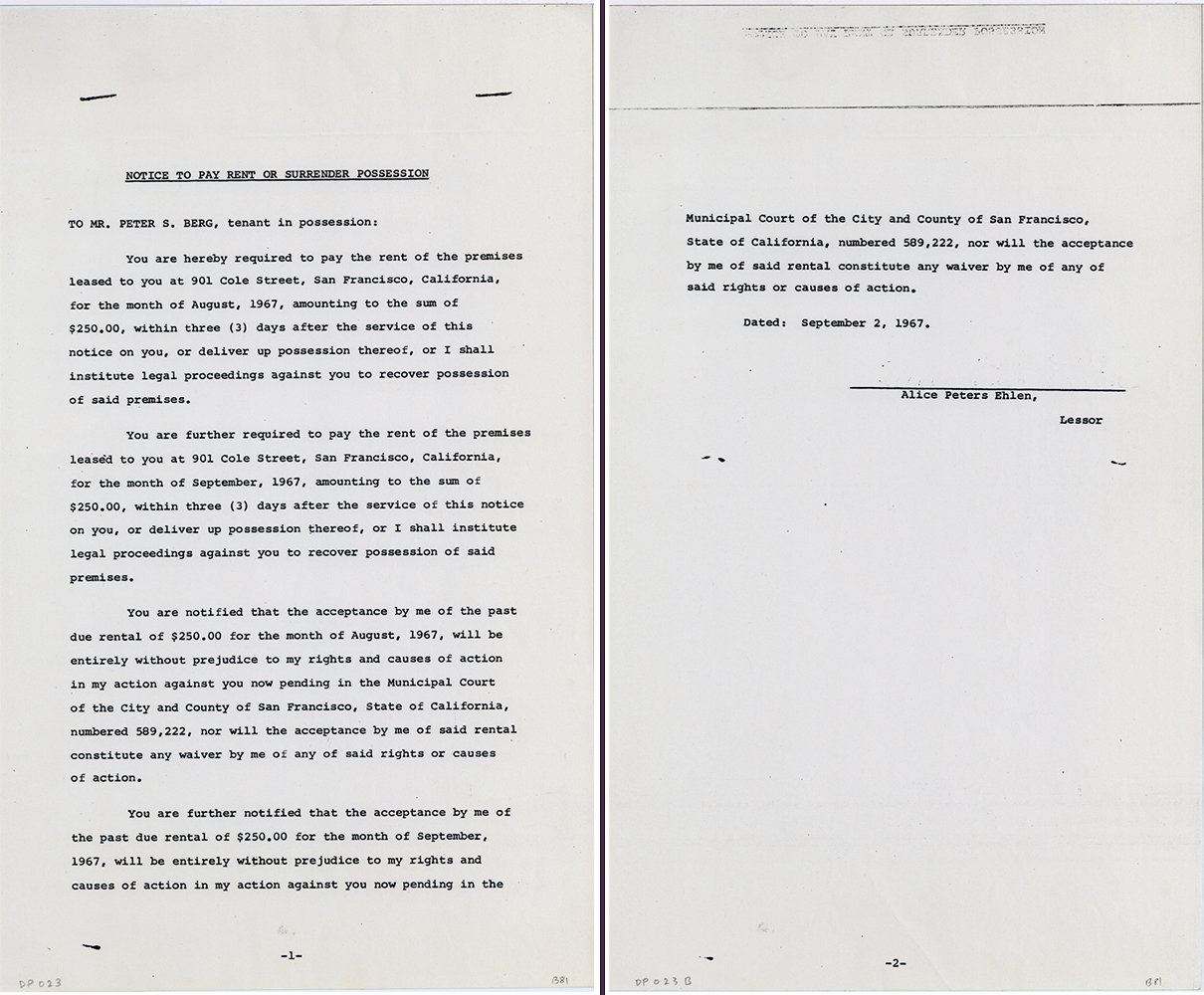
Cat. No.: DR-007a/b Full record BibCit: 9/2/1967. Leaflet. Legal size. Collation: 2 sht; dual stapled along top edge. Collection: SOLA-x(PB). Abstract: This eviction-related notice, dated September 2, 1967, demands that Peter S. Berg pay back rent for August and September on the premises at 901 Cole Street or surrender possession. As a Digger-related document, it gives a stark glimpse of the material conditions surrounding the Trip Without A Ticket free store: even a space dedicated to Free existed within the ordinary legal machinery of rent, ownership, and eviction. Its importance lies in that tension between the Digger practice of Free and the property system pressing in around it.